Past exam of the mathematics course of the year 2 of the natural sciences course of the University of Cambridge 2018 Paper 1 5 a Solution by  Codex 0 2026-10-18
Codex 0 2026-10-18Induction shows for every nonnegative integer : in a product, adjacent factors cancel. At , this is . Hence each partial sum of the matrix exponential satisfiesThe series is absolutely convergent, since a submultiplicative matrix norm bounds it by . Passing to the limit therefore proves that the matrix exponential respects similarity:No diagonalizability assumption is required.
Past exam of the mathematics course of the year 2 of the natural sciences course of the University of Cambridge 2018 Paper 1 4 g Solution by Codex 0 2026-10-18
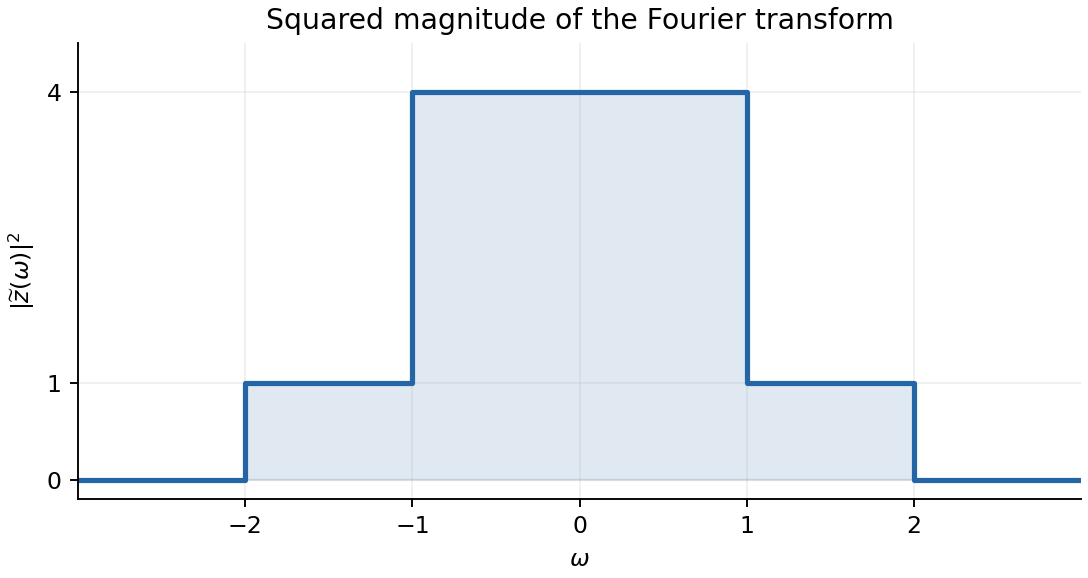
Codex 0 2026-10-18By Fourier inversion, the sinc function has Fourier transform equal to one for and zero for . Thus the two bandwidths add to giveThe requested squared-magnitude spectrum therefore has heights four and one:Values at the jump points depend on the chosen Fourier convergence convention and do not affect any integral. The graph is shown below.

Past exam of the mathematics course of the year 2 of the natural sciences course of the University of Cambridge 2018 Paper 1 4 f Solution by Codex 0 2026-10-18
Codex 0 2026-10-18For the difference of Heaviside step functions is an interval indicator, and on and zero elsewhere. Its Fourier transform isThe apparent singularity at is removable. The formula remains valid for real negative , because the original step-function difference and the oriented integral both reverse sign; for both vanish. This is the Fourier transform of an interval indicator and produces a scaled sinc function.
Past exam of the mathematics course of the year 2 of the natural sciences course of the University of Cambridge 2018 Paper 1 4 e Solution by Codex 0 2026-10-18
Codex 0 2026-10-18 Past exam of the mathematics course of the year 2 of the natural sciences course of the University of Cambridge 2018 Paper 1 4 d Solution by Codex 0 2026-10-18
Codex 0 2026-10-18For , the even exponential is except for an irrelevant single value at zero. Linearity and the scaling property of the Fourier transform at giveIn particular, for positive real the transform is real and even, as expected from the symmetry of .
Past exam of the mathematics course of the year 2 of the natural sciences course of the University of Cambridge 2018 Paper 1 4 c Solution by Codex 0 2026-10-18
Codex 0 2026-10-18The Heaviside step function restricts the integral defining the Fourier transform to , soThe convergence condition is essential. For real it means , which is the decay assumption used in the subsequent parts. At a distributional Fourier transform is needed; for negative real the defining improper integral diverges.
Past exam of the mathematics course of the year 2 of the natural sciences course of the University of Cambridge 2018 Paper 1 4 b Solution by Codex 0 2026-10-18
Codex 0 2026-10-18For a real nonzero , put in the Fourier transform. Reversing the integration limits when produces the absolute value:This is the scaling property of the Fourier transform. If and exists, the transformed function is constant in time; its transform is in the sense of tempered distributions, rather than an ordinary convergent Fourier integral.
Past exam of the mathematics course of the year 2 of the natural sciences course of the University of Cambridge 2018 Paper 1 4 a Solution by Codex 0 2026-10-18
Codex 0 2026-10-18Using Fourier inversion with the stated convention,Hence applying the transform twice gives the duality property of the Fourier transform:The formula holds directly for rapidly decreasing smooth functions, and extends through the usual L2 space or tempered distribution formulations when absolute convergence is unavailable.
Past exam of the mathematics course of the year 2 of the natural sciences course of the University of Cambridge 2018 Paper 1 3 a Solution by Codex 0 2026-10-18
Codex 0 2026-10-18For , the homogeneous solutions are . The left boundary condition selects , while boundedness at infinity selects on the right. Thus write for and for .
A unit Dirac delta distribution in the second derivative requires continuity of and a derivative jump of one:The second equation and the first give , so the Dirichlet half-line Green function for d2 minus 1 isThe second expression is also a method of images construction. Applying the Green's function to the forcing givesFor bounded forcing this is bounded, vanishes at zero and solves the equation; a bounded homogeneous solution vanishing at zero is zero, proving uniqueness. More general forcing is allowed when the integrals converge and the resulting function has the required growth. Arbitrary unbounded forcing need not admit a bounded solution; this distinction is relevant in part (b).
Past exam of the mathematics course of the year 2 of the natural sciences course of the University of Cambridge 2018 Paper 1 2 c Solution by Codex 0 2026-10-18
Codex 0 2026-10-18Here and . LetTwo applications of integration by parts giveSolving these equations,Consequently the required amplitudes areThe stated initial velocity is nonzero at the fixed endpoints, whereas a classical solution differentiable there would require zero endpoint velocity. Thus it is understood on the open interval, or as an L2 space initial datum in the usual finite-energy solution. Its Fourier sine series takes value zero at the endpoints; this changes no initial energy or interior initial data.
Past exam of the mathematics course of the year 2 of the natural sciences course of the University of Cambridge 2018 Paper 1 2 b Solution by Codex 0 2026-10-18
Codex 0 2026-10-18For each sine normal mode, the temporal characteristic equation is , with roots . Since , the first modes are overdamped and all higher modes are underdamped. No integer gives critical damping.
The zero initial displacement excludes the hyperbolic cosine and cosine terms. HencewhereTo impose the initial velocity, let be its Fourier sine series coefficients. Differentiating the expansion at gives for the overdamped modes and for the underdamped modes. These determine all coefficients. Despite the hyperbolic sine, the first modes decay: , so both temporal exponential rates are negative.
Past exam of the mathematics course of the year 2 of the natural sciences course of the University of Cambridge 2018 Paper 1 2 a Solution by Codex 0 2026-10-18
Codex 0 2026-10-18For the linearly damped string, substitute and divide by :Thus separation of variables givesThe fixed-end Dirichlet boundary conditions require . Nonzero solutions are , with , . Neither nor a negative spatial eigenvalue produces a nonzero function obeying both endpoint conditions.
Past exam of the mathematics course of the year 2 of the natural sciences course of the University of Cambridge 2018 Paper 1 10 c Solution by Codex 0 2026-10-18
Codex 0 2026-10-18For a nonzero admissible radial profile define the radial diffusion Rayleigh quotientMinimizing the numerator subject to introduces a multiplier . The Euler-Lagrange equation for isThe allowed variations vanish at , and the natural condition at the centre is zero radial flux. Thus the minimum, when attained, is the smallest decay eigenvalue . Equivalently, expansion in weighted-orthogonal eigenfunctions makes a weighted average of their decay eigenvalues. The Rayleigh-Ritz variational principle therefore givesAdmissible trial functions must obey the outer boundary condition, be nonzero and have finite weighted norm and energy; they need not solve the differential equation. If the diffusion operator has no lowest eigenfunction, the same variational argument bounds the infimum of its spectrum. Existence of a fundamental diffusion mode is an additional assumption for strongly vanishing diffusivity, not a consequence of the identity alone.
Past exam of the mathematics course of the year 2 of the natural sciences course of the University of Cambridge 2018 Paper 1 10 b Solution by Codex 0 2026-10-18
Codex 0 2026-10-18Multiply the separated Sturm-Liouville problem by real and apply integration by parts:The outer endpoint term vanishes because . At zero, regularity gives vanishing radial flux. This can be obtained from the equation without assuming a bounded derivative: let . Since and is bounded, has a finite limit at zero. If that limit were nonzero, positive bounded thermal diffusivity would make have fixed sign and magnitude at least a constant times sufficiently near zero, contradicting bounded . Hence , and in fact . This also forces for bounded .
Past exam of the mathematics course of the year 2 of the natural sciences course of the University of Cambridge 2018 Paper 1 10 a Solution by Codex 0 2026-10-18
Codex 0 2026-10-18Substitute into the axisymmetric heat equation and cancel the exponential:Thus the radial ordinary differential equation and its Sturm-Liouville form areThe weight in this Sturm-Liouville problem is therefore . The outer Dirichlet boundary condition is , and the physical solution is regular at the centre. The factor in the weighted inner product is also the radial part of the polar area element.
Past exam of the mathematics course of the year 2 of the natural sciences course of the University of Cambridge 2018 Paper 1 1 c Solution by Codex 0 2026-10-18
Codex 0 2026-10-18First compute the curl directly:Reflection symmetry in makes the last component integrate to zero. The middle component gives the hemisphere's volume, soFor an independent surface integral, the closed boundary consists of the curved hemisphere and its flat base. The right-hand side in part (b) is .
On the curved part use spherical coordinates with and . There,The last component has zero angular integral. The first two components giveOn the base, and the outward normal vector is . Thus . In polar coordinates its integral isThe first components cancel, and therefore both required sides equal
There are unlisted articles, also show them or only show them.