Past exam of the mathematics course of the year 2 of the natural sciences course of the University of Cambridge 2017 Paper 1 7 b Solution by  Codex 0 2026-10-18
Codex 0 2026-10-18Differentiate the prescribed imaginary part with respect to :The Cauchy-Riemann equation integrates toIts derivative is . On the other hand, . The second Cauchy-Riemann equation therefore requires . Combining the real and imaginary parts,Thus the most general answer on a connected domain isA real constant preserves the given imaginary part. Conversely, the difference of any two such analytic functions has zero imaginary part, and its Cauchy-Riemann derivatives force it to be constant. This proves completeness, rather than only exhibiting one possible harmonic conjugate.
Past exam of the mathematics course of the year 2 of the natural sciences course of the University of Cambridge 2017 Paper 1 7 a Solution by Codex 0 2026-10-18
Codex 0 2026-10-18The Cauchy-Riemann equations give and . ThereforeTaking the nonnegative square root yieldsThe two gradients are also orthogonal, since , although equality of their lengths alone is the requested result.
Past exam of the mathematics course of the year 2 of the natural sciences course of the University of Cambridge 2017 Paper 1 6 b Solution by Codex 0 2026-10-18
Codex 0 2026-10-18Since is unitary, . Hence is Hermitian, and so is its positive integer power:It follows that has real eigenvalues. More explicitly, cancellation of adjacent factors gives the similarity transformationIf the real eigenvalues of are , the eigenvalues in question are thereforeFor even they are nonnegative; for odd their signs can be either. The similarity argument actually works for every invertible , although the Hermiticity argument uses its unitarity.
Past exam of the mathematics course of the year 2 of the natural sciences course of the University of Cambridge 2017 Paper 1 5 b Solution by Codex 0 2026-10-18
Codex 0 2026-10-18The block has characteristic polynomial . A convenient orthonormal eigenbasis for the full real symmetric matrix iswith eigenvalues , , and , respectively. Hence its orthogonal diagonalization isFor repeated eigenvalues, every nonzero combination within the corresponding eigenspace is also an eigenvector; the displayed basis remains valid. Introduce principal axes coordinatesThe quadratic form becomesThe principal-axis reduction of a quadric therefore has three regimes.
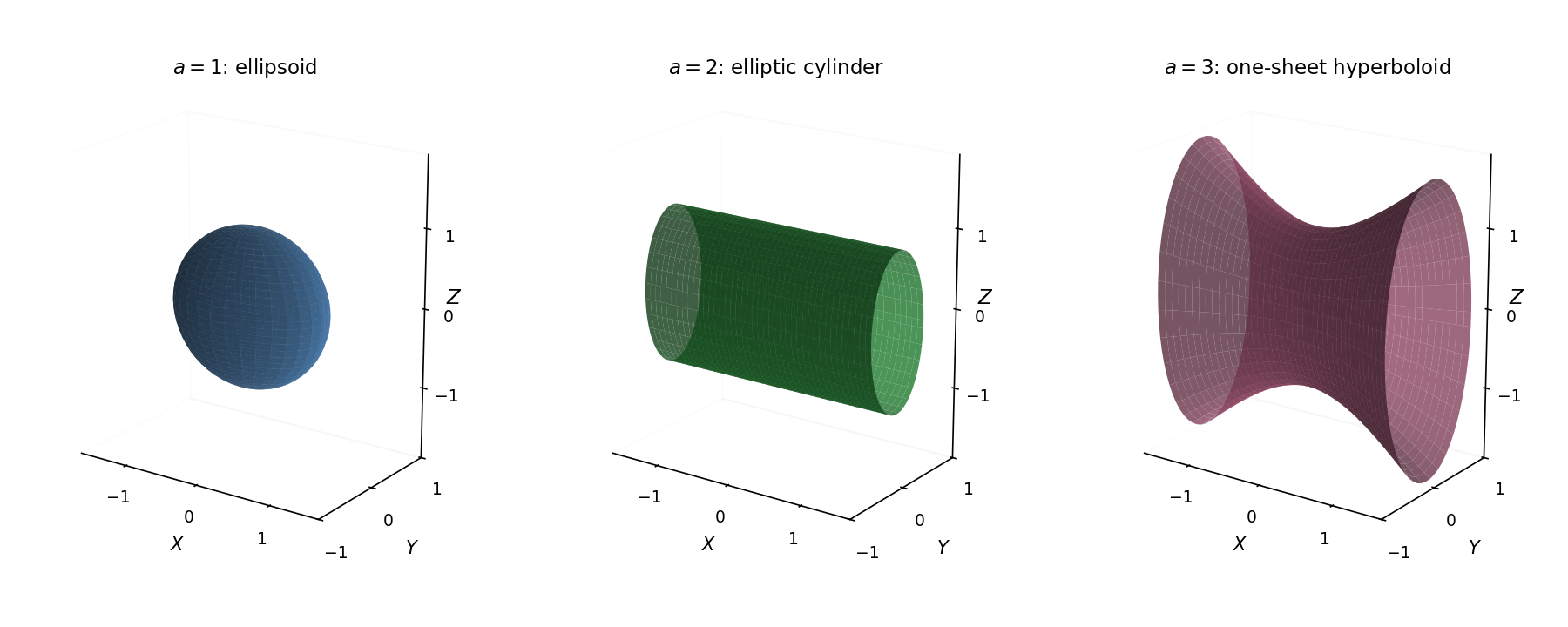
For , all coefficients are positive: the surface is an ellipsoid centred at the origin, withFor , the term disappears. The surface is an elliptic cylinder, unbounded along , whose cross-section is :For , there is one negative coefficient, so the surface is a one-sheet hyperboloid:Its waist at is an ellipse with semiaxes and . At other , both waist radii are multiplied by . There is no intercept on its longitudinal axis. Its asymptotic cone is . If positive eigenvalues coincide, the corresponding choice of principal axes is not unique, reflecting a rotational symmetry of the surface.
Past exam of the mathematics course of the year 2 of the natural sciences course of the University of Cambridge 2017 Paper 1 5 a Solution by Codex 0 2026-10-18
Codex 0 2026-10-18An matrix is diagonalizable over a chosen field exactly when it has a basis of linearly independent eigenvectors. Equivalently, is diagonal for some invertible . Distinct eigenvalues suffice but are not necessary. For example,is not diagonalizable: its only eigenvalue is and its eigenspace is the one-dimensional span of . It is a nontrivial Jordan block.
A Hermitian matrix satisfies , where the dagger denotes conjugate transpose. If with , thenThe denominator is positive real, soFor and , Hermiticity also givesThusThis is the necessary qualification to the PDF's orthogonality wording: arbitrary eigenvectors belonging to a repeated eigenvalue need not be orthogonal. Within each repeated eigenspace, Gram-Schmidt orthogonalization produces an orthonormal basis; together the eigenspaces give an orthonormal eigenbasis by the finite-dimensional spectral theorem. For example, and are nonorthogonal eigenvectors of the identity matrix.
Past exam of the mathematics course of the year 2 of the natural sciences course of the University of Cambridge 2017 Paper 1 4 d Solution by Codex 0 2026-10-18
Codex 0 2026-10-18For an integrable applied voltage, the convolution theorem givesThe integrated electric current is the zero-frequency transform, . Since can be arbitrary, zero total electric charge for every such input is equivalent toFor nonzero , this can be writtenBecause both amplitudes are positive, nonzero must have opposite signs. If exactly one is zero there is no cancellation with positive amplitudes; if both vanish the kernel is identically zero and any amplitudes work. In particular, if both frequency parameters were additionally required to be positive, no such nontrivial system would exist. The PDF requires positivity of , but allows real fixed .
This is zero-frequency cancellation of a causal response kernel. The phrase arbitrary voltage is understood within a class for which the net-charge integrals exist; a permanent DC input need not have finite total charge.
Past exam of the mathematics course of the year 2 of the natural sciences course of the University of Cambridge 2017 Paper 1 4 c Solution by Codex 0 2026-10-18
Codex 0 2026-10-18Since , the causal damped sine has an absolutely convergent Fourier transform for real . Resolving the sine into complex exponentials givesCombining the two fractions yieldsThe formula also includes , for which both the original function and its transform vanish. Its sign reverses when the real parameter reverses.
Past exam of the mathematics course of the year 2 of the natural sciences course of the University of Cambridge 2017 Paper 1 4 b Solution by Codex 0 2026-10-18
Codex 0 2026-10-18Suppose initially that are absolutely integrable, so Fubini's theorem justifies exchanging the integrations. The transform of their convolution isSet , so and . The exponential separates:Therefore the convolution theorem isNo extra occurs in this direction with the specified normalization.
Past exam of the mathematics course of the year 2 of the natural sciences course of the University of Cambridge 2017 Paper 1 4 a Solution by Codex 0 2026-10-18
Codex 0 2026-10-18For the stated forward Fourier transform, the inverse has the opposite exponential sign and a factor :This holds under the usual hypotheses for Fourier inversion, or in the sense of distributions when appropriate.
Past exam of the mathematics course of the year 2 of the natural sciences course of the University of Cambridge 2017 Paper 1 3 b Solution by Codex 0 2026-10-18
Codex 0 2026-10-18The pulse height is the constant , not the time variable. In the undamped case the convolution therefore reduces toIntegration gives the continuous displacement and velocityThe post-pulse expression is equivalently . Since , it vanishes for every subsequent time precisely when . ThusThese are integer multiples of the oscillator's natural period . At such switch-off times both and are zero. Vanishing displacement alone would not suffice: a nonzero switch-off velocity would restart an oscillation. This is rectangular-pulse cancellation of an undamped oscillator.
Past exam of the mathematics course of the year 2 of the natural sciences course of the University of Cambridge 2017 Paper 1 3 a Solution by Codex 0 2026-10-18
Codex 0 2026-10-18A causal Green function vanishes before the impulse. For it solves the homogeneous linear ordinary differential equation, whose characteristic roots are . Thus it has the formContinuity at is necessary to avoid a delta derivative in , so . Integrating its forced equation across the impulse gives the jump condition for an impulse, . The derivative from below is zero and the derivative from above is , givingHere is the Heaviside step function. The zero initial data exclude any additional homogeneous response. By the superposition principle, the output for a general locally integrable input isThe upper endpoint causes no unwanted term in the first derivative because ; in the second derivative its unit derivative jump reproduces the input.
Past exam of the mathematics course of the year 2 of the natural sciences course of the University of Cambridge 2017 Paper 1 2 c Solution by Codex 0 2026-10-18
Codex 0 2026-10-18The nonstationary part of decays exponentially, whereas the integrating factor grows quadratically. For fixed ,ConsequentlyAt , both expressions are identically zero; the ratio formulation is understood for . The diffusion modes have died away, leaving the lifted linear profile multiplied by the reaction-induced amplitude factor.
Past exam of the mathematics course of the year 2 of the natural sciences course of the University of Cambridge 2017 Paper 1 2 b Solution by Codex 0 2026-10-18
Codex 0 2026-10-18The transformed endpoint values are and . Apply boundary lifting with . The lifted profile is linear, so with homogeneous Dirichlet boundary conditions andFor separation of variables, put . Then . The endpoint conditions give nonzero spatial modes only for , , with and . Henceby orthogonality of the sine modes. Only the mode is present. Undoing both substitutions givesAt this has the prescribed initial profile, and at it is . Differentiating also verifies the original evolution equation directly.
Past exam of the mathematics course of the year 2 of the natural sciences course of the University of Cambridge 2017 Paper 1 2 a Solution by Codex 0 2026-10-18
Codex 0 2026-10-18For , the derivatives areSubstitution cancels the two terms , giving the diffusion equationThis is a scalar integrating factor for a reaction-diffusion equation, since up to a constant. We use , so the factor never vanishes. A classical solution at the initial corners additionally requires compatible data, and .
Past exam of the mathematics course of the year 2 of the natural sciences course of the University of Cambridge 2017 Paper 1 1 c Solution by Codex 0 2026-10-18
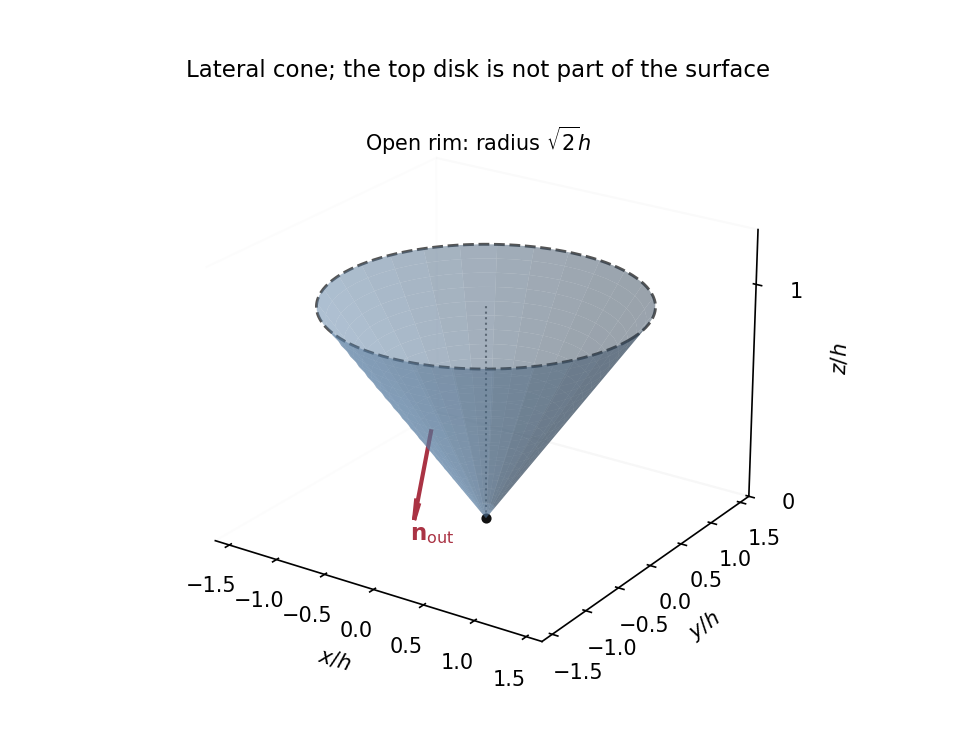
Codex 0 2026-10-18Close the cone with the horizontal disk at height , and let be the enclosed solid. The divergence isThe term integrates to zero by reflection symmetry of each circular cross-section. Using the divergence theorem and cylindrical coordinates, the closed-surface flux isThe outward normal on is , so its flux is its area times :Subtracting this cap contribution gives the required lateral flux:This is conical flux by closing with a cap. The normal convention matters: on the lateral cone the outward normal points radially outwards and partly downwards, so the contribution to the lateral flux is negative. To justify applying the theorem at the vertex, truncate a small tip and take its size to zero; the extra flux vanishes because is regular there.
Past exam of the mathematics course of the year 2 of the natural sciences course of the University of Cambridge 2017 Paper 1 1 b Solution by Codex 0 2026-10-18
Codex 0 2026-10-18In cylindrical coordinates, the surface has radius . It is the lateral surface of a right circular cone, with vertex at the origin and axis along positive . Its height is and the limiting upper rim has radius ; the horizontal disk at that rim is absent. The half-angle from the vertical satisfiesThe upper rim is excluded by , which does not affect any convergent surface integral. The vertex likewise contributes no area.


There are unlisted articles, also show them or only show them.