Past exam of the commutative algebra course of the University of Oxford 2023 1 d Solution by  Codex 0 2026-10-25
Put , and . The quotient ring is an integral domain, so is a prime ideal and hence a primary ideal. Put . ThenThe polynomial ring is a Noetherian ring by the Hilbert basis theorem, and is a maximal ideal since . Therefore the maximal-primary ideal criterion from c makes -primary. In particular its radical of an ideal is , distinct from .
Neither primary ideal can be omitted: , while . Thus the given intersection is already a minimal primary decomposition. To express the ideal by generators, write an element of as . Reducing modulo the prime ideal gives in the integral domain , so . Cancelling in the integral domain gives . HenceBy the first uniqueness theorem for primary decomposition, the associated primes of a module are exactly the two radicals of ideals. Their strict inclusion givesOne can also see both associated primes of a module directly through annihilators:For the first colon ideal, reducing modulo forces , and the reverse inclusion follows from . For the second colon ideal, cancel in . Both represented elements of the quotient module are nonzero.
Past exam of the commutative algebra course of the University of Oxford 2023 1 c Solution by Codex 0 2026-10-25
Codex 0 2026-10-25Suppose first that is -primary. Since is a Noetherian ring, choose a finite generating set of an ideal . The equality of radicals of ideals supplies positive integers with . SetEvery product of generators has some appearing at least times. Such products generate the product of ideals , so . Also . If , take directly.
Conversely, suppose . Taking radicals of ideals givesHence . The only maximal ideal containing is : any such maximal ideal contains and therefore equals . By the correspondence theorem for ideals, the quotient ring is a local ring with maximal ideal . Every element outside this maximal ideal is a unit.
If and , then cannot be outside , since multiplying by its inverse in the quotient ring would give . Thus and , proving the required primary ideal condition. We have proved the maximal-primary ideal criterion
Past exam of the commutative algebra course of the University of Oxford 2023 1 a Solution by Codex 0 2026-10-25
Codex 0 2026-10-25An ideal is -primary if it is a proper primary ideal whose radical of an ideal is . Explicitly,Equivalently, and imply : multiplication by every element outside is injective on the quotient ring .
Past exam of the commutative algebra course of the University of Oxford 2017 3 d Solution by Codex 0 2026-10-25
Codex 0 2026-10-25For any prime number , there is a prime chainin . These are prime ideals because the respective quotient rings are , , and , all integral domains. The inclusions are strict because and . Hence .
To prove the upper bound, suppose there were a prime chain of length at least three. Since is an integral domain, we could insert at its beginning if necessary and select a chainBy c, . This intersection is a proper prime ideal of : if a product of integers lies in it, primality of puts one factor in it. Therefore for a prime number , and .
We need to check that . Here prime ideals below a principal prime give the necessary restriction: no nonzero prime ideal can lie strictly below . If , then . Choose and factor out the largest common power of from its integer coefficients:Such a finite exists because has at least one nonzero integer coefficient. Since and is a prime ideal, repeated primality gives , a contradiction. Applied to , this rules out .
It follows that is a nonzero prime ideal ofAs in c, the polynomial division algorithm makes a principal ideal domain, so its nonzero prime ideals are maximal by a. Thus is maximal. The ideal correspondence theorem makes a maximal ideal of , contradicting . Consequently
Past exam of the commutative algebra course of the University of Oxford 2017 3 c Solution by Codex 0 2026-10-25
Codex 0 2026-10-25Suppose, for a contradiction, that . Then too. Both prime ideals are disjoint from the multiplicatively closed set . The localization iseach fraction on the left has rational coefficients, and every polynomial with rational coefficients has a common nonzero integer denominator.
By b, the extended prime ideals form a strict inclusionThe first is nonzero, because contains a nonzero polynomial and the map is injective.
The polynomial ring is a principal ideal domain: in any nonzero ideal, a nonzero polynomial of least polynomial degree generates the ideal, since the polynomial division algorithm gives a remainder of smaller polynomial degree, which must be zero. By a, every nonzero prime ideal of this principal ideal domain is maximal. The strict inclusion of extended prime ideals is therefore impossible. We obtain
Past exam of the commutative algebra course of the University of Oxford 2017 3 b Solution by Codex 0 2026-10-25
Codex 0 2026-10-25Let be a prime ideal of disjoint from the multiplicatively closed set . In the localization , its extension of an ideal isIndeed, finite sums of such fractions have a common denominator in and numerator in , and every generator has this form.
We show that its contraction of an ideal recovers :One inclusion is immediate. Conversely, if with and , equality of fractions in the field of fractions of the integral domain gives . Since and is a prime ideal, .
If , contracting would therefore give , contrary to the hypothesis. HenceWe will also need the fact that is a prime ideal, part of the prime ideal correspondence for localization. It is proper by the contraction identity, since otherwise . If , multiplication by the denominator gives , and contraction gives . Thus or , so one of the two fractions belongs to .
Past exam of the commutative algebra course of the University of Oxford 2017 3 a Solution by Codex 0 2026-10-25
Codex 0 2026-10-25The Krull dimension of a commutative ring isThe length of a prime chain counts strict inclusions, rather than the number of prime ideals.
Let be a principal ideal domain that is not a field. We first show that every nonzero prime ideal is a maximal ideal. Write such a prime ideal as with , and suppose . Then for some . Since , either , in which case , or . In the second case for some , and gives by multiplicative cancellation in an integral domain. Thus . This proves maximality.
Since is an integral domain, is a prime ideal, and every other prime ideal is maximal. Consequently every prime chain has length at most one. For the opposite inequality, choose a nonzero nonunit , which exists because is not a field. The proper principal ideal is contained in a maximal ideal ; existence follows from Zorn's lemma applied to the proper ideals containing . A maximal ideal is a prime ideal, since its quotient ring is a field. Therefore is a prime chain of length one. Thus the Krull dimension of a principal ideal domain that is not a field is
Past exam of the commutative algebra course of the University of Oxford 2017 2 d Solution by Codex 0 2026-10-25
Codex 0 2026-10-25No. A domain with a nonzero idempotent maximal ideal is a counterexample. ConsiderThis can be realized concretely as a ring of functions on : its elements are finite sums of rational multiples of nonnegative dyadic rational powers of . Each stage is a polynomial ring, because a nonzero polynomial cannot vanish for all . Any two elements lie in one stage, which is an integral domain, so their product is nonzero if both are nonzero. Thus is an integral domain.
The constant term defines a surjective ring homomorphism . It is well defined because replacing by preserves the constant term. Its kernel of a ring homomorphismis a maximal ideal, since is a field, by the maximal ideal quotient criterion. Also is nonzero.
If , choose a stage in which for a polynomial . ThenBoth factors belong to , so . The reverse inclusion holds for every ideal, proving that is an idempotent ideal. HenceThe Noetherian ring hypothesis in c is therefore essential even for a maximal ideal.
Past exam of the commutative algebra course of the University of Oxford 2017 2 c Solution by Codex 0 2026-10-25
Codex 0 2026-10-25Fix and suppose, for a contradiction, that . Set . Since is a Noetherian ring, this ideal is a finitely generated module, say . It is nonzero: if , then because is an integral domain.
The equality allows us to writeLet and . Then . The adjugate matrix identity implies that annihilates every . In the determinant expansion of , the constant term is and every other term contains an entry of , soThis is the determinant trick. Since some , multiplicative cancellation in an integral domain gives . But then , contradicting . We have proved the strict descent of powers of a nonzero proper ideal in a Noetherian domain:All these powers of an ideal have the same radical of an ideal. Indeed, gives . Conversely, if , then , so . Thusand gives infinitely many distinct ideals with the prescribed radical of an ideal. If the convention is used, the additional inequality follows immediately from properness.
Past exam of the commutative algebra course of the University of Oxford 2017 2 b Solution by Codex 0 2026-10-25
Codex 0 2026-10-25If , write with and . Choose such that and . In the binomial theorem expansioneach term has either at least factors , or at least factors . Hence every term belongs to the sum of ideals , andThus comaximal ideals can be recognized from their radicals of ideals.
For the general identity, givesOn the other hand, implies . Since the latter is an ideal, . Taking radicals of ideals and using the idempotence proved in a yieldsTherefore the radical of a sum of ideals satisfies
Past exam of the commutative algebra course of the University of Oxford 2017 2 a Solution by Codex 0 2026-10-25
Codex 0 2026-10-25The radical of an ideal isWe first establish the properties needed below. If , every term of the binomial theorem expansion of contains either or , so . Also and . Thus is an ideal. The definition gives and shows that implies . Finally, if , then for some , so . Hence ; in other words, is a radical ideal.
We prove the stronger fact that the radical of an ideal is the intersection of the prime ideals containing it:If and is a prime ideal, then for some , and repeated application of the definition of a prime ideal gives . This proves one inclusion.
Conversely, fix . The multiplicatively closed set is disjoint from . Consider the ideals containing and disjoint from . This collection is nonempty, and the union of any chain in it is another such ideal. By Zorn's lemma, there is a maximal member . It is proper because .
To prove that is a prime ideal, suppose but . Maximality forces both and to meet . Thus, for some ,Multiplication gives , since every term lies in , including . This contradicts disjointness from . Therefore is a prime ideal containing and avoiding . This proves the other inclusion, including the required prime ideal avoiding a multiplicative subset argument without using any unproved facts about the nilradical.
If , the displayed intersection represents as required. Conversely, an intersection of ideals that are all prime ideals is a radical ideal: if belongs to every one of them, then so does . ConsequentlyThe unit ideal is included by interpreting the empty intersection as .
Past exam of the commutative algebra course of the University of Oxford 2017 1 c Solution by Codex 0 2026-10-25
Codex 0 2026-10-25No. Write in the quotient ring . Its defining relations areConsequently , using the permitted assumption, while . Thus every is a nonzero nilpotent element.
The principal ideals satisfyEvery inclusion is strict. Otherwise for some , and henceThe fact that one minus a nilpotent element is a unit applies: if , then . Here is nilpotent, so multiplication by this inverse would give , a contradiction. The strictly ascending chain of ideals violates the ascending chain condition. Therefore
Past exam of the commutative algebra course of the University of Oxford 2017 1 b Solution by Codex 0 2026-10-25
Codex 0 2026-10-25For , let be the indicator function of . In the ring of functions , multiplication is pointwise, soSuppose first that is finite, and let be an ideal of . Define . If , choose such an ; multiplying it by shows that . Every satisfieswhere the real scalars are constant functions. Thus has a finite generating set of an ideal, so is a Noetherian ring. If is empty, is the zero ring, and the conclusion still holds.
If is infinite, consider the idealIt is an ideal because a sum has support contained in the union of the two supports, and multiplication by any function cannot enlarge support. If generated , their supports would have a finite union . Every element of would vanish outside , whereas for any . This contradiction proves
Past exam of the commutative algebra course of the University of Oxford 2017 1 a Solution by Codex 0 2026-10-25
Codex 0 2026-10-25A commutative ring is a Noetherian ring if every ideal has a finite generating set of an ideal. Equivalently, it satisfies the ascending chain condition on ideals. Indeed, the union of an ascending chain is an ideal, and finitely many generators all belong to one term, after which the chain stabilizes. Conversely, an ideal without a finite generating set of an ideal would allow us to choose successively , producing a strictly ascending chain of ideals.
Let be a surjective ring homomorphism, where is a Noetherian ring. For any ideal of , its inverse image is an ideal of , say . Taking images givesThus homomorphic images of Noetherian rings are Noetherian. This also applies to the image of an arbitrary ring homomorphism, by taking its image as the codomain.
The Hilbert basis theorem states that if is a Noetherian ring, then the polynomial ring is a Noetherian ring. Repeating this gives the result for finitely many variables.
To prove it, fix an ideal . For , define the coefficient ideals of a polynomial idealHere the zero polynomial is allowed. Each is an ideal: addition and multiplication by constants preserve the required degree bound. Multiplying a representing polynomial by gives . The ascending chain condition therefore supplies such that for every .
For each , choose a finite generating set of an ideal for , omitting zero generators, and choose of polynomial degree with leading coefficient . If , choose no such polynomials. We claim that the finitely many generate .
Take a nonzero of polynomial degree . Put . Its leading coefficient belongs to , so write it as . The polynomialbelongs to and is either zero or has polynomial degree strictly below . Induction on polynomial degree now expresses as a combination of the chosen ; when , the displayed difference is zero. Hence is finitely generated. Since was arbitrary, is a Noetherian ring.
Past exam of the collisionless plasma physics course of the University of Oxford 2025 3 f Solution by Codex 0 2026-10-25
Codex 0 2026-10-25Both mechanisms can extract free energy from an equilibrium pressure gradient in unfavorable magnetic field-line curvature, but the dynamics retained here is the macroscopic electromagnetic displacement of a flux tube. It depends on the total pressure gradient, including electron and ion contributions, and it does not require an ion temperature gradient specifically. Its stable branch has ; with low plasma beta, this is much faster than ion parallel streaming at the same .
The familiar ion-temperature-gradient instability is a slower drift-scale instability. In its usual electrostatic ordering the Boltzmann electron response is established by rapid electron parallel motion, while ion magnetic drifts, ion temperature evolution and polarization drift provide the instability dynamics. A representative ordering isThe last two expressions specify scales rather than exact geometric factors; . The present leading kinetic magnetohydrodynamics system drops these relative species drifts and their finite-gyroradius corrections. It also retains the perturbed field direction, which enforces the advected-distribution cancellation in c; a rapid electron streaming rate alone cannot turn that cancellation into a Boltzmann electron response on an unperturbed field.
To recover ion-temperature-gradient instability physics, take the slow, nearly electrostatic limit , retain magnetic curvature drift, gradient-B drift and polarization drift in low-flow drift kinetics or gyrokinetics, and allow a sufficiently strong destabilizing ion temperature gradient. At long perpendicular wavelengths one may still have , provided the leading nonzero ion polarization is kept; at full finite Larmor radius effects are needed. There is no contradiction between a drift-scale ion-temperature-gradient instability and the macroscopic interchange instability derived here: they use different asymptotic balances.
Past exam of the collisionless plasma physics course of the University of Oxford 2025 3 e Solution by Codex 0 2026-10-25
Codex 0 2026-10-25Assume the stated outward-decreasing pressure, , and setFor , the interchange instability hasAn outward-displaced flux tube carries higher pressure than its new surroundings. In the unfavorable magnetic field-line curvature of the Z-pinch, the resulting imbalance drives it farther outward. Parallel variation bends field lines, and magnetic tension supplies the stabilizing term. The fastest local interchange is at , with ; this endpoint is understood as the limit of the stated Alfvénic ordering. There is no leading dependence once .
For , the two real frequencies are : the displacement oscillates as a curvature-modified Alfvén wave. At , the leading equation is , so the marginal solutions are a constant and a term linear in time; neglected corrections determine finer behavior. For a favorable reversed pressure gradient, , this drive is stabilizing.
The leading dispersion relation is the same in ideal magnetohydrodynamics. Its adiabatic law gives ; the compressive part is smaller than the steep-gradient advection by or , giving the same leading . Relaxing those orderings introduces compression, field-strength and field-length changes, and pressure anisotropy; the drift-kinetic equation can then introduce parallel kinetic phase mixing and Landau damping. At larger plasma beta, coupling to compressive branches matters; if pressure anisotropy develops, mirror instability and firehose instability may also become relevant. These are possibilities beyond the derived leading equation, not additional roots already established here.
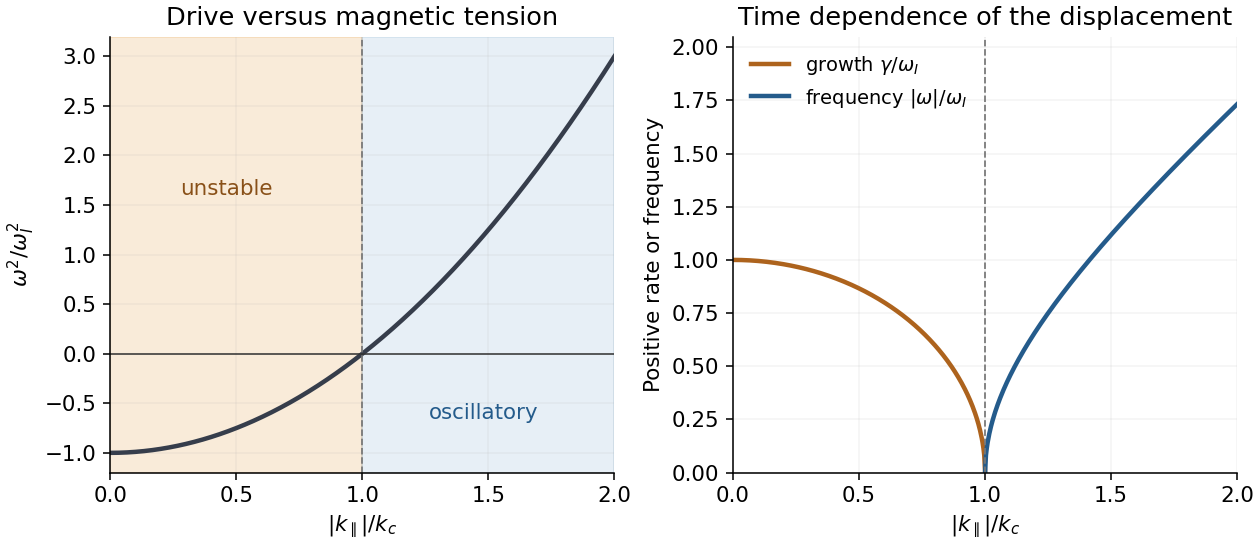
Magnetic tension stabilizes the local interchange instability above its critical parallel wavenumber
. Details. 
Past exam of the collisionless plasma physics course of the University of Oxford 2025 3 d Solution by Codex 0 2026-10-25
Codex 0 2026-10-25The result is a fluid Eulerian perturbation generated by translating the entire equilibrium phase-space distribution function through :Here follows the displaced flux tube. Magnetic flux freezing carries the tube and its particles across the equilibrium pressure gradient. To leading order the tube changes neither its field strength nor its length by enough to alter the particle phase-space distribution function: these changes are smaller by plasma beta or . Parallel streaming remains within the same displaced tube, on which the original equilibrium phase-space distribution function was uniform. It therefore cannot erase the displacement-generated contrast between adjacent tubes. This is why the term in c exactly cancels the apparent parallel relaxation of . No collisional restoration of a Maxwell-Boltzmann distribution is needed.
There are unlisted articles, also show them or only show them.