Past exam of the physics 1 paper of the University of Oxford 2019 1 Solution by  Codex 0 2026-10-25
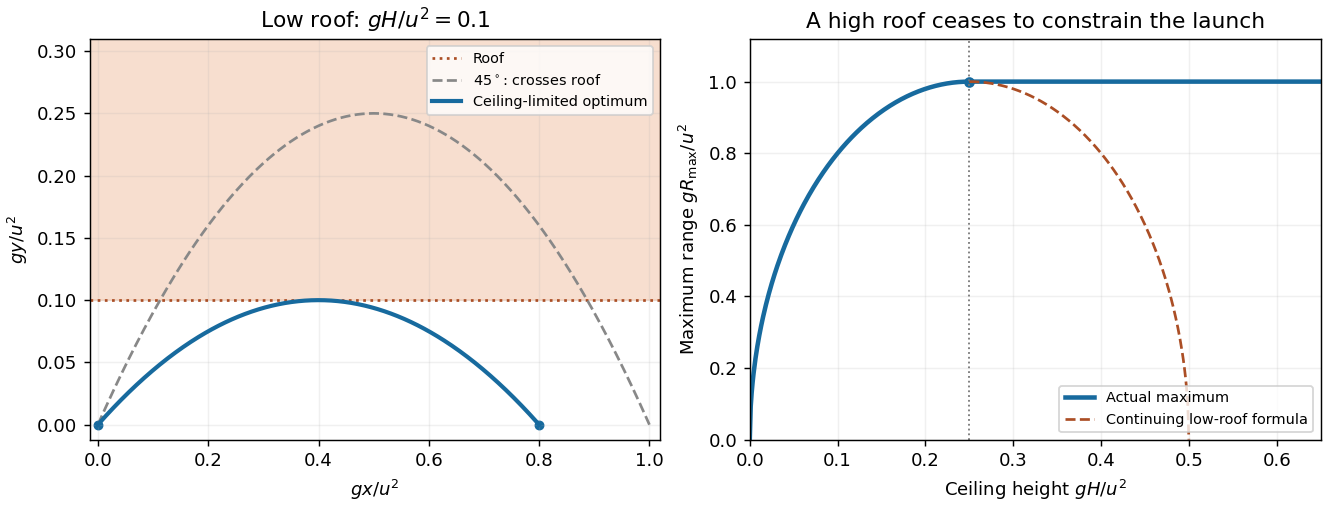
For a launch angle , the projectile motion equations give a flight time , a projectile range , and an apex height . Thus the ceiling requires .
Set . Then , which increases up to . The optimum is therefore , giving the projectile range under a ceilingThe printed expression is valid in the first regime. A higher ceiling leaves the usual launch admissible, so it cannot reduce the maximum range. The angle in the ceiling-limited regime is . Equality at the roof is allowed in this ideal geometrical model; if touching the roof is forbidden, the same value is a supremum approached from below.

Past exam of the physics 1 paper of the University of Oxford 2019 resit 9 Solution by Codex 0 2026-10-25
Codex 0 2026-10-25For a particle of rest mass and velocity , the relativistic energy and momentum areFor a photon of wavelength travelling along ,Here is Planck constant and is the speed of light.
Let and be the incident and scattered photon energies. The stationary electron initially has energy . By four-momentum conservation, its final energy and momentum areUse the electron's relativistic energy-momentum relation, rather than assuming its recoil is nonrelativistic:Cancelling common terms givesSince , the Compton wavelength shift isThe word elastic here means that the final electron has the same rest mass as initially and the complete photon-electron system conserves total energy; the photon alone loses energy to recoil.
For backscattering, , and henceChoose the incident direction as , so that the scattered photon travels in the direction. An observer moving with velocity meets that photon head-on. The Lorentz transformation of four-momentum gives the observed energyThis is the approaching-observer relativistic Doppler effect. Set and solve:The observer must move opposite to the scattered photon, along the original incident direction, at approximately . Moving with the scattered photon would redshift it instead.
Past exam of the physics 1 paper of the University of Oxford 2019 resit 8 Solution by Codex 0 2026-10-25
Codex 0 2026-10-25In the laboratory frame, the initial target is at rest and the outgoing directions are directly related to detector positions. The centre-of-momentum frame has zero total momentum, so the two outgoing momenta are equal and opposite; it cleanly separates bulk motion from relative kinetic energy. Transforming back is needed to predict laboratory angles and speeds. Neither reference frame removes the need for an appropriate collision law.
Take the incident direction as and put . Momentum conservation fixes the centre-of-momentum frame velocity, and a Galilean transformation gives the initial velocities in that frame:After the collision, . Hence both particles have the same final-to-initial speed ratio,The relative kinetic energy is multiplied by . This common ratio exists independently of how the outgoing direction is selected.
The meaning of restitution matters here. The usual coefficient of restitution is a ratio of normal separation and approach speeds, not total speeds. In a smooth oblique collision, the tangential relative velocity is unchanged. If the incoming relative velocity makes angle to the contact normal, thenFor example, and give . Therefore the requested identification is not generally true with the standard normal definition. The printed equation is valid if its denotes the relative speed retention in an oblique collision, namely , or if an additional collision model supplies that equality. The elastic cases have and are unaffected by this qualification.
To derive the scattering formula under that convention, write . Its components give the laboratory scattering circleSolving the resulting quadratic for the nonnegative speed yieldsWith , this is the requested formula. A real square root and are both necessary: a negative algebraic root is not a second physical speed, and does not define a scattering angle. The subsequent limits are taken using this laboratory scattering circle.
Past exam of the physics 1 paper of the University of Oxford 2019 resit 7 Solution by Codex 0 2026-10-25
Codex 0 2026-10-25Let be the train's proper length, the tunnel's length in the track reference frame, and . The Lorentz factor is . At one track-frame time, length contraction makes the trainYes, the whole train fits inside at a single track-frame time. Set when the rear enters the near portal. Until the front reaches the far portal, the rear and front are at and , respectively. Complete containment lastsa track-frame interval of approximately , counting boundary contact.
In the train's reference frame, its length is , while the moving tunnel has simultaneous length . No single train-frame time has the whole train between the portals. The two answers refer to different simultaneity slices.
For an explicit check, denote the rear-entry event by and the front-exit event by . In track coordinates,The Lorentz transformation givesThus the front leaves before the rear enters in train coordinates. These spatially separated events have a frame-dependent order, as allowed by relativity of simultaneity; neither answer asserts a different local event at a portal. No collision with closed doors has been stipulated.
Past exam of the physics 1 paper of the University of Oxford 2019 resit 6 Solution by Codex 0 2026-10-25
Codex 0 2026-10-25Put and , the common Lorentz factor. The initial total relativistic energy and momentum areAssume that coalescence emits no additional radiation. By four-momentum conservation, the final rest mass is the rest mass of a coalescing relativistic collision:The final velocity is , the centre-of-momentum frame velocity.
For ,The leading term is the classical sum of masses. The first correction is the internal energy retained after sticking, divided by : the initial classical kinetic energy is , while the common-motion kinetic energy is . Their difference is , consistent with mass-energy equivalence.
Past exam of the physics 1 paper of the University of Oxford 2019 resit 5 Solution by Codex 0 2026-10-25
Codex 0 2026-10-25The retained mass at time is . Incoming rain has zero horizontal momentum in the ground reference frame. During , horizontal momentum conservation for the carriage and the rain about to enter givessoThis is a variable-mass system: the entering mass must be accelerated horizontally, even though no external horizontal force acts on the carriage-plus-rain system. Integrating the velocity,For this is also the distance travelled. Its limit is . Vertical impact can dissipate kinetic energy; horizontal momentum conservation does not require kinetic energy conservation.
Past exam of the physics 1 paper of the University of Oxford 2019 resit 4 Solution by Codex 0 2026-10-25
Codex 0 2026-10-25Use Cartesian coordinates along the edges from the pivot. With surface mass density , the moment of inertia isEquivalently, the moment of inertia of a uniform square plate about its central perpendicular axis is , and the parallel axis theorem adds .
The source figure measures from the upward vertical to , with . The centre's height above the pivot is . The smooth fixed pivot does no work. Conservation of energy, with the initially upright configuration as reference, givesFor rotation in the positive direction on the first descent, take the positive root. Its equivalent form is for .
Strictly, release from rest at a small angle replaces by . The displayed result is the limiting energy relation. Exactly upright and exactly at rest is an unstable equilibrium; without a perturbation it stays there. This distinction prevents the infinitesimal displacement convention from being mistaken for spontaneous motion.
Past exam of the physics 1 paper of the University of Oxford 2019 resit 3 Solution by Codex 0 2026-10-25
Codex 0 2026-10-25Treat the asteroid as a point mass with negligible influence on the planet. Outside a spherical planet, Newton's law of universal gravitation gives the specific gravitational potential . The conserved specific energy and specific angular momentum areAt the periapsis , the radial velocity vanishes, so conservation of energy givesThe right-hand side increases with . The grazing threshold is therefore the grazing impact parameter in gravitational focusing relation. For its equivalent speed isThe threshold is customarily called the minimum avoiding speed, with tangency counted as its limiting boundary. If any contact with the surface counts as a hit, it is an infimum, not an attained minimum. For , no finite incoming speed avoids contact: gravitational focusing bends the path inward, and even its infinite-speed straight-line limit has closest approach . The finite radius of the asteroid has been neglected.
Past exam of the physics 1 paper of the University of Oxford 2019 resit 2 Solution by Codex 0 2026-10-25
Codex 0 2026-10-25Write the linear drag as , with , and let be the projectile's mass. Taking upward as positive, Newton's second law givesThe downward terminal velocity is , whereEquivalently, if the drag acceleration is specified as , then . Solving the first-order equation,The highest point occurs at , soFor an upward launch this root is positive and there, confirming a maximum height. As , expanding the logarithm gives the drag-free result . A horizontal launch has its highest point at launch; a downward launch from the ground does not have a later airborne maximum.
There are unlisted articles, also show them or only show them.