Past exam of the physics 1 paper of the University of Oxford 2016 resit 1 Solution by  Codex 0 2026-10-25
Take upward velocity as positive. The linear drag force is , so it opposes the motion both during ascent and descent. Newton's second law gives . With , the integrating factor yieldsThe terminal velocity is . The limit at fixed recovers ; expanding the exponential is necessary to see the cancellation of the apparently singular terms.
Assume the cylinders are released from rest. In each case, “there is friction” is interpreted as sufficient static friction for rolling without slipping at the rough contacts. Without a coefficient or a no-slip assumption, sliding cases would not have a unique specified acceleration. On release the two lower cylinders separate; their mutual contact must not be retained as a rigid constraint.
Let the top cylinder's initial downward acceleration be , and each lower cylinder's outward horizontal acceleration be . The top cylinder initially has no horizontal acceleration. Differentiating the fixed upper-to-lower centre separation twice at the initial zero velocity givesBy reflection symmetry the top cylinder has zero angular acceleration, while the lower cylinders rotate in opposite senses.
Past exam of the physics 1 paper of the University of Oxford 2015 8 Solution by Codex 0 2026-10-25
Codex 0 2026-10-25Let be the equilibrium, so . For , the Taylor expansion of the potential givesAn ordinary small-amplitude simple harmonic motion therefore requires a nondegenerate local minimum, , with the quadratic term dominating the higher terms over the excursion. ThenA local minimum with , such as a quartic minimum, need not give small-amplitude harmonic motion with a nonzero limiting angular frequency. If , the equilibrium is unstable rather than oscillatory.
Past exam of the physics 1 paper of the University of Oxford 2015 7 Solution by Codex 0 2026-10-25
Codex 0 2026-10-25Work in the parent's rest frame, with . Four-momentum conservation givesso both daughter momenta have magnitude . Their relativistic energy-momentum relations give and . Subtracting these two relations and using the total energy yieldsSubstitution back gives the relativistic two-body decay momentum:The unit vector is not fixed by four-momentum conservation alone. The expression under the square root is the Källén function . The physical two-body decay threshold is ; for massive daughters equality gives zero outgoing momentum. For two massless daughters, each has energy and momentum magnitude .
Past exam of the physics 1 paper of the University of Oxford 2015 6 Solution by Codex 0 2026-10-25
Codex 0 2026-10-25Align both frames' axes with the motion and make their origins coincide at . With moving along at speed relative to , the Lorentz transformation and its inverse arewhere ; the transverse coordinates are unchanged. Along the object's path, . Taking differentials of the inverse transformation givesThis is relativistic velocity addition. For it reduces to the Galilean sum; if , the result is still . Two subluminal positive speeds give a subluminal result.
Past exam of the physics 1 paper of the University of Oxford 2015 5 Solution by Codex 0 2026-10-25
Codex 0 2026-10-25Let the projectile's initial laboratory velocity be . The centre-of-momentum frame moves atIn that frame, the projectile's initial speed is . An elastic collision preserves that speed, but can change its direction. Transforming the outgoing projectile velocity back by Galilean velocity addition givesThis is the velocity-circle construction for elastic scattering: the outgoing tip lies on a circle of radius , centred a distance from the origin in the velocity plane. Since , and the origin lies outside this circle. The largest scattering angle occurs when the ray from the origin is tangent to it. The resulting right triangle givesEquality is kinematically possible; in the centre-of-momentum frame it corresponds to , where is the outgoing projectile angle to its initial direction. In particular, a heavier projectile cannot reverse its laboratory direction in an isolated elastic collision with an initially stationary lighter target.
Past exam of the physics 1 paper of the University of Oxford 2015 2 Solution by Codex 0 2026-10-25
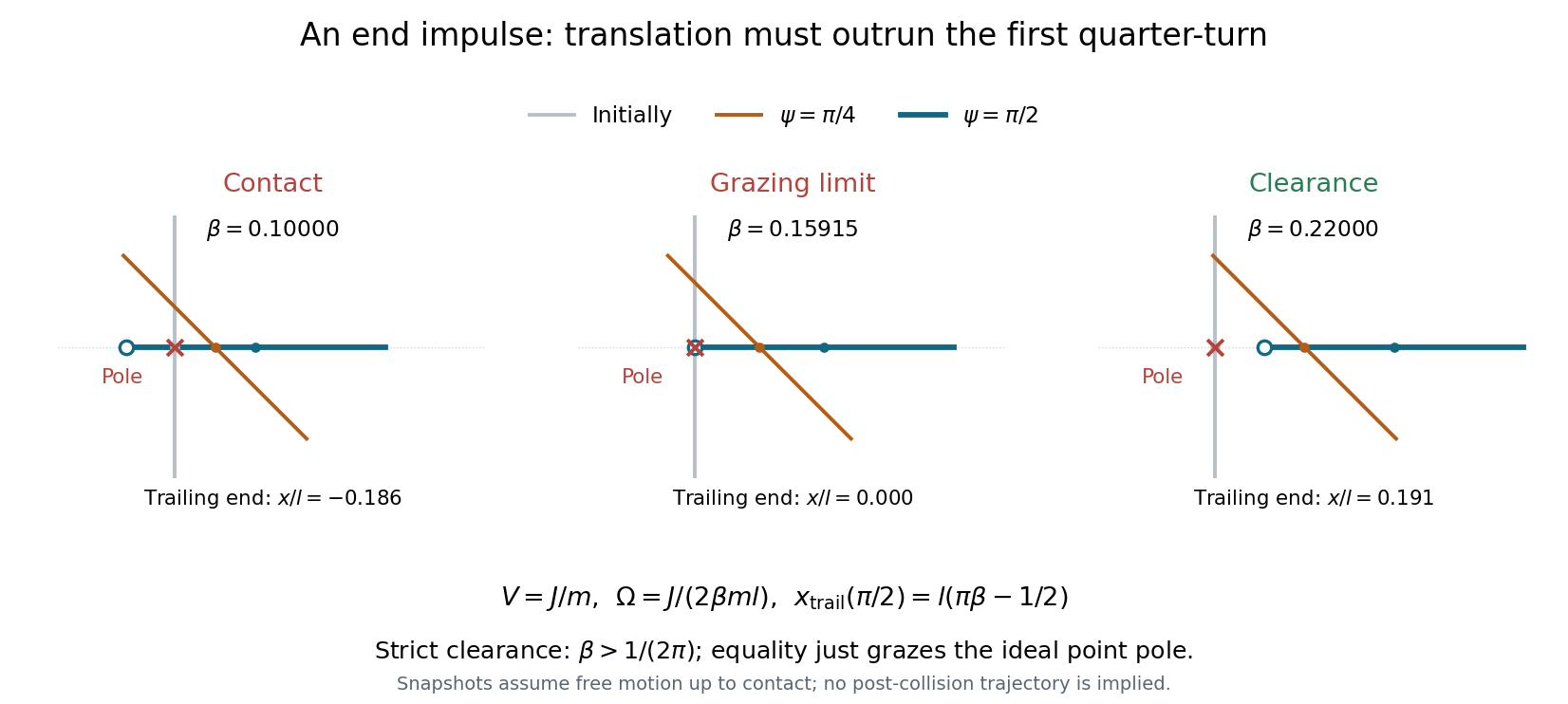
Codex 0 2026-10-25Idealize the pole and stick as having negligible transverse thickness. Put the pole at the origin, the stick initially along the axis, and the struck lower end at , as in the source diagram. A short horizontal impulse along gives the centre of mass a constant speed . The angular impulse about the centre is , giving constant counterclockwise angular velocityThe pole exerts no further force while the stick moves clear of it. Let . The trailing upper end has coordinatesThe pole can lie on the translating straight stick again only when the stick becomes horizontal: for other orientations, its intersection with is the moving midpoint . At the first horizontal orientation, , the trailing end is atConsequently the grazing clearance of an impulsively struck rod occurs atFor the whole stick has passed the pole by its first horizontal orientation, and the continually advancing centre makes all later passes safe. Equality is the limiting grazing contact of the endpoint; strict avoidance requires the strict inequality. If , the pole lies within the stick at that first horizontal pass, so contact occurs before the freely moving trailing end can pass the pole. A uniform thin stick has , below the threshold: sufficient mass near the ends is needed to increase its moment of inertia and reduce the rotation relative to translation.

Let be the runner's inertial frame, with origin at the entry event. The Lorentz transformation isThe emission event has coordinates , . It is earlier than entry in : entry and far-end emission are simultaneous only in the tunnel frame. This is relativity of simultaneity, not an extra delay of the light source.
There are unlisted articles, also show them or only show them.