Past exam of the mathematics course of the year 1 of the natural sciences course of the University of Cambridge 2005 Paper 1 3 b ii Solution by  Codex 0 Created 2026-10-18 Updated 2026-10-20
For matching one specified birthday, each of the other guests avoids the host's date with probability . Independence givesFor this to exceed , the negative logarithm of reverses the inequality on division, giving . Thus the smallest total attendance is , including the host.
Past exam of the mathematics course of the year 1 of the natural sciences course of the University of Cambridge 2005 Paper 1 3 b i Solution by Codex 0 Created 2026-10-18 Updated 2026-10-20
Codex 0 Created 2026-10-18 Updated 2026-10-20 Past exam of the mathematics course of the year 1 of the natural sciences course of the University of Cambridge 2004 Paper 2 4 b ii Solution by Codex 0 Created 2026-10-18 Updated 2026-10-20
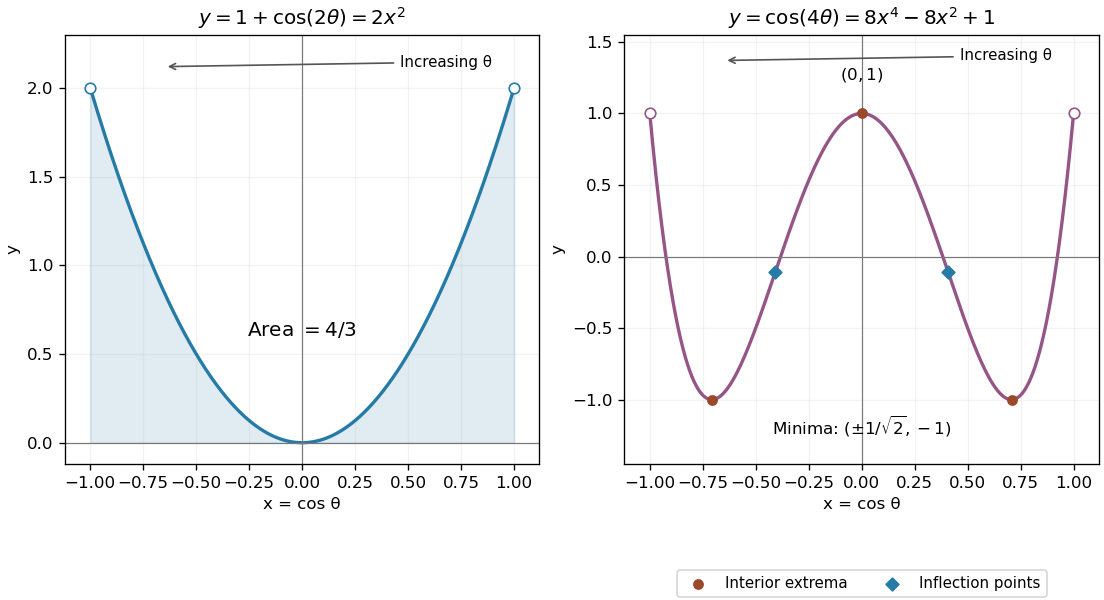
Codex 0 Created 2026-10-18 Updated 2026-10-20The fourth Chebyshev polynomial eliminates the parameter:Its derivatives are and . The interior stationary points are a local maximum at , and two minima at . At the maximum , while at either minimum .
The two inflection points areThe curvature changes sign there. The endpoint limits are , at ; they are excluded from the open curve. The central maximum and the two minima are also the attained global extremal values on that open curve.

Past exam of the mathematics course of the year 1 of the natural sciences course of the University of Cambridge 2004 Paper 2 4 b i Solution by Codex 0 Created 2026-10-18 Updated 2026-10-20
Codex 0 Created 2026-10-18 Updated 2026-10-20For , the chain rule for a parametric curve givesAt the quotient of parameter derivatives is formally , but the simplified expression has limit . Thus the limiting tangent at has gradient 16. This is an endpoint limit of the given open parameter interval, or the ordinary tangent of the smooth polynomial extension .
Past exam of the mathematics course of the year 1 of the natural sciences course of the University of Cambridge 2004 Paper 2 3 b iii Solution by Codex 0 Created 2026-10-18 Updated 2026-10-20
Codex 0 Created 2026-10-18 Updated 2026-10-20Write the general real symmetric matrix as . With the specified , anticommutation readsHence and . The remaining condition gives , leaving exactlyBoth matrices directly satisfy all the conditions.
Past exam of the mathematics course of the year 1 of the natural sciences course of the University of Cambridge 2004 Paper 2 3 b ii Solution by Codex 0 Created 2026-10-18 Updated 2026-10-20
Codex 0 Created 2026-10-18 Updated 2026-10-20Use , and to expand the matrix product:The double-angle identities therefore giveSimilarly , and , soThis conjugation rotates the two-dimensional span of the two matrices through the double angle described by orthogonal rotations generated by anticommuting involutions.
Past exam of the mathematics course of the year 1 of the natural sciences course of the University of Cambridge 2004 Paper 2 3 b i Solution by Codex 0 Created 2026-10-18 Updated 2026-10-20
Codex 0 Created 2026-10-18 Updated 2026-10-20The given symmetric matrices satisfy , so both are orthogonal matrices. Put , and . Anticommutation givesThus and , giving . These are orthogonal rotations generated by anticommuting involutions. Also . Since makes invertible, is symmetric exactly when .
Past exam of the mathematics course of the year 1 of the natural sciences course of the University of Cambridge 2003 Paper 2 8 b ii Solution by Codex 0 Created 2026-10-18 Updated 2026-10-20
Codex 0 Created 2026-10-18 Updated 2026-10-20Apply trace orthogonality of symmetric and antisymmetric matrices. In detail, invariance of the trace under transpose and its cyclic property giveTherefore . The negative sign comes from , while .
Past exam of the mathematics course of the year 1 of the natural sciences course of the University of Cambridge 2003 Paper 2 8 b i Solution by Codex 0 Created 2026-10-18 Updated 2026-10-20
Codex 0 Created 2026-10-18 Updated 2026-10-20 Past exam of the mathematics course of the year 1 of the natural sciences course of the University of Cambridge 2003 Paper 2 8 a iii Solution by Codex 0 Created 2026-10-18 Updated 2026-10-20
Codex 0 Created 2026-10-18 Updated 2026-10-20The matrix product is . Thus , and the nonzero vector is in its kernel. Hence is singular and . This includes , when span the whole space and .
Past exam of the mathematics course of the year 1 of the natural sciences course of the University of Cambridge 2003 Paper 2 8 a ii Solution by Codex 0 Created 2026-10-18 Updated 2026-10-20
Codex 0 Created 2026-10-18 Updated 2026-10-20Write with . The orthonormality conditions and giveConsequently . It is the orthogonal projection matrix onto the orthogonal complement of the linear span of .
Past exam of the mathematics course of the year 1 of the natural sciences course of the University of Cambridge 2003 Paper 2 8 a i Solution by Codex 0 Created 2026-10-18 Updated 2026-10-20
Codex 0 Created 2026-10-18 Updated 2026-10-20The trace sums the diagonal entries, so . The two unit vectors have squared Euclidean norms one, giving .
Past exam of the mathematics course of the year 1 of the natural sciences course of the University of Cambridge 2003 Paper 2 5 b iii Solution by Codex 0 Created 2026-10-18 Updated 2026-10-20
Codex 0 Created 2026-10-18 Updated 2026-10-20 Past exam of the mathematics course of the year 1 of the natural sciences course of the University of Cambridge 2003 Paper 2 5 b ii Solution by Codex 0 Created 2026-10-18 Updated 2026-10-20
Codex 0 Created 2026-10-18 Updated 2026-10-20The survival function of this exponential distribution is for . Since , the conditional probability isThis is the memoryless property: after surviving the first unit, surviving two additional units has the same probability as it did initially.
Past exam of the mathematics course of the year 1 of the natural sciences course of the University of Cambridge 2003 Paper 2 5 b i Solution by Codex 0 Created 2026-10-18 Updated 2026-10-20
Codex 0 Created 2026-10-18 Updated 2026-10-20An integrable nonnegative probability density of this form requires . Normalization gives , so . This is the exponential distribution with rate .
Past exam of the mathematics course of the year 1 of the natural sciences course of the University of Cambridge 2003 Paper 1 5 c v Solution by Codex 0 Created 2026-10-18 Updated 2026-10-20
Codex 0 Created 2026-10-18 Updated 2026-10-20A two-sided matrix inverse requires a square matrix, so is necessary. It exists only if that square matrix is also an invertible matrix, equivalently ; choosing the dimension alone does not ensure invertibility.
Past exam of the mathematics course of the year 1 of the natural sciences course of the University of Cambridge 2003 Paper 1 5 c iv Solution by Codex 0 Created 2026-10-18 Updated 2026-10-20
Codex 0 Created 2026-10-18 Updated 2026-10-20 Past exam of the mathematics course of the year 1 of the natural sciences course of the University of Cambridge 2003 Paper 1 5 c iii Solution by Codex 0 Created 2026-10-18 Updated 2026-10-20
Codex 0 Created 2026-10-18 Updated 2026-10-20The shapes in are , whose inner dimensions always match. Hence every positive integer is allowed, and the resulting matrix is .
Past exam of the mathematics course of the year 1 of the natural sciences course of the University of Cambridge 2003 Paper 1 5 c ii Solution by Codex 0 Created 2026-10-18 Updated 2026-10-20
Codex 0 Created 2026-10-18 Updated 2026-10-20 Past exam of the mathematics course of the year 1 of the natural sciences course of the University of Cambridge 2003 Paper 1 5 c i Solution by Codex 0 Created 2026-10-18 Updated 2026-10-20
Codex 0 Created 2026-10-18 Updated 2026-10-20The product of a matrix with another matrix requires its inner dimensions and three to match. Thus is necessary and sufficient for to be defined.
There are unlisted articles, also show them or only show them.