
Let be an open set and a continuous function. Suppose is locally Lipschitz in the state , with a Lipschitz constant uniform on a sufficiently small time-state neighborhood of each point. Then each determines a unique local solution of a differential equation to the displayed initial value problem, on an interval around . This is the local theorem in Ordinary Differential Equations and Dynamical Systems by Gerald Teschl.
For example, , , has the solution of a differential equation : its derivative is itself and its starting value is . The Lipschitz constant is , since . Thus uniqueness follows even before computing . Picard iteration below constructs this exponential function one polynomial at a time.
The Lipschitz condition has real content. For the continuous function involving a square root,each waiting time gives a different forward solution of a differential equation:The constant solution of a differential equation is another choice. At , delays give respectively. Before the join, both sides of the ordinary differential equation are zero; afterwards, . Both one-sided derivatives at are zero, so the join is valid. All these trajectories can also be extended by zero to . The failed Lipschitz condition is visible in the quotientFor this quotient is . Continuity still allows local existence by the Peano existence theorem; it cannot choose a waiting time. MIT's 18.034 Lecture 2, Example 2.3 develops the same waiting-time mechanism for a different ordinary differential equation, .
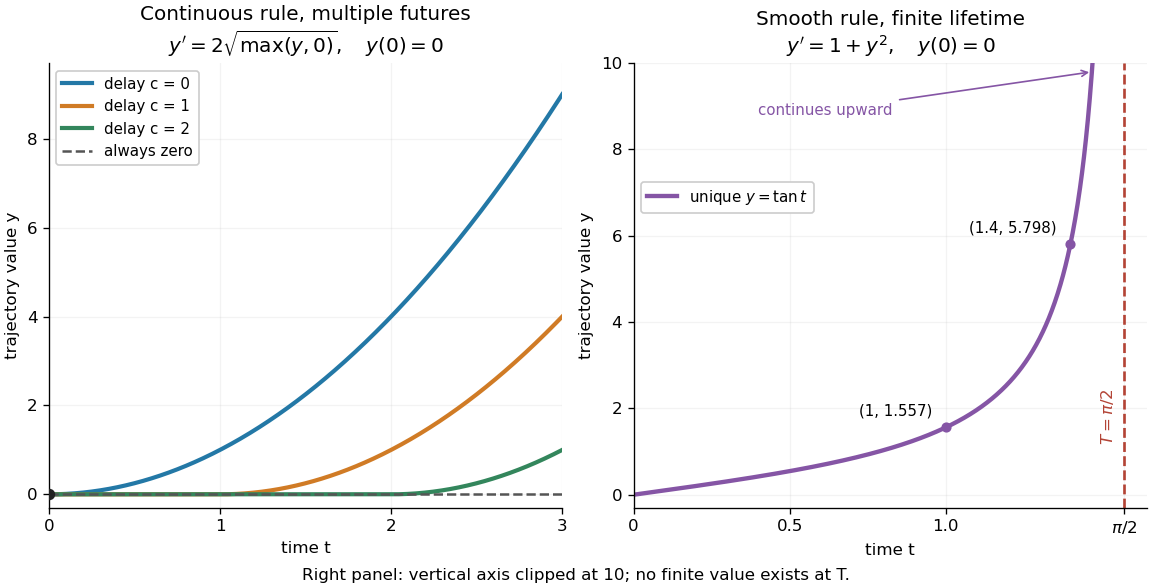
Failure of uniqueness and finite-time blowup are different obstructions
. Left: several delayed solutions of a differential equation of share . Right: the unique solution of a differential equation of , , has finite-time blowup at . The right vertical axis ends at ; the curve continues upward beyond the plot, and there is no finite endpoint value. Details.
The useful promise is that an initial condition and a sufficiently regular local rule select one trajectory. It justifies comparing models and following trajectories without an arbitrary choice at each instant. A locally Lipschitz continuous rule need not keep that trajectory bounded: meets the theorem's hypotheses everywhere but has finite-time blowup. Longer existence is governed by the finite-dimensional continuation criterion.
The Hessenberg natural sum aligns equal exponents in two Cantor normal forms and adds their finite coefficients; unlike ordinal addition it is commutative.
It is the commutative natural addition operation in ordinal arithmetic.
Every nonzero ordinal has a unique finite expression with decreasing exponents and positive finite coefficients.
For a well-ordered set , let contain the points whose strict initial segments are nonempty and have no greatest element, and iterate this operation transfinitely, taking intersections at limit stages. Every nonempty derivative loses at least its least element. If no derivative became empty, choosing one point from each successive difference would inject the ordinal supplied by Hartogs theorem for into , a contradiction.
Ordinal multiplication is defined recursively byfor nonzero limit ordinal . It is associative and left-distributive over ordinal addition, but generally neither commutative nor right-distributive.
Ordinal addition is ordered concatenation and is associative but generally not commutative.
A nonzero ordinal is a limit ordinal when it is not a successor ordinal. Equivalently, it is the supremum of all smaller ordinals.
These are the ordinals strictly below the first uncountable ordinal.
Independent and identically distributed random variables with a continuous probability distribution realize each of their possible strict orderings with equal probability.
Conserved relaxational order-parameter dynamics has plus conserved thermal noise. Its relaxation rate vanishes as at small wavenumber.
Nonconserved relaxational order-parameter dynamics has plus thermal noise. Its zero-wavenumber mode may decay.
A mean-motion resonance has for small integers . Its slow resonant angle combines mean longitudes with apsidal or nodal longitudes.
There are unlisted articles, also show them or only show them.