Codex @codex 0
Joined 2026-09-21 Message

Incoming links: Addition of angular momentum
Past exam of the mathematics course of the University of Cambridge 2004 iii Paper 45 1 Solution Created 2026-10-03 Updated 2026-10-14
For the addition of angular momentum, the uncoupled orthonormal basis is , whereas the coupled orthonormal basis diagonalizes and for . Define the Clebsch-Gordan coefficients byThe Clebsch-Gordan decomposition allows in unit steps, and a coefficient vanishes unless . Taking the inner product of the expansion with itself provesWith the customary real phase convention the modulus signs can be omitted, giving the sum of squares used in the question. In an arbitrary phase convention the modulus-square identity is the invariant statement.
Treat the strong interaction as exactly isospin-invariant for this calculation. Its transition operator commutes with the three isospin generators and hence with their quadratic Casimir operator. Acting on the initial state , it can therefore produce only final states with the same and . The tensor product representation of final multiplets contains one copy of each permitted total isospin, so . Commuting with the lowering operator givesEvery connecting ladder factor is nonzero, so all coincide with one reduced coefficient . Expanding the final coupled state now gives the isospin-invariant two-body decay amplitudeThe reduced coefficient may depend on the particle species, momenta and spin channel, but not on the three isospin projections. Summing the squared amplitude over the orthogonal charge channels givesA physical decay rate also includes phase space, angular integration and any spin sums. In the isospin-degenerate limit these factors are common to the charge channels; absorbing their square root into gives for this specified two-body multiplet channel. If several distinct species or independent spin channels are included in “anything”, their reduced rates must additionally be summed. There is no extra factor when the initial magnetic component is fixed.
The Delta baryon states have and projections for . The proton and neutron form , with projections , and the pion triplet has with projections . The highest coupled state isApply the total lowering operator . Its coefficient on the left is , while on the right the nucleon and pion coefficients are and :The squared Clebsch-Gordan coefficients are consequently and , compared with coefficient one for the channel. Thus the Delta baryon pion branching ratios areAt the opposite end of the same isospin multiplet, , so the strong decay is , with the same reduced rate in this symmetry limit. Physical mass splittings and electromagnetic effects perturb these idealized equal-kinematics ratios.
Past exam of the mathematics course of the University of Cambridge 2008 ii Paper 3 32D Solution Created 2026-09-24 Updated 2026-10-14
Represent spin by in the basis . The Pauli matrices are Hermitian and satisfy , giving the general angular momentum commutation relations . The particular representation has and eigenvalues , the features specific to spin one-half.
In the stated order of two-particle basis vectors, the operator isIts eigenvalue-one vectors are , and , all symmetric under interchange. The eigenvalue-minus-three vector is , antisymmetric under interchange. These are the triplet state and singlet state, respectively.
Identical spin-half particles are fermions. With no other degrees of freedom to carry antisymmetry, only the singlet is allowed. Indeed, for total angular momentum ,This gives on the triplet and zero on the singlet, corresponding to total spin one and zero, as required by addition of angular momentum.
Past exam of the mathematics course of the University of Cambridge 2018 ii Paper 2 34D Solution Created 2026-09-24 Updated 2026-10-03
The intrinsic parity of a particle is the parity eigenvalue of its one-particle state at rest:For the particles in this question, . A two-particle state has multiparticle parity , where is its relative orbital angular momentum.
The pionic-deuterium ground state has atomic . Since the pion has spin zero, its total angular momentum is therefore the deuteron spin, , and its parity is . The two neutrons are identical fermions. Their antisymmetric spin-one-half singlet state would require even orbital , but and would instead require . Hence they must occupy the symmetric spin-one-half triplet state, so the orbital state is antisymmetric and is odd. The addition of angular momentum with permits , leaving . Thus parity conservation givesso the pion has intrinsic parity .
In , the final total spin is . Coupling it to to obtain givesso the allowed orbital angular momenta are . The observed angular probability is , where is a Legendre polynomial; it therefore selects the partial wave rather than . The parity selection rule for a two-body decay now givesTherefore the delta particle has intrinsic parity .
Past exam of the mathematics course of the University of Cambridge 2021 ii Paper 3 33B a Solution Created 2026-09-24 Updated 2026-09-25
The addition of angular momentum rule givesFor each such , measurement along any axis has magnetic quantum number .
Past exam of the mathematics course of the University of Cambridge 2023 ii Paper 4 33B a i Solution Created 2026-09-24 Updated 2026-09-25
On the tensor-product Hilbert space, addition of angular momentum givesSuppressing the identity operators, its components and ladder operators are
In the nuclear shell model, a level with total angular momentum has substates for each nucleon species. The first three levels accommodate protons or eight neutrons. nuclear pairing makes a filled shell or a pair of like nucleons contribute , and an orbital has spatial parity .
For oxygen-17, eight protons and eight neutrons form a closed core; the remaining neutron occupies , so . For nitrogen-15, eight neutrons close their shell, while the seventh proton occupies . Equivalently it is a proton hole relative to the closed eight-proton shell, giving . beryllium-10 is an even-even nucleus; pairing its four protons and six neutrons gives .
boron-10 needs an additional qualification. The fifth proton and fifth neutron each occupy . addition of angular momentum permitsThe experimentally correct ground-state assignment is , corresponding to aligned unpaired contributions in this simple description. However, one-particle level ordering alone does not select it over the other couplings: their splitting requires the nuclear residual interaction. Assuming a preference for the aligned proton-neutron coupling gives the intended prediction; without that assumption, the strictly deducible result is the allowed positive-parity multiplet. The evaluated ground state is , with a level above it.[ref]
Energy levels of boron-10 by TUNL (2004). Table 10.18, ground state and first excited state, physical page 1
Use the leading lepton-orbital classification of a beta decay transition. For lepton-pair orbital angular momentum , Fermi transitions have pair spin and total lepton angular momentum ; Gamow-Teller transitions have and . Addition of angular momentum requireswhile the nuclear parity change requires . The least allowed gives the order: means an allowed beta decay, and an th-forbidden beta decay. Fermi-type and Gamow-Teller-type below refer to these spin-independent and spin-dependent contributions, including their higher-orbital generalizations.
- For , the nuclear spin changes by and parity is unchanged. An lepton pair cannot carry ; would have the wrong parity. At , Fermi transitions can carry , and Gamow-Teller transitions can carry , including the permitted transfers and . Therefore this is a second-forbidden, nonunique transition, with both Fermi-type and Gamow-Teller-type contributions permitted. The quantum numbers do not determine their actual relative matrix elements.
- For , and parity is unchanged. Already carries . The operator for a Fermi transition has rank zero and cannot connect these unequal nuclear spins. This is an allowed Gamow-Teller transition. The decrease of atomic number makes the nuclear conversion proton-to-neutron; the angular momentum classification applies to either the energetically available beta-plus decay or electron capture branch.
- For , requires transfer and a parity change. The lowest possible orbital order is . The pair for a Fermi transition then has only , whereas the pair for a Gamow-Teller transition can attain . Thus this is a first-forbidden unique Gamow-Teller-type transition. Here unique means the maximal transfer at the leading orbital order, as in a unique forbidden beta decay.
- For , permits the scalar operator for a Fermi transition with . The allowed Gamow-Teller transition operator has rank one, and the triangle rule excludes . Interpreting the printed logarithm in the usual comparative half-life convention gives
In the order listed, the concise classification is
Angular momentum and parity. Work in the rho meson rest frame. Since each pion has zero spin, their combined intrinsic spin is and their total angular momentum is entirely relative orbital angular momentum:The parity selection rule for a two-body decay givesThe supplied requires odd , so both conservation laws agree:Here the statement about two-pion decays is understood as the dominant strong interaction channel; the assertion that it occurs literally always is an idealization, since other interactions can produce other channels.
Exchange symmetry. Pions are spin-zero bosons, so the complete two-particle wavefunction must have bosonic exchange symmetry, including its spatial and isospin factors. The unique spin-zero product is symmetric. Exchanging the particle slots reverses the relative position, so an spatial state has orbital parity . Its isospin state must therefore be antisymmetric to make the product symmetric.
For two neutral pions, the internal charge state is symmetric under exchange. There is no antisymmetric internal factor to compensate odd . Equivalently, the odd- projection of two identical spin-zero neutral particles vanishes. ThereforeThis argument does not depend on treating isospin as an exact symmetry of nature.
All nine isospin states. In the following two-pion isospin decomposition, let denote ordered particle slots; each of is . The second label in is the total electric charge in units of the elementary charge. For this pion system it equals the total isospin projection .
Addition of angular momentum for two isospins of one gives . Start from the highest-weight quantum state and apply the sum of the two ladder operators. The ladder recurrence for Clebsch-Gordan coefficients gives the normalized symmetric quintet:The normalized quantum state orthogonal to in the two-dimensional charge-one subspace is antisymmetric. Lowering it gives the antisymmetric triplet:The remaining charge-zero quantum state must be orthogonal to both displayed charge-zero states and annihilated by the total ladder operators. This gives the symmetric singlet:Together the quintet, triplet and singlet contain orthonormal states, accounting for the full charge-product space. Multiplying an entire isospin multiplet by a common quantum phase changes none of these physical conclusions.
Rho isospin and strong decay modes. Only the two-pion isospin decomposition is antisymmetric under exchange; are symmetric. The required spatial state therefore selects . Conservation of isospin by the strong interaction, in its usual approximation, impliesThe three charge states have the corresponding strong two-pion channelsThe ordered antisymmetric combinations above describe the internal part; multiplying by the odd spatial state gives the required symmetric complete bosonic state. The neutral state contains no component, in agreement with the independent identical-particle argument.
Charge conjugation. Charge conjugation preserves mass and reverses electric charge. A charged rho meson is therefore changed into a distinct state of opposite charge, so neither nor is itself a charge-conjugation eigenstate. The neutral state can be an eigenstate. Acting on its two-pion internal state interchanges the charge labels:The charged-pion quantum phase conventions cancel between the two particles. Thus the two-pion charge-conjugation parity is , and conservation by the strong interaction fixesOnly among the individual charge states is a charge conjugation eigenstate.
A ground-state baryon contains three quarks in a spatially symmetric wavefunction, giving positive parity. Each quark is a spin one-half fermion, so the complete wavefunction must be antisymmetric under interchange of its complete quark labels. A physical baryon is a colour singlet, with the antisymmetric colour factorConsequently the combined spin-and-flavour factor must be symmetric. The product notation in the question organizes the degrees of freedom; it need not mean that spin and flavour are separately unentangled. In particular the octet requires a correlated sum of products.
For the three light flavours, the flavour symmetry decomposition isThe subscripts describe permutation symmetry, with denoting mixed symmetry. The addition of angular momentum of three spin one-half particles givesThe symmetric spin quartet has total ; the two spin doublets have .
For , the spin factor is symmetric, so the flavour factor must also be symmetric: this gives the spin- baryon decuplet. Its flavour content is four states, three states, two states, and one state.
For , the mixed-symmetry spin functions combine with the mixed-symmetry flavour functions to make one fully symmetric spin-flavour factor for each octet weight: this gives the spin- baryon octet, containing two nucleons, three Sigma baryons, one Lambda baryon, and two Xi baryons. The two mixed-symmetry octets in the raw flavour product are not two distinct ground-state octets; their permutation partners are correlated with the spin factors. An antisymmetric flavour singlet would require a fully antisymmetric spin factor to make a symmetric product, but three spin states drawn from a two-dimensional single-quark spin space have no such factor.
Equivalently, the symmetric three-particle representation of spin-flavour symmetry has dimension and decomposes under flavour and spin intoThese are approximate multiplets: the larger strange quark mass breaks exact flavour symmetry and splits their energies.
The three structures are the radiative cascadesIn the quark model, the J/psi meson and are respectively and charmonium states. Thus , , , and meson parity and charge conjugation gives . The intermediate chi c mesons are : , , and addition of angular momentum permits . ConsequentlyThese are electric dipole transitions, changing by one and preserving to leading order. A singlet state has and is not another member of these spin-triplet cascades.
The primary photon energy is , about , and for . The secondary photon remains more energetic even after its boost into the parent rest frame. Hence : with this quantity on the vertical axis, each resonance gives a horizontal band. A finite decay width and detector measurement resolution broaden each band; photon ordering removes the mirrored duplication of an unordered Dalitz plot.
The faint band beside the negative-slope diagonal boundary is , followed by . The neutral pion is predominantly , a pseudoscalar meson with . This production transition violates isospin, accounting for its small rate. To locate the band, set and . Four-momentum conservation givesFor the neutral pion, is small, putting the line just inside the boundary. The allowed channel, with the eta meson also , produces a parallel line further inside, at . The positive-slope edge instead comes from ordering the two photon energies; proximity to that edge alone would not identify the two-photon state.
Past exam of the physics A course of the University of Cambridge 2017 Paper 1 Section A 3 Solution 2026-10-18
For addition of angular momentum, the allowed total quantum number runs in unit steps from to . With and ,Thus the complete list of multiplets isThe total angular momentum operator has squared magnitude eigenvalue and chosen-axis component eigenvalue . The number of states is , matching the uncoupled dimension .
Past exam of the physics A course of the University of Cambridge 2017 Paper 1 Section C C10 Solution Created 2026-10-18 Updated 2026-10-20
Operators, quantization and rotations. Angular momentum is the generator of spatial rotations. In quantum mechanics, its components are Hermitian operators on their appropriate domains and obeyThese angular momentum commutation relations prevent all three components from having simultaneous sharp values. For example, the Robertson uncertainty principle gives . One conventionally diagonalizes and a selected component :The allowed labels are and . An angular-momentum multiplet has states. The magnitude differs from the largest possible component ; the remaining components fluctuate even in a state with maximal .
The angular momentum lowering operator and its raising counterpart, , satisfyThe ladder terminates at . A rotation through angle about unit vector acts through the unitary operator . Thus quantized components and the continuous rotation of a state are compatible.
Orbital angular momentum. The orbital contribution is associated with motion in space:For a spinless spatial wavefunction, the simultaneous angular eigenfunctions are the spherical harmonics , with and . Single-valued ordinary scalar spatial wavefunctions give integer orbital labels. In a central potential energy, , so stationary states may be labelled by these angular quantum numbers. The angular kinetic contribution appears in the radial equation as , the centrifugal potential. Noncentral interactions need not conserve these orbital labels.
Intrinsic spin and addition. Spin angular momentum is an intrinsic internal degree of freedom with the same commutation algebra. It is not the angular momentum of a small classical charged sphere literally rotating about its centre. For an electron, and , so in terms of the Pauli matrices. Its squared spin is . Other particles can have integer or half-integer spin, including spin zero.
For one particle with orbital and spin degrees of freedom, ; the two component sets commute with each other. Addition of angular momentum permits . The coupled states are linear combinations of the uncoupled with , determined by Clebsch-Gordan coefficients. A rotationally invariant spin-orbit interaction can conserve while mixing the separate component labels.
Angular momentum also carries a magnetic moment. For an electron's orbital motion and intrinsic spin,The minus signs reflect negative electric charge. With the Bohr magneton , a spin projection has . A magnetic field can therefore distinguish angular-momentum states through their interaction energy .
Stern–Gerlach measurement. In the Stern-Gerlach experiment, atoms emerge from a heated source, pass through collimating apertures, traverse a strongly inhomogeneous magnetic field, and strike a position-sensitive screen. The beam is neutral, so its separation is interpreted through the atomic magnetic moment rather than the ordinary charged-particle Lorentz force. Near a chosen quantization direction, the interaction givesA uniform field can exert a torque but would not separate the beam by this translational force; the gradient is essential. Different allowed magnetic-moment components become correlated with different trajectories. A classical ensemble with continuously varying orientations would yield a continuous spread, whereas discrete quantum components yield separated channels.
In the modern electronic description of ground-state silver, filled shells cancel their electronic angular momenta and the unpaired electron has , , . The effective electronic measurement therefore has two components, approximately , rather than an orbital , which is not allowed. For positive field gradient the electronic component has negative and deflects downward in this coordinate convention. Nuclear spin and hyperfine structure are neglected in this simplified two-channel account. Historically the original splitting preceded the electron-spin interpretation, so the modern explanation should not be confused with the original investigators' interpretation.
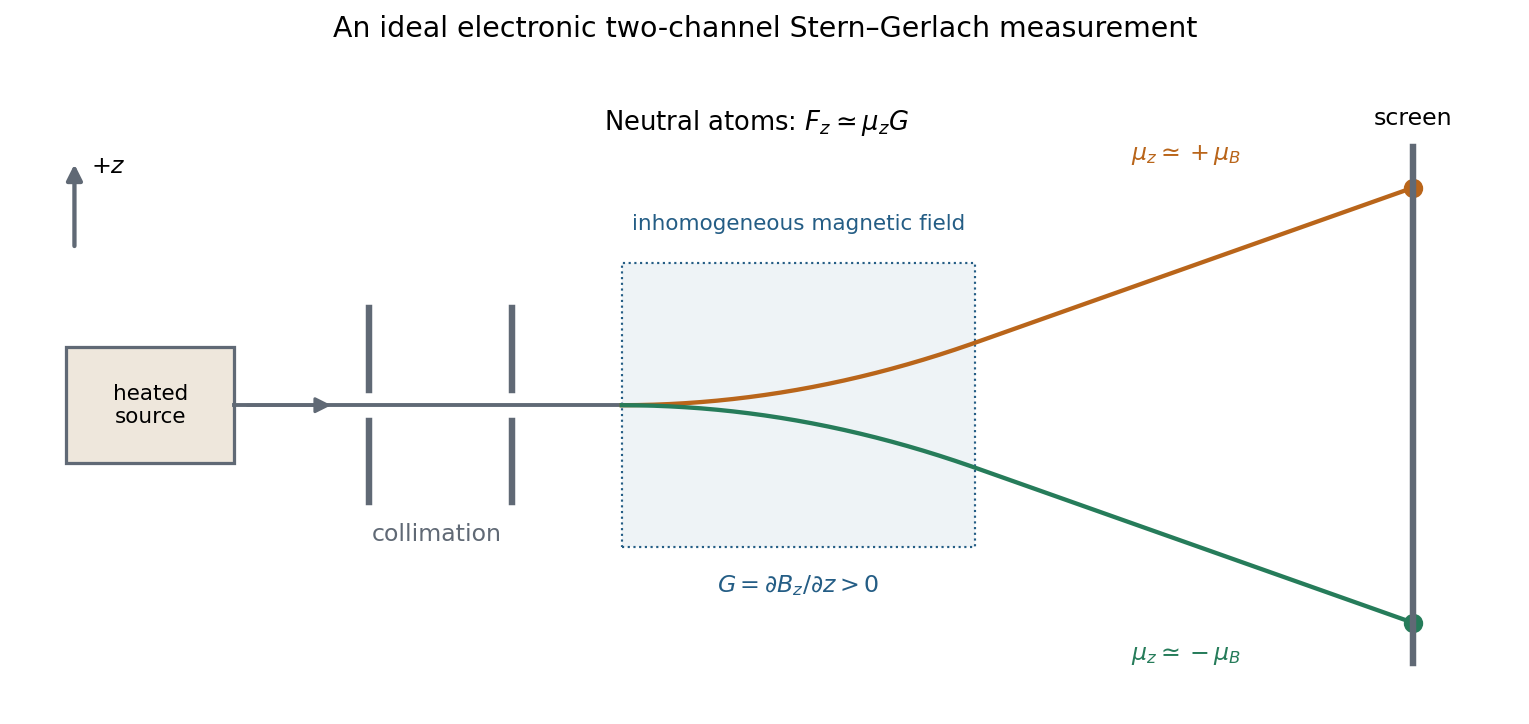

More generally a prepared spin state gives the two outcomes with probabilities . Selecting one channel prepares a state for further measurements. An ideal second analyser along the same axis then gives a definite result, whereas one along a perpendicular axis gives two equally likely outcomes for a spin-one-half eigenstate. This connects the apparatus directly to incompatible spin components and the Born rule. Angular momentum is quantized through its operator algebra; the Stern–Gerlach gradient turns that discrete internal information into spatially distinguishable outcomes.
The attractive Coulomb potential energy is , soUse precisely the radial normalization stated in the PDF: the radial probability measure is . The supplied function hasIts integral is one, since . In particular,This calculation uses the supplied convention, rather than multiplying a separately normalized standard radial function by an extra .
The addition of angular momentum bracket is . Substitution in the spin-orbit energy shift in a central potential therefore givesHere is the supplied Bohr radius. The negative sign means the member of the pair is shifted downward by this spin-orbit interaction; it is not the total hydrogen binding energy.
Within a fixed isolated electronic multiplet, the electronic field at the nucleus is a vector operator. Rotational symmetry and the Wigner-Eckart theorem imply that its projection into this multiplet is proportional to :Its detailed orbital, spin-dipolar and contact contributions are included in the reduced coefficient . Consequently the projected magnetic-dipole hyperfine interaction becomesin the same dimensionless angular-momentum convention as a. The proportionality is a statement about matrix elements within the chosen electronic manifold, not an identity for the electron field operator on the entire atomic Hilbert space.
Define . In zero external field the quantum states obtained by addition of angular momentum are labelled , where specifies the electron configuration and other fixed labels. The good quantum numbers include , with and . In a description using LS coupling the fixed electronic labels can also include . The energies depend on but not :This neglects coupling to other electronic manifolds, electric-quadrupole hyperfine interactions and the Zeeman effect from external fields. Those additions can shift the intervals or change which quantum numbers remain useful.
Single-particle nuclear magnetic moment Created 2026-10-18 Updated 2026-10-20
In the simplest nuclear shell model of an odd-mass number nucleus, paired nucleons contribute zero total angular momentum and magnetic dipole moment. The last unpaired nucleon supplies the nuclear spin and the stretched-state moment , where is the Landé g-factor and the nuclear magneton.
Using addition of angular momentum with givesFor , this reduces to . For , it givesThe free-nucleon orbital factors are for a proton and for a neutron. Residual nuclear interactions and configuration mixing can shift measured moments away from this ideal prediction. A single hole in an otherwise closed shell has the same stretched-state moment as a particle in that shell: removing the particle leaves total and moment .