Adiabatic compression decreases the volume of a sample without heat transfer across its boundary. For the fixed-composition ideal gas and endpoint assumptions in adiabatic process, compression work increases internal energy; positive heat capacity at constant volume then means a higher final temperature. The effect comes from supplied work, even though no heat enters. The amount of temperature increase depends on the work actually delivered to the gas, not on the adiabatic process condition alone.
The reversible ideal-gas adiabat supplies a particularly useful quantitative benchmark. Assume a fixed amount of substance , a quasistatic process, negligible friction, only pressure-volume work, and constant heat capacity ratio . Here and are the whole sample's heat capacity at constant pressure and heat capacity at constant volume. With the molar gas constant, Mayer's relation gives . The proof outline is from the first law of thermodynamics, followed by from the ideal gas law and integration. The result isThese finite power laws belong to this reversible, constant- ideal gas model. If heat capacity ratio varies, use the integral relation in heat capacity ratio; if the compression is irreversible, use the actual work balance, as in irreversible adiabatic piston compression. A short stroke by itself justifies neither power law. [ref]
https://openstax.org/books/university-physics-volume-2/pages/3-6-adiabatic-processes-for-an-ideal-gas. Ling, Moebs and Sanny, University Physics Volume 2, §3.6: quasi-static ideal-gas adiabat
Writing for the compression ratio, the reversible model predictsAll temperatures in these ratios are absolute. The larger pressure rise than in an isothermal compression, where , explains the greater local stiffness described by isentropic compressibility.
For an original stipulated example, set , and . Then and . The input work and internal energy increase are both , while . No initial temperature or apparatus performance is implied by the chosen energy scale. Independent integration gives the signed outward workwhich is negative during compression and agrees with . This integral uses equilibrium gas pressure only because the path is reversible.
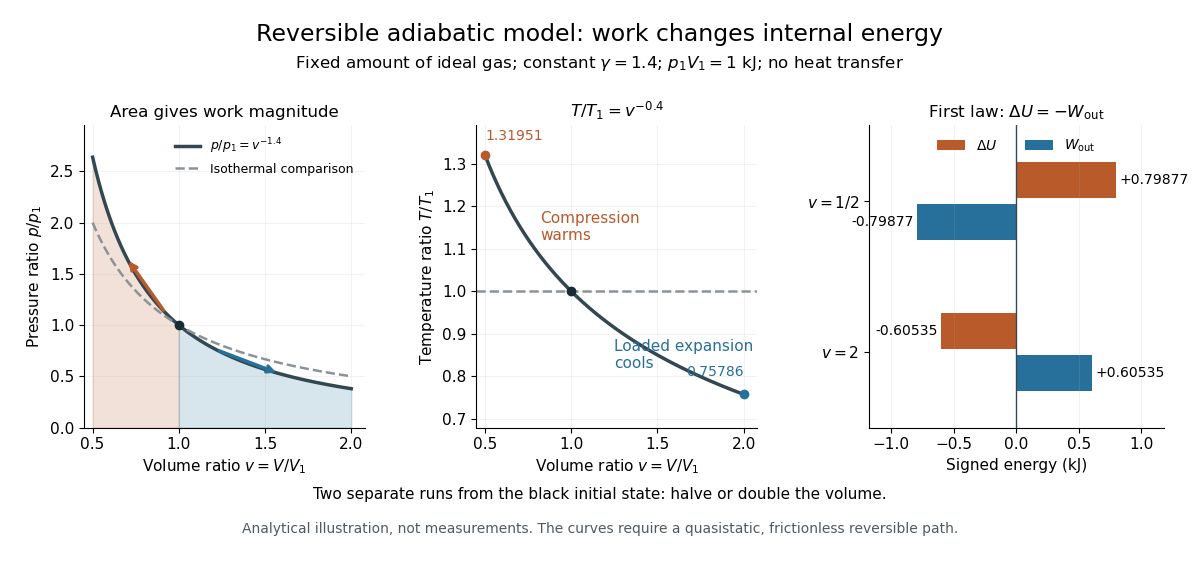

In the sensor experiment of adiabatic process, compare the pressure-volume integral with as an energy check only when internal pressure is sufficiently uniform and piston dynamics permit that boundary-work estimate. Account for friction separately before comparing it with hand input work. PASCO's manual supplies a compression procedure and an illustrative logarithmic-slope result , compared with the model value for a diatomic gas; that is its sample result, not new measurements here. [ref]
https://cdn.pasco.com/product_document/Adiabatic-Gas-Law-Apparatus-TD-8565-Manual.pdf. PASCO scientific, guide 012-05110D, pp. 5–6: work comparison and sample fitted exponent
Articles by others on the same topic
There are currently no matching articles.