Hexokinase provides a concrete connection between sugar chemistry and energy coupling: it transfers a terminal phosphate group from ATP to glucose, forming a phosphorylated sugar and adenosine diphosphate. The enzyme accelerates the transfer, while consuming ATP changes the net chemical reaction being carried out. The donated group reaches the substrate through the catalytic route.[ref]
Biology 2e by Mary Ann Clark and others. §7.2, First Half of Glycolysis, step 1: hexokinase and ATP-dependent glucose phosphorylation
For a symbolic teaching model, write for an unphosphorylated sugar, for its phosphorylated form, and for inorganic phosphate. These are labels for chemical states, not complete elemental formulas. Using one consistent reference convention at fixed pH and temperature, stipulate the following molar changes in Gibbs free energy:All three numbers are chosen illustrative values, not measured properties of glucose or a particular enzyme. The prime marks a biochemical reference convention with pH held fixed; explicit proton and metal-binding bookkeeping is suppressed consistently. The first two lines are a thermodynamic decomposition: cancelling water and inorganic phosphate gives the net transfer. They do not assert that the reaction mechanism first releases free inorganic phosphate and then recaptures it.
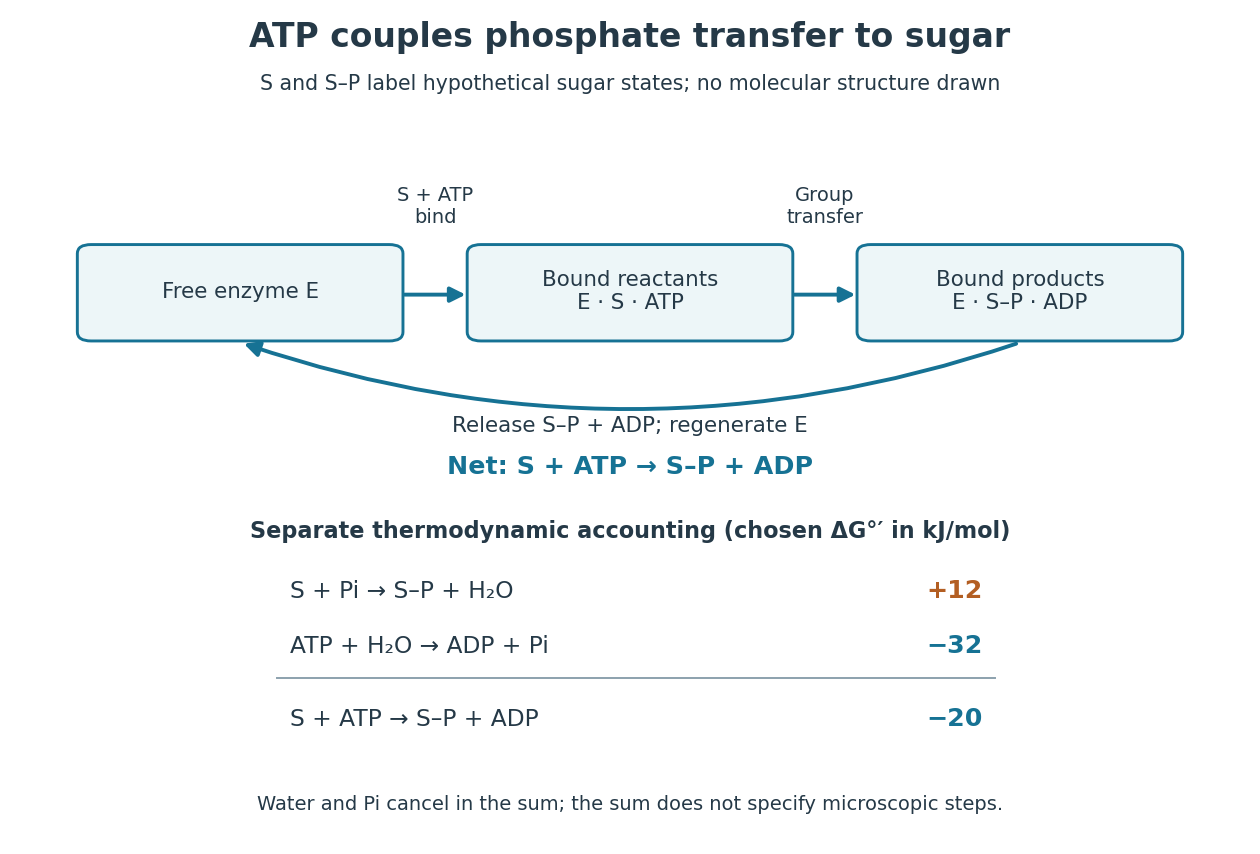

Because Gibbs free energy is a state function, consistently defined reaction changes add. A working reaction mechanism must also connect the desired conversion to ATP consumption; independently allowing ATP hydrolysis beside the sugar does not establish energy coupling. The general distinction is developed under energy coupling. ATP-dependent phosphorylation of a membrane protein can likewise connect a chemical change to active transport.[ref]
Biology 2e by Mary Ann Clark and others. §6.4, Energy Coupling, Figure 6.14: transfer to the sodium-potassium pump and its conformational cycle
Actual Gibbs free energy changes depend on thermodynamic activities. Even a favourable reference sum can be overcome by accumulation of reaction products or depletion of ATP; it supplies no prediction of the reaction rate. A living biological cell also regenerates ATP. Sustained operation therefore requires a connected metabolism, not an inexhaustible stock of a special molecule.
Articles by others on the same topic
There are currently no matching articles.