Energy coupling links an endergonic reaction to an exergonic reaction through a reaction mechanism, so that the combined transformation has a favourable change in Gibbs free energy. ATP hydrolysis is a common driving chemical reaction. A shared reaction intermediate, produced in one step and consumed in another, can physically connect the transformations; merely placing two independent chemical reactions in the same chemical solution does not establish energy coupling. See Alberts et al., Molecular Biology of the Cell: coupled reactions and activated intermediates.
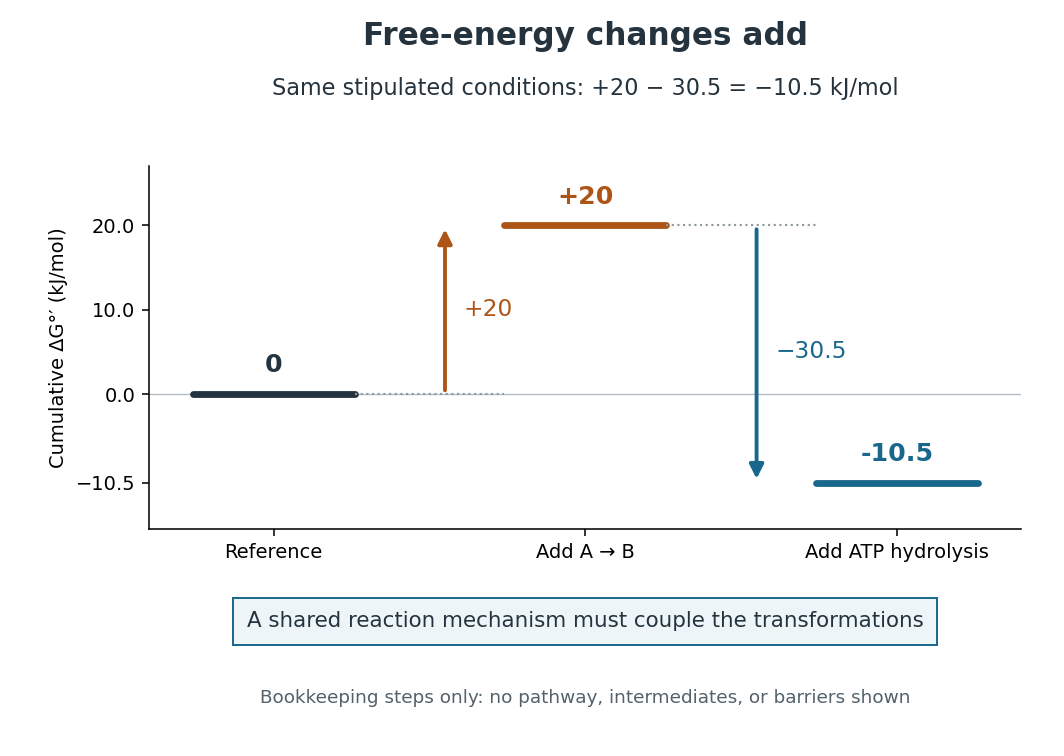
Energy coupling: under the same stipulated conditions
. Original diagram of cumulative changes in Gibbs free energy as two contributions are added. The levels are bookkeeping steps, not a reaction mechanism, actual reaction intermediates, elapsed time, or activation energy barriers. A reaction mechanism must enforce the joint transformation for the net favourable value to drive the desired conversion. Details.
For a computed example, stipulate an endergonic reaction with under precisely the same biochemical standard state conditions as the quoted ATP hydrolysis value. Assume a reaction mechanism couples one ATP hydrolysis to each A-to-B conversion. The formal sum isThe sum gives an exergonic reaction. The is a chosen teaching value, not a measured property of an identified substance. Outside these reference conditions, add the actual and , each evaluated using consistent thermodynamic activities; mixing a standard value for one chemical reaction with an unrelated cellular value for the other gives no justified prediction.
Why do the changes in Gibbs free energy add? Gibbs free energy is a state function. Adding consistent reaction changes cancels any shared reaction intermediate and leaves the difference between the combined reactants and combined reaction products. This explains the thermodynamic accounting; it does not construct the reaction mechanism. In many ATP-dependent routes, phosphorylation transfers a phosphate group to a substrate or an enzyme, and subsequent transformation consumes that modified material. The shared material is what connects the steps. Other reaction mechanisms use ATP differently. See Alberts et al., Molecular Biology of the Cell: ATP-driven biosynthesis.
The useful achievement is that a common regenerated nucleotide can connect many different processes in metabolism. The net negative change in Gibbs free energy permits the coupled conversion, but supplies no reaction rate: enzymes can lower activation energy barriers without changing the endpoint difference. Energy coupling changes which overall chemical reaction is being considered; catalysis accelerates an available route. See OpenStax Biology 2e, 6.2: free-energy changes and reaction barriers.
A historical landmark is Fritz Lipmann's [ref]
https://doi.org/10.1002/9780470122464.ch4. 1941 essay, Metabolic Generation and Utilization of Phosphate Bond Energy
. Its sections on the phosphate cycle, generation and utilization of phosphate-bond energy, and group transfer organized these processes around a reusable chemical carrier. The historical terminology should be read with the modern distinction between net hydrolysis and the cost of breaking a chemical bond. Articles by others on the same topic
There are currently no matching articles.