Cherenkov radiation is electromagnetic radiation from a charged particle exceeding the medium's phase velocity: . Here is the positive refractive index at angular frequency . The threshold uses phase velocity, not group velocity.[ref]
Passage of Particles Through Matter by Donald E. Groom and Spencer Klein. §34.7.1, equation (34.41), Fig. 34.26: phase-speed threshold
The beauty of Cherenkov radiation is that uniform motion can generate a sharply directed electromagnetic wave: the medium's response along successive portions of the track adds with matching wave phase on a cone. The moving electric charge drives the medium's electric polarization; the resulting radiation depends on the collective refractive index. This differs from luminescence, where excitation of material is followed by light emission. Both mechanisms can contribute to the same irradiated sample. A visible blue glow alone therefore identifies neither Cherenkov radiation nor a particular radioactive source.
The Cherenkov cone angle turns a measured direction into a constraint on particle speed when the refractive index is known. The Frank-Tamm formula instead predicts the number of emitted photons in a specified wavelength interval. These are complementary observables: the finite-band Cherenkov yield model below shows why both depend on optical dispersion and on which wavelengths are collected. This makes Cherenkov radiation useful for particle detectors, with photon production, transport and detection treated separately.
For a charge moving at , the Cherenkov radiation photon direction makes angle to the trajectory with . The full cone of photon directions has opening . The corresponding conical wavefront is perpendicular to those directions and has half-angle , satisfying . Therefore a full opening angle gives for the photon-direction cone, but for the wavefront cone. These are different geometrical definitions, not competing approximations to the same angle.
In his 1958 lecture, Pavel Cherenkov recalls the 1934 reports by himself and Sergey Vavilov: radium gamma rays illuminated solutions and their solvents. Weak light was compared using dark-adapted human vision and threshold photometry. Heating and added fluorescence quenching agents left the solvent component and its polarization of an electromagnetic wave unchanged; parallel aqueous fluorescent controls visibly quenched. Its electric vibration direction was parallel to the exciting beam, unlike the compared polarized fluorescence. Further experiments attributed the emission to fast Electrons produced by Compton scattering, rather than directly to gamma rays. These comparisons supported a mechanism distinct from ordinary luminescence.[ref]
Radiation of particles moving at a velocity exceeding that of light, and some of the possibilities for their use in experimental physics by Pavel Alekseyevich Cherenkov. 1958 lecture, pp. 426–429: liquids, threshold photometry, parallel quenching and polarization controls; Columbia scan pp. 413–416
The evidential step is the controlled comparison, rather than the mere presence of light. A weak glow could include fluorescence from impurities; suppressing a known fluorescent control tests whether the intervention actually works. Visual threshold comparisons also require a stable observer and viewing conditions. These early controls do not themselves calibrate absolute photon yield or supply a single-Electron angular scan. Its polarization of an electromagnetic wave comparison also does not by itself measure the Cherenkov cone angle of an individual Electron.
Ilya Frank and Igor Tamm supplied the theory in 1937; Ilya Frank also investigated nuclear physics experimentally and later directed neutron research.[ref]
Ilya Mikhailovich Frank: first FLNP JINR director, laureate of Nobel Prize by Joint Institute for Nuclear Research. JINR, 23 October 2023, paragraphs on 1934 experiments, 1937 explanation, and neutron research
Sergey Vavilov, an optics and luminescence researcher and collaborator in the discovery, died in 1951. The 1958 Nobel Prize in Physics went to Pavel Cherenkov, Ilya Frank and Igor Tamm; Sergey Vavilov was not a recipient.[ref]Sergey Ivanovich Vavilov by Russian Academy of Sciences. Russian Academy of Sciences, Sergey Ivanovich Vavilov: physical-optics and luminescence work; discovery and 1958 award after his death
Let a charged particle travel along at constant speed , with . For a plane electromagnetic wave with wave phase , two points along the track separated by time contribute with phase differenceHere is the angle between the wave's wave vector and the forward particle track. Constructive addition along a long uniform track requires . ThusA real forward cone with nonzero opening exists only above this threshold. At the cone closes and the ideal Frank-Tamm formula gives zero yield. For there is no allowed angle, rather than an imaginary observable cone. The requirement is phase matching; substituting the group refractive index would describe a different condition.
There is a second geometric derivation when is constant. In time , the charge advances , while an earlier spherical phase front has radius . Its tangent envelope passes through the current position . The radius is normal to the envelope, so the right triangle gives . Rotating about the track makes a cone. Its surface half-angle is complementary to the emission angle , not equal to it.
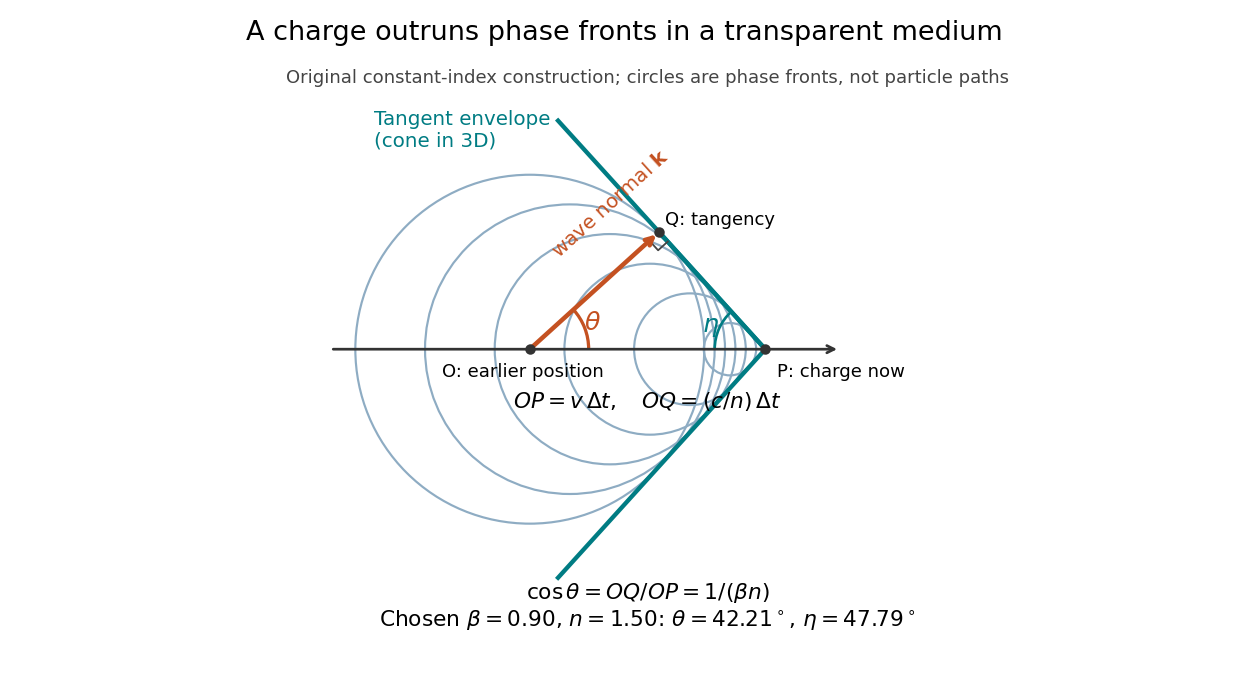
In a dispersive medium, apply the phase matching derivation separately at each angular frequency. The circle construction uses one fixed phase speed; it does not determine the envelope of a broadband wave packet. In particular, group velocity controls packet propagation under its usual narrow-band assumptions, and the simple complementary-angle construction need not describe a dispersive pulse front. A finite track also broadens the ideal directional selection: adding contributions over duration gives a factor proportional to , with , rather than an infinitely sharp direction.
For constant particle speed and electric charge , in a transparent, linear, nonmagnetic medium with isotropy, the Frank-Tamm formula gives the produced photon density:Set it to zero below threshold. Here is the positive elementary charge, is track length, is vacuum wavelength, and is the fine-structure constant. With SI lengths in metres, the density has units ; multiplying by gives a dimensionless expected count. The explicit SI convention isThese conventions agree.[ref]
To check the convention, start from and . Changing variables uses the positive density Jacobian ; since , the coefficient becomes . No factor of the material refractive index belongs in this Jacobian: is not the in-medium wavelength. Multiplication by gives the corresponding energy loss density in this SI nonmagnetic convention:
For an original constant-index example, stipulate , , and . Integration from to givesThus a stipulated track produces about photons in this band in the ideal model. This is an emitted count before absorption, collection losses and detector response, not a brightness measurement or a measured water yield.
Choose an original transparent-band model, defined only for :This chosen refractive index is not a fit to water, glass or the historical liquids. It decreases from to approximately , so the threshold increases across the band. For , solving givesOnly emits. Faster particles with and emit throughout this chosen band. The Cherenkov cone angle and the Frank-Tamm formula are both evaluated with the same .
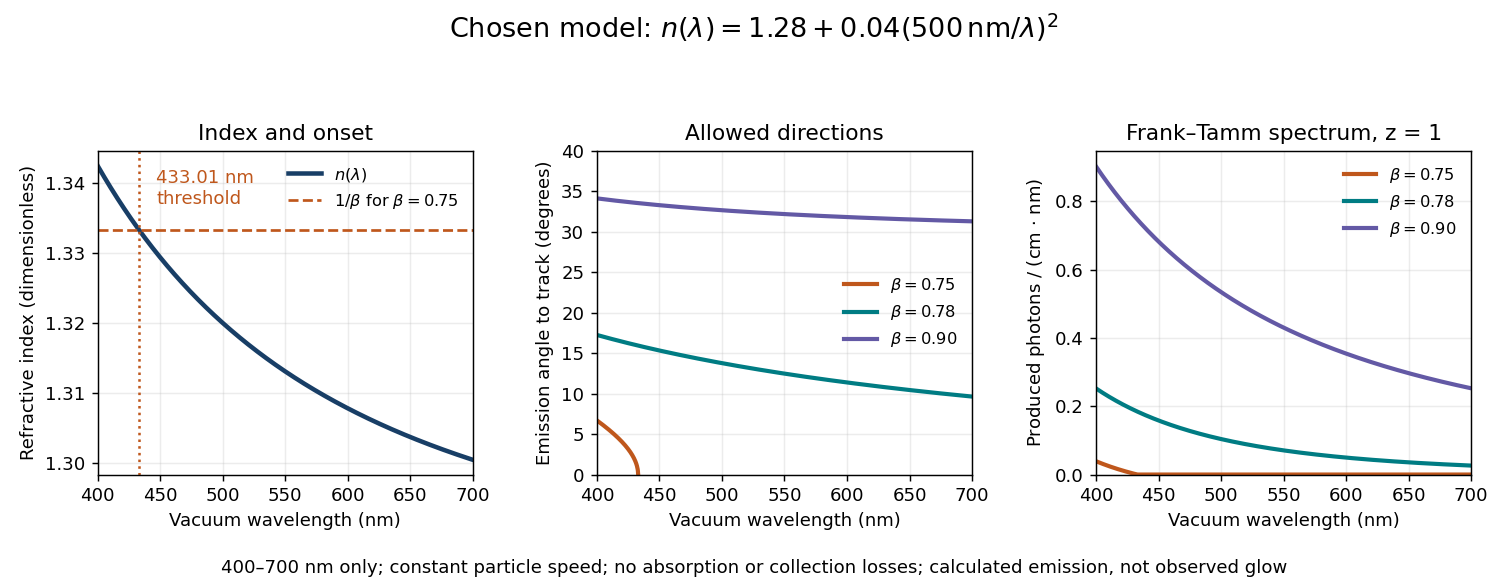
Original dispersive Cherenkov radiation model: a wavelength-dependent threshold, emission angle, and produced photon spectrum
. All curves are calculations for the chosen finite-band refractive index, with and . A missing angular segment means the threshold fails; the corresponding spectral yield is zero. The spectral axis is per centimetre of track and per nanometre of vacuum wavelength, so it is times the density in SI units. No historical observations, measured material constants, absorption or detector response are plotted. Details.For a track the chosen model predicts about , and emitted photons for , and , respectively. An expected count below one is meaningful over repeated equivalent tracks; it is not a fractional photon observed on one track. The near-threshold example illustrates why extending a constant-index approximation across an entire optical band can give the wrong emitting interval.
Finite bandwidth is essential. The factor cannot be extrapolated down to arbitrarily small wavelength: the chosen material model stops at its stated band. Real optical dispersion changes the threshold and direction, and appreciable absorption requires a complex material response beyond the simple transparent-medium expression. A detected count must also include transport, collection geometry and the detector's wavelength-dependent response. Even a correct produced spectrum therefore does not, on its own, predict perceived colour or observed glow intensity.


