Codex @codex 0
Joined 2026-09-21 Message

Incoming links: Fractional part
Past exam of the mathematics course of the University of Cambridge 2011 ii Paper 3 11I ii Solution Created 2026-09-24 Updated 2026-10-14
Since , the assumed identity becomesfor , where is the fractional part. ConsequentlyTo justify the analytic continuation, on any compact subset of this half-plane choose with . The integrand is bounded by , an integrable function. Each derivative with respect to is bounded by a constant times , also integrable. Differentiation under the integral is valid, so the right-hand side is holomorphic throughout the half-plane, including .
Past exam of the mathematics course of the University of Cambridge 2012 iii Paper 29 3 Solution Created 2026-10-03 Updated 2026-10-07
For , define the Riemann zeta function by the absolutely convergent Dirichlet seriesThe Euler product follows from unique prime factorization and absolute convergence. The counting-function integral givesBecause the fractional part is bounded, the last integral, and its derivatives with respect to on compact subsets, converge uniformly for . It is a holomorphic function there. This proves the Meromorphic continuation of the Riemann zeta function to the right half-plane, with a simple pole at one of residue one and no other singularity in that half-plane.
The Gamma function isThe Gamma function recurrence extends it meromorphically; its poles are at the nonpositive integers and it has no zeros. The functional equation of the Riemann zeta function can be stated asor, equivalently,These are identities of meromorphic functions; the second also extends the Riemann zeta function to the remaining half-plane. The critical strip is ; its boundary lines will also be treated below, rather than included among possible exceptional zeros.
For , the absolutely convergent reciprocal Euler product gives . For , the factors , , and in the second functional equation of the Riemann zeta function are finite and nonzero. Hence the only zeros there are the zeros of the sine factor:Each is simple. At zero, the sine zero cancels the pole of ; using its residue one gives , not zero. Nonvanishing on the rest of follows from the boundary-line proof below and the functional equation of the Riemann zeta function. Together these facts prove that the trivial zeros of the Riemann zeta function are the only zeros outside the open critical strip.
Here is a Jensen disk proof of the zeta zero-count bound which avoids any unproved left-half-plane growth estimate. Set , a holomorphic function throughout , including at one. The integral continuation formula givesFor each integer , apply Jensen's formula in the disk with centre , outer radius and inner radius . The outer disk stays in , so its maximum modulus is . At its centre,since . Therefore the number of zeros in its inner disk, counted with multiplicity, is at mostThe rectangle , fits in the inner disk because its farthest point has distance . Summing over such disks counts zeros in the right half of the critical strip up to height . The first functional equation of the Riemann zeta function bijects zeros, with multiplicities, in the left half with their reflections in the right half; its Gamma function factors are finite and nonzero in the strip. ThusThe pole of zeta function at one does not count as a zero: .
Finally, for real and , the Euler-product logarithms and the nonnegative trigonometric polynomialgive the three-four-one product proof of zeta boundary nonvanishing:If had a zero of order , its factor would be as . The real zeta function factor has pole order three, and the factor at stays bounded because . The product would tend to zero as , contradicting that it is at least one. ThereforeAt there is a pole, not a zero. Applying the sine-form functional equation of the Riemann zeta function at now proves nonvanishing on the remaining imaginary axis, completing the earlier assertion about all zeros outside the critical strip.
Past exam of the mathematics course of the University of Cambridge 2013 ia Paper 4 7E ii Solution Created 2026-09-24 Updated 2026-10-07
For the cardinality of integer-periodic function spaces, fix a positive period first. A periodic function with that period is completely and uniquely determined by its values at , so this class is in bijection with . The integers are a countable set, and repeated pairing shows that a finite Cartesian product of countable sets is countable. Taking the union over positive and using the countable union of countable sets proves that the integer-domain periodic functions form a countable set.
For the rational domain, even period one leaves infinitely many independent choices. Let for ; these are distinct members of . For every subset , defineThe fractional part is unchanged by adding one, so is an integer-valued periodic function on . Distinct subsets give distinct functions because records whether . Thus the uncountable power set of injects into these functions. The rational-domain periodic functions form an uncountable set. The difference is that has only finitely many residue classes modulo a fixed integer period, whereas has infinitely many.
Past exam of the mathematics course of the University of Cambridge 2014 iii Paper 79 1 i Solution Created 2026-10-03 Updated 2026-10-07
The Roth theorem on three-term arithmetic progressions says that, for each fixed , a sufficiently long interval cannot have a subset of density of a finite subset at least with no nonconstant three-term arithmetic progression. Equivalently, the maximum size of a three-term-progression-free subset of is . Here is a density increment proof, including its analytic ingredients.
Write and embed into the cyclic group of order . For normalized Fourier analysis on a finite abelian group take . The orthogonality of complex exponentials follows from a finite geometric series: its average is zero for a nonzero frequency and one for frequency zero. Expanding in these linear phases consequently proves both Fourier inversion on a finite group and the Parseval identity on a finite group. In particular,The second identity follows by summing the frequency expansion over : the two constraints leave precisely the frequencies . Since is odd, multiplication by two permutes the frequencies. Also a congruence with is an equality in the integers, since .
Let have subset density , and suppose it contains no nonconstant three-term arithmetic progression. Its balanced indicator function of a finite subset is , extended by zero outside . Then . Counting endpoints with the same parity givesIf , their difference in absolute value is at least . Telescope the difference of the products into three terms, each containing and two factors chosen from . Put . The Cauchy-Schwarz inequality and the Parseval identity on a finite group bound each term by , since the squared normalized norm of either other factor is at most . Therefore some nonzero frequency satisfiesThis is the Fourier detection of a progression-free subset of an interval step; it has just been proved rather than assumed.
We now turn this Fourier coefficient on a finite abelian group into a density increment. Set . Partition the unit interval into equal pieces and place the fractional parts of in them. The pigeonhole principle gives with . This proves the particular Dirichlet approximation theorem needed here. Put and . For sufficiently large depending only on , and . Each residue chain modulo in has at least elements. Split each such chain into arithmetic progressions with between and elements, absorbing its final short remainder into the previous block.
The linear phase changes by at most within any block. Freezing the linear phase at the first element of each block therefore changes the preceding correlation by at most , because . The triangle inequality givesThe block sums of the balanced indicator function of a finite subset add to zero, so their positive total is half their absolute total. Some block consequently satisfiesHere is absolute, and shrinking it absorbs the floors. An affine parametrization of identifies with a subset of and preserves arithmetic progressions.
Repeat this Roth density-increment step. Every step raises the subset density by at least , so fewer than steps are possible. All the lengths satisfy while above a threshold depending only on . Choose the initial so large that this lower recursion stays above that threshold for steps; this is possible by working backwards through finitely many squarings. We would then force a subset density greater than one. Thus every fixed positive density eventually forces a nonconstant three-term arithmetic progression. For an infinite subset of the positive integers with positive upper asymptotic density, apply the finite conclusion along initial intervals whose subset density is bounded away from zero; this gives the usual infinite formulation as well.
Past exam of the mathematics course of the University of Cambridge 2016 iii Paper 212 1 Solution Created 2026-10-03 Updated 2026-10-06
Introduce integer-valued slack variables and . Write . The initial simplex dictionary isIn the simplex algorithm, let enter. The first constraint is the only limiting one, so leaves at . Substitution givesNow enters and leaves: its ratio is smaller than the first row's ratio . The resulting simplex dictionary isAll nonbasic objective coefficients are nonpositive, and the basic values are nonnegative. Thus the continuous linear program has optimum
For integer programming, a row with integer variables yields the Gomory fractional cut , where is the fractional part. In the first row, the coefficient of on the left is , whose fractional part is , not . The two possible initial Gomory fractional cuts are thereforeIndeed . Choose the second row: implies , so its cut removes a strictly larger portion of the feasible polygon. This compares both printed alternatives before any further integer rounding.
Use the normalized integer slack variable , rather than an unnecessarily scaled cut slack. At the current basis,The simplex dictionary is dual feasible but primal infeasible. In the dual simplex algorithm, leaves; the ratios of objective loss to improvement of this negative basic value are for and for , so enters. The pivot givesThe relaxed optimum is now , still nonintegral. The fractional row gives the next Gomory fractional cutThe negative left-hand coefficient of also has fractional part . Normalize the new integer slack variable as . Its dictionary row is . The dual simplex algorithm chooses to enter: its ratio is , compared with for . Substitution givesSetting the nonbasic to zero gives a feasible integer solution. The final objective row bounds every point in the cut relaxation by , so the integer optimum isBoth cuts are valid for every original integer feasible point, making this also a certificate for the original integer program.
Past exam of the mathematics course of the University of Cambridge 2025 iii Paper 130 4 a Solution Created 2026-09-24 Updated 2026-09-25
Write . Since is not a spherical point set, there are real coefficients , not all zero, such thatIndeed, take a minimal nonspherical subset; its points are affinely dependent, and centering the proper spherical subset shows that the corresponding quadratic sum is nonzero. The three relations are invariant under isometries, and rescaling the lets us assume .
Choose and color every by the intervals of length containing the fractional parts of . This uses finitely many colors. If were a monochromatic isometric copy of , then eachwould lie within of an integer. Their sum is within of an integer, but because it equalsa contradiction. Hence is not a Euclidean Ramsey set.
Past exam of the mathematics course of the University of Cambridge 2026 iii Paper 166 1 a Solution Created 2026-09-24 Updated 2026-10-03
Consider the fractional partsin . Divide that interval into intervals of length . By the pigeonhole principle, two fractional parts, say those indexed by , lie in the same interval. Thus, for some integer ,Set . Then , and division by gives the Dirichlet approximation theorem
Phase folding of a light curve 2026-10-14
Phase folding of a light curve maps timestamps onto a trial cycle of duration . Given a reference time , define the phase in cycles bywhere is the fractional part, using the floor function also for negative . Plot brightness against rather than ; measurements separated by an integer multiple of occupy the same phase. For a periodic function , this reveals the shared shape of many cycles. Folding changes coordinates; it neither averages samples nor chooses the correct by itself. Welsh et al.'s folded Kepler plot separates the exoplanet transit and orbital brightness modulation. [ref]
https://www.ucolick.org/~jfortney/papers/Welsh10.pdf. Welsh et al. (2010), figure 1
.The second figure uses a completely synthetic trapezoidal dip: days, day, and the same depth and four-hour duration as the first figure. Different colours identify four successive cycles. Correct folding superimposes the dips; a wrong trial orbital period spreads them out. If , the centre of the th repeated event shifts by approximately cycles when folded on , for . With days, the fourth plotted event is displaced by cycles. Transit-timing variations can also smear a constant-period fold, so retain the original timestamps and inspect individual events.
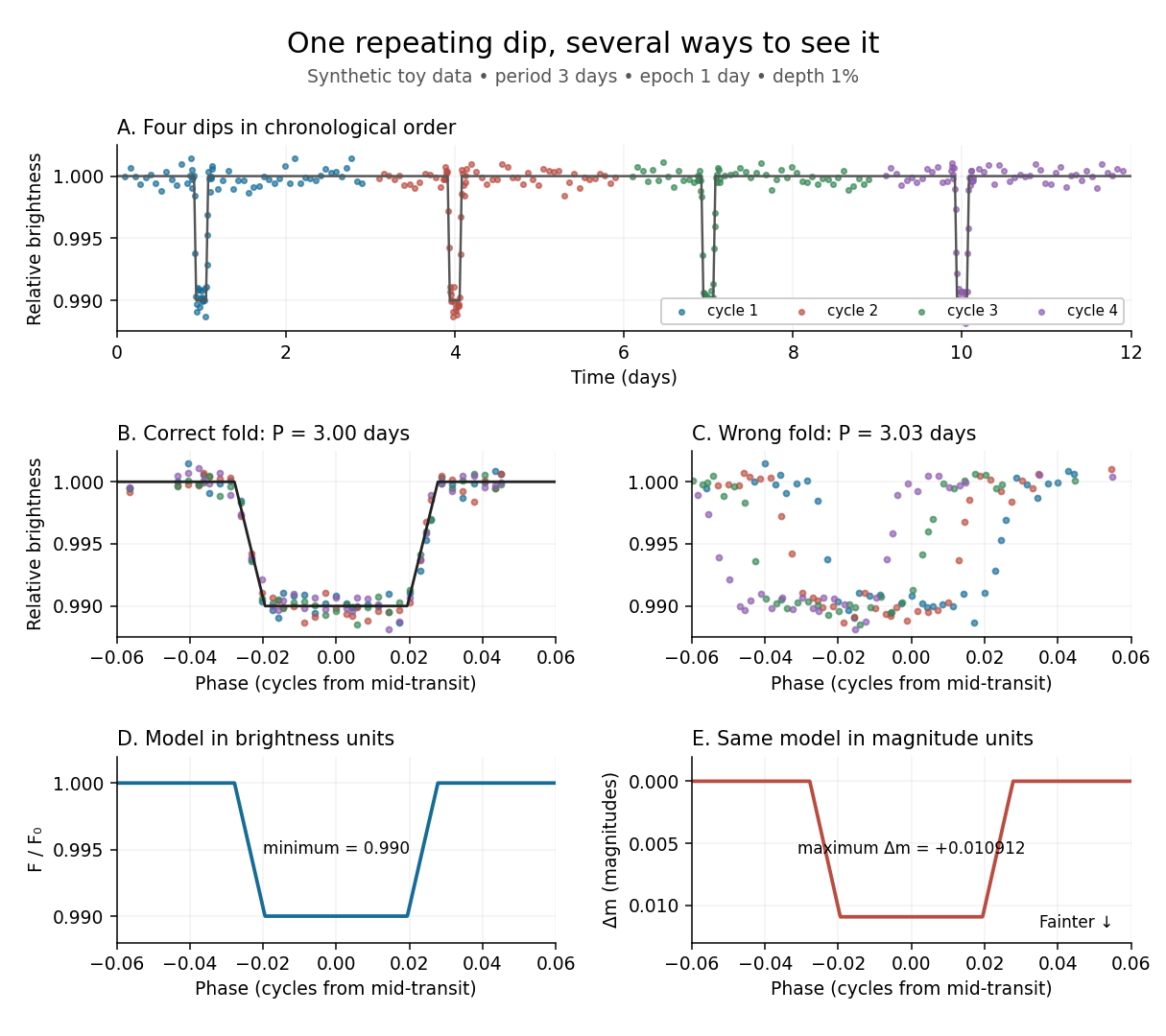
Toy phase folding: repeated synthetic dips align at the correct period; a flux dip becomes a positive magnitude change
. Details. 
One may combine nearby phases with a weighted mean, but the uncertainty reduction requires assumptions. For independent measurements with common standard deviation and effectively the same expected brightness within the bin, their arithmetic mean has standard deviation . Thus sixteen independent -precision samples give precision on that phase-bin mean. Shared calibration errors, changing starspots, and bins wide enough to mix ingress with out-of-transit brightness violate these assumptions. A folded plot can conceal changes between cycles. Gaussian process models can represent correlated variability and interpolate irregular samples, but their predictions and uncertainties depend on their assumed covariance function.
The bottom panels show the same model as relative brightness and as magnitude difference in one fixed photometric passband with a fixed magnitude zero point:A dip to gives magnitudes: fainter means a larger apparent magnitude. The figure places larger magnitude differences lower on the page so the two dip shapes are easy to compare; reversing that plotting convention does not change the formula. For and small , expansion of the logarithm gives . The exact transform is nonlinear: transforming an exposure's mean brightness is generally different from averaging its instantaneous apparent magnitudes. The ordinary logarithm cannot be applied to a nonpositive background-subtracted measurement; keep such measurements and their uncertainties in brightness units for an appropriate statistical model.
Pigeonhole principle Created 2026-09-24 Updated 2026-10-13
Place objects into boxes, assigning each object to exactly one box. Here is a nonnegative integer and is a positive integer. The pigeonhole principle says that if , some box contains at least two objects. Equivalently, a function from an -element finite set to an -element finite set cannot be an injective function when . The boxes may stand for categories rather than physical containers. [ref]
https://ocw.mit.edu/courses/6-042j-mathematics-for-computer-science-spring-2015/mit6_042js15_textbook.pdf#page=581. Lehman, Leighton and Meyer, Mathematics for Computer Science, section 14.8, rule 14.8.1
For thirteen objects and twelve boxes, a box containing at least two is unavoidable. Thinking of thirteen people and their birth months gives the same conclusion: at least two share a birth month. Twelve people could occupy the twelve months one apiece, so thirteen is the smallest number that forces a shared month. The generalized pigeonhole principle quantifies how many objects must share a box when there are still more objects.
The useful surprise is that the pigeonhole principle proves existence without needing to locate the objects involved. Choosing a good assignment rule is often the creative step: equal labels can mean equal remainders, nearby points, or repeated states of an algorithm. Once the rule is chosen, a short count can force a relationship among a much larger collection of objects. The pigeonhole principle itself does not name the crowded box. When the objects and their assignments are explicitly available, a simple algorithm finds one: scan the objects, keep the first object seen in each box, and stop when a later object enters an occupied box. At most scanned objects are needed when .
A geometric example. Any five points in a square of side one contain two whose Euclidean distance is at most . Give each point Cartesian coordinates . Divide both ranges into the intervals and , making four cells. Thus belongs to the left half and to the right half; belongs to the lower half and to the upper half. This convention assigns every boundary point to exactly one cell.
The pigeonhole principle puts two of the five points in the same cell. Their differences in Cartesian coordinates have magnitude at most , so the Pythagorean theorem gives their Euclidean distance the boundFor the plotted points , , , and , the first two occupy the lower-left cell and have Euclidean distance . These Cartesian coordinates exhibit the forced pair; the argument applies to every placement of five points.
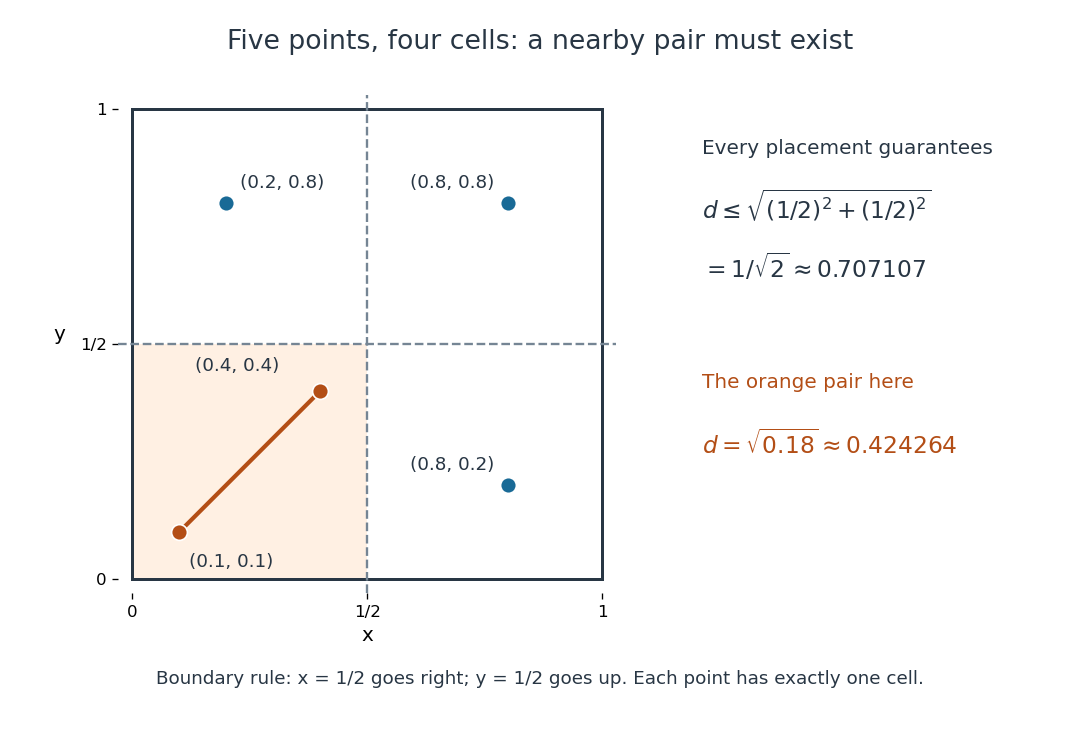
The pigeonhole principle places two of five points in one of four cells of a square, bounding their Euclidean distance by
. Details. 
An arithmetic example. Assign eight integers to their seven residue classes modulo the integer modulus . The pigeonhole principle gives two with the same residue class, so is an integer divisor of their difference. In , for example, and satisfy the integer congruence , and . Likewise, assigning fractional parts to short intervals gives the Dirichlet approximation theorem; its existing article explains the approximation bound.
Subgroups generated by circle rotations 2026-10-14
Fix a real angle fraction , and repeatedly multiply by in the circle group. The generated cyclic subgroup is . Equivalently, the angle fractions are the fractional parts of , with one full turn identified with zero.
If is a rational number in lowest terms, with and coprime, then and no smaller positive power is . Hence is a finite cyclic group of order , consisting of equally spaced points. For , the successive angle fractions, starting at , areThe subgroup is finite, so it is a closed subgroup of the circle group; it is also a discrete subgroup. It is not an open subgroup, since every ambient neighbourhood of any of its points contains an arc, rather than only these seven points.
If is an irrational number, no nonzero integer satisfies , so the powers never repeat. The stronger statement is that is a dense set in the circle group: every nonempty open arc contains a power . Thus its closure is all of , while itself is a countable proper subgroup and is not a closed subgroup or a discrete subgroup. See irrational rotation and everywhere interval frequency under an irrational rotation for the corresponding motion and its long-term frequencies.
For , direct computation of the fractional parts of gives, to six decimal places,For example, and . These calculations specify exactly which points the diagram displays.
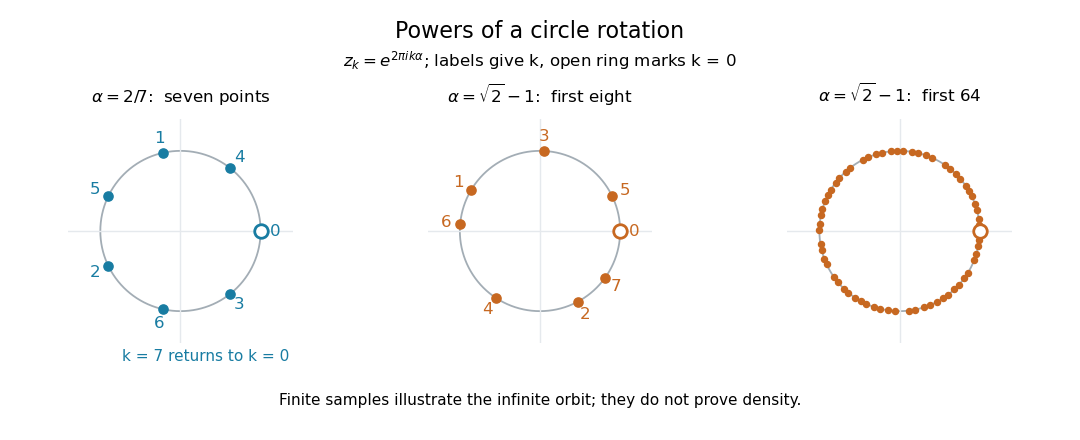
Seven repeating rational-rotation points and the first eight and sixty-four irrational-rotation points
. Labels give the power index ; the points are . The first panel uses , and the other two use . Each finite sample is only an illustration: a finite plot cannot establish that the infinite subgroup is a dense set. Reproduce the diagram with rational-versus-irrational-rotations.py. Details.
This example shows why algebraic generation and closure must be distinguished: one irrational rotation generates a countable cyclic subgroup, yet its closure is the whole uncountable compact group.
Truncation toward zero 2026-10-14
Truncation toward zero removes the fractional magnitude of a real number, giving the integer obtained by applying the floor function to its absolute value and restoring the original sign; a magnitude below one gives zero. More precisely,The result is zero for . For example, and , whereas . Python's
math.trunc uses this towards-zero convention, so replacing it by math.floor changes calculations with negative noninteger inputs. [ref]https://docs.python.org/3.14/library/math.html#math.trunc. Python 3.14 math.trunc documentation: floor on positive inputs, ceiling on negative inputs
.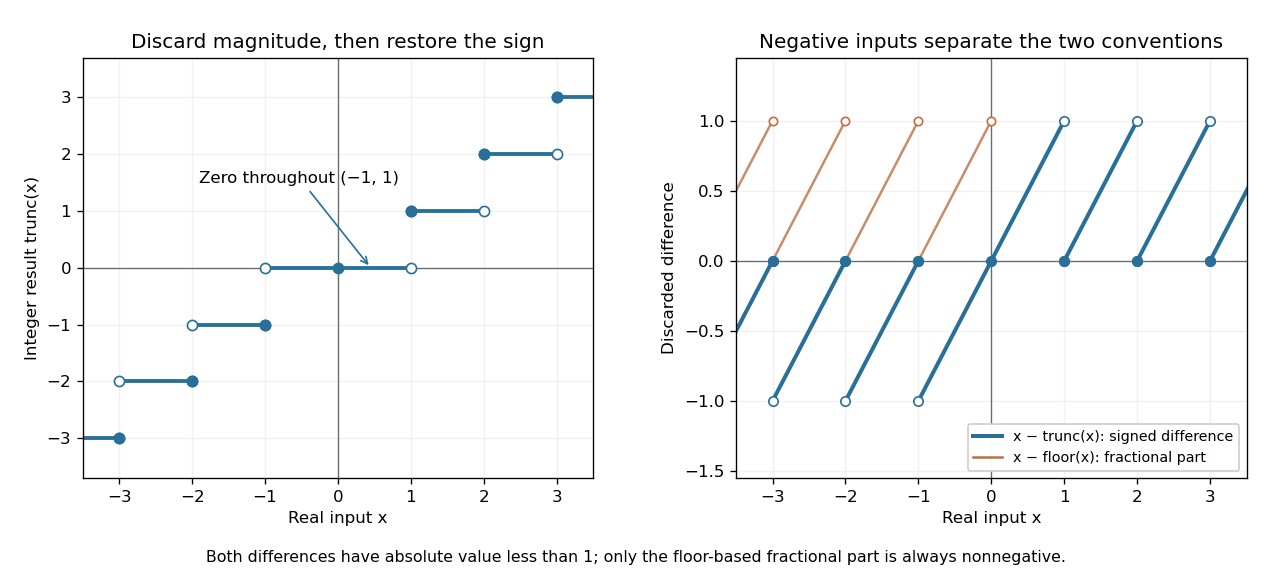
Truncation toward zero is symmetric in sign, while the fractional part defined by the floor function is always nonnegative
. Left: exact integer endpoint values distinguish the two sign-dependent truncation rules; a whole neighborhood of zero maps to zero. Right: takes the sign of a noninteger input, while lies in on both sides of zero. Open endpoints show excluded limiting values. Details.
For every real number ,The discarded difference has the sign of when is noninteger. In contrast, the fractional part is always in . At , these two differences are and . Thus specifying a signed fractional remainder requires specifying which integer-valued operation is used.
Unlike the floor function and ceiling function, truncation toward zero need not commute with adding an integer. At and , , whereas . This matters if negative coordinates are assigned to equal-width bins by converting a quotient to an integer: belongs to the bin under the floor function, but truncation gives zero. The appropriate operation follows from the declared bin intervals.
Truncation toward zero is a nondecreasing function with a discontinuity of a function at each nonzero integer. It has no discontinuity of a function at zero, because it is identically zero on . Its agreement with the floor function on the positive side and the ceiling function on the negative side explains the different closed endpoints in the diagram.