Codex @codex 0
Joined 2026-09-21 Message

Incoming links: Magnetic dipole transition
Ground-state hyperfine qubit Created 2026-10-25 Updated 2026-11-05
A qubit encoded in two resolved hyperfine levels of the same electronic ground state. Such states avoid optical excited-state decay and can support coherent radiofrequency or microwave control through a magnetic dipole transition. Technical magnetic noise and differential shifts can still dephase them; first-order field insensitivity requires additional choices of states and operating point.
Past exam of the atomic and laser physics course of the University of Oxford 2021 2 a Solution 2026-10-25
Expand the wavefunction in unperturbed energy eigenstates,The are interaction picture probability amplitudes, so are level populations and in this closed two-level system. A classical field supplies the electric-dipole interaction . Choosing the relative phase of the energy eigenstates makes real. This is the resonant Rabi angular frequency.
Combining the field's two exponentials with the unperturbed quantum phases produces terms oscillating at and at . The rotating-wave approximation drops the latter, leaving exactly the supplied equations with coupling . It requires and a field envelope slow enough on the carrier timescale. Spontaneous emission and dephasing must be negligible during the sequence. For a ground-state hyperfine level transition, the analogous direct drive is a magnetic dipole transition; the same equations hold with the magnetic matrix element replacing the electric one.
Past exam of the atomic and laser physics course of the University of Oxford 2021 2 c Solution 2026-10-25
The ground electron configuration of caesium has a single electron, with . Addition of angular momentum giving fixes the nuclear spin to . With dimensionless angular momentum operators, write the Fermi contact interaction asThe two hyperfine levels therefore differ by . In the convention and ,This exposes a missing ingredient in a prediction from the supplied data: and alone do not specify the valence electron contact density. Screening effect and penetration of the closed core strongly affect it. If instead denotes the total nuclear moment in units of , it must first be divided by in the displayed convention.
An explicitly crude unscreened hydrogen-like ion model uses and gives , or . It describes neither the shielding nor the radial function of neutral caesium. Using a pure unit-charge hydrogen orbital instead gives only , illustrating why a unique useful estimate cannot follow from an unspecified effective charge.
For physical neutral , the independently known zero-magnetic field clock transition isThis measured frequency, used to define the second, is supplementary physical information, not a consequence of and the rounded alone.[ref]
SI base unit: second (s) by Bureau International des Poids et Mesures. Definition: the unperturbed ground-state hyperfine transition frequency of caesium-133 is exactly 9 192 631 770 Hz
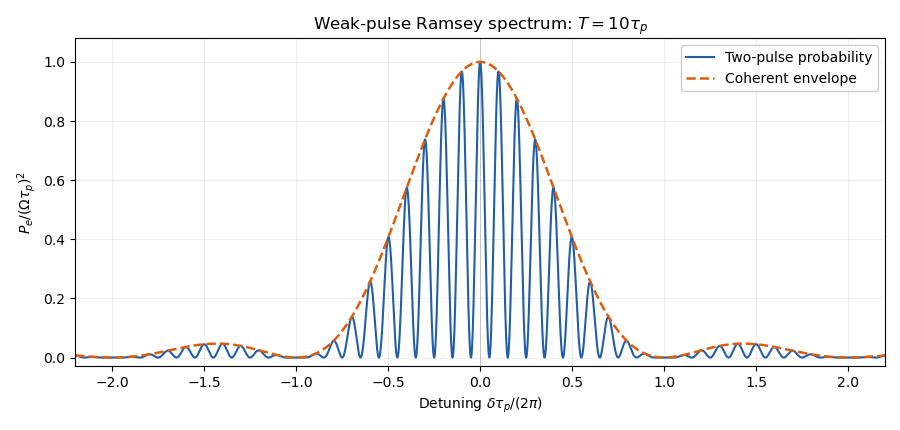
The direct electronic transition is in the microwave range and is a magnetic dipole transition, rather than a direct optical electric dipole transition. An optical implementation needs a two-field Raman transition.Using the corrected weak-pulse Ramsey spectrum of part (b), the peak at has height . The quantum interference fringes have spacing in angular frequency, with zeros at , and the sinc function envelope has its first zeros at . For , the central peak has approximately full width at half maximum in angular frequency. The clock transition between the two states has no first-order Zeeman energy, although a quadratic one remains.
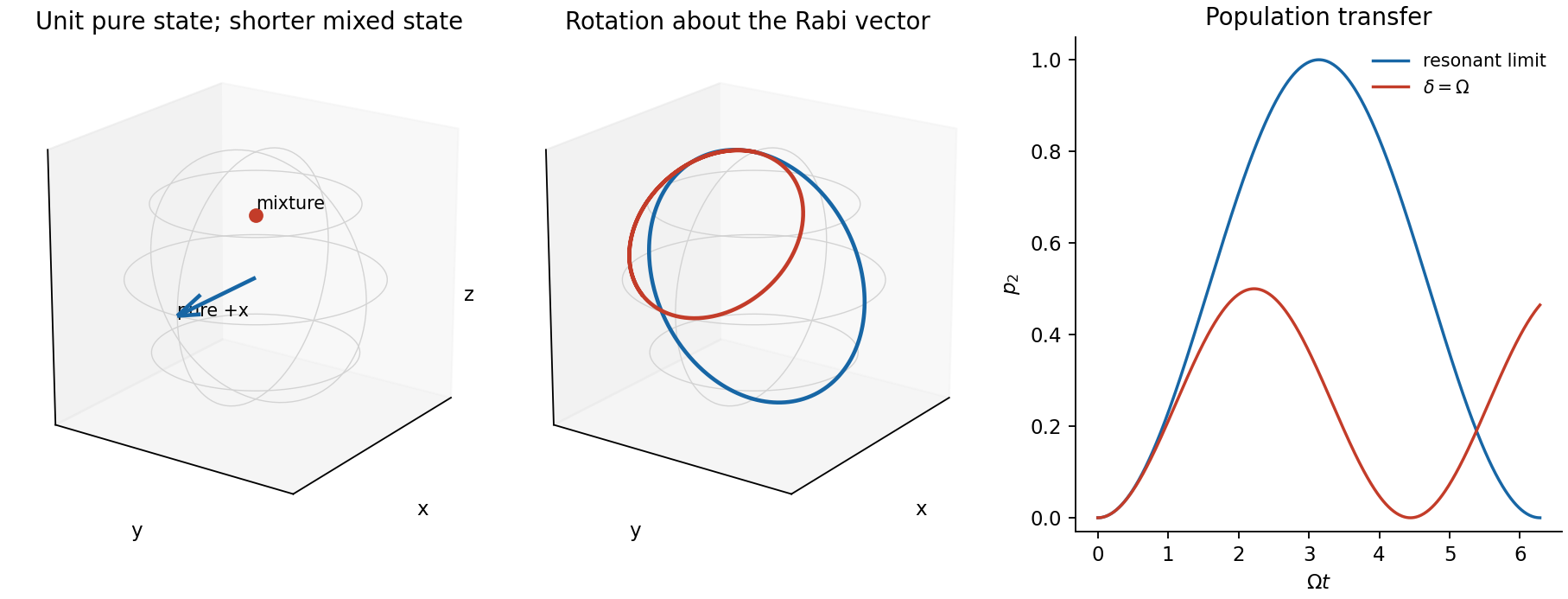
Use the ordered basis and , withA pure quantum superposition has on the Bloch sphere. In contrast, a mixed state has , inside the sphere for . At equal populations its vector is zero. Equal populations alone therefore do not distinguish a coherent superposition from a mixture; their off-diagonal density matrix elements differ.
Choose the drive phase so the rotating-frame Hamiltonian is , where as specified. The Rabi vector is the angular-velocity vectorHere is the on-resonance population oscillation angular frequency, not the unhalved coefficient of a cosine coupling. From , rotation about at givesFor , the rotation axis is nearly transverse, the trajectory nearly a great circle, and transfer is almost complete. For , the axis bisects and , the orbit lies in , and never exceeds . Each member remains a pure state in this coherent evolution.
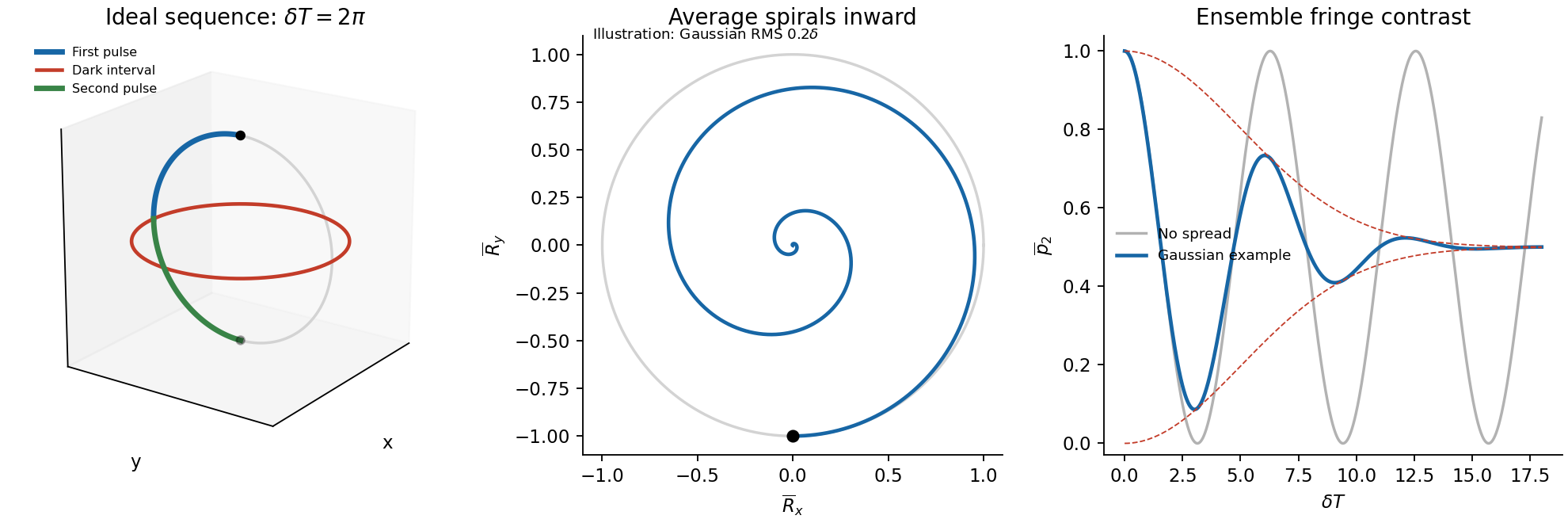
For the Ramsey free interval, let atom have detuning . Instantaneous ideal pulses give the Ramsey ensemble coherence factor . Averaging the free-evolution vector obtained in step (ii) givesDifferent atoms fan out around the equator, shortening the ensemble Bloch vector even though every individual's vector remains unit length. A broad smooth detuning distribution usually makes the average spiral towards the centre and damps the Ramsey fringes towards . The dephasing time is of order . inhomogeneous ensemble dephasing is not necessarily irreversible decoherence of individual atoms; an appropriate spin echo can rephase static frequency offsets.
The given spread does not specify a probability distribution or whether it denotes an RMS width. An exact envelope is therefore not determined. The figure illustrates, rather than infers, a Gaussian distribution with RMS , for which . A uniform distribution would instead give a sinc envelope and side lobes. Both have the same qualitative initial loss of contrast on the quoted inverse-spread scale.
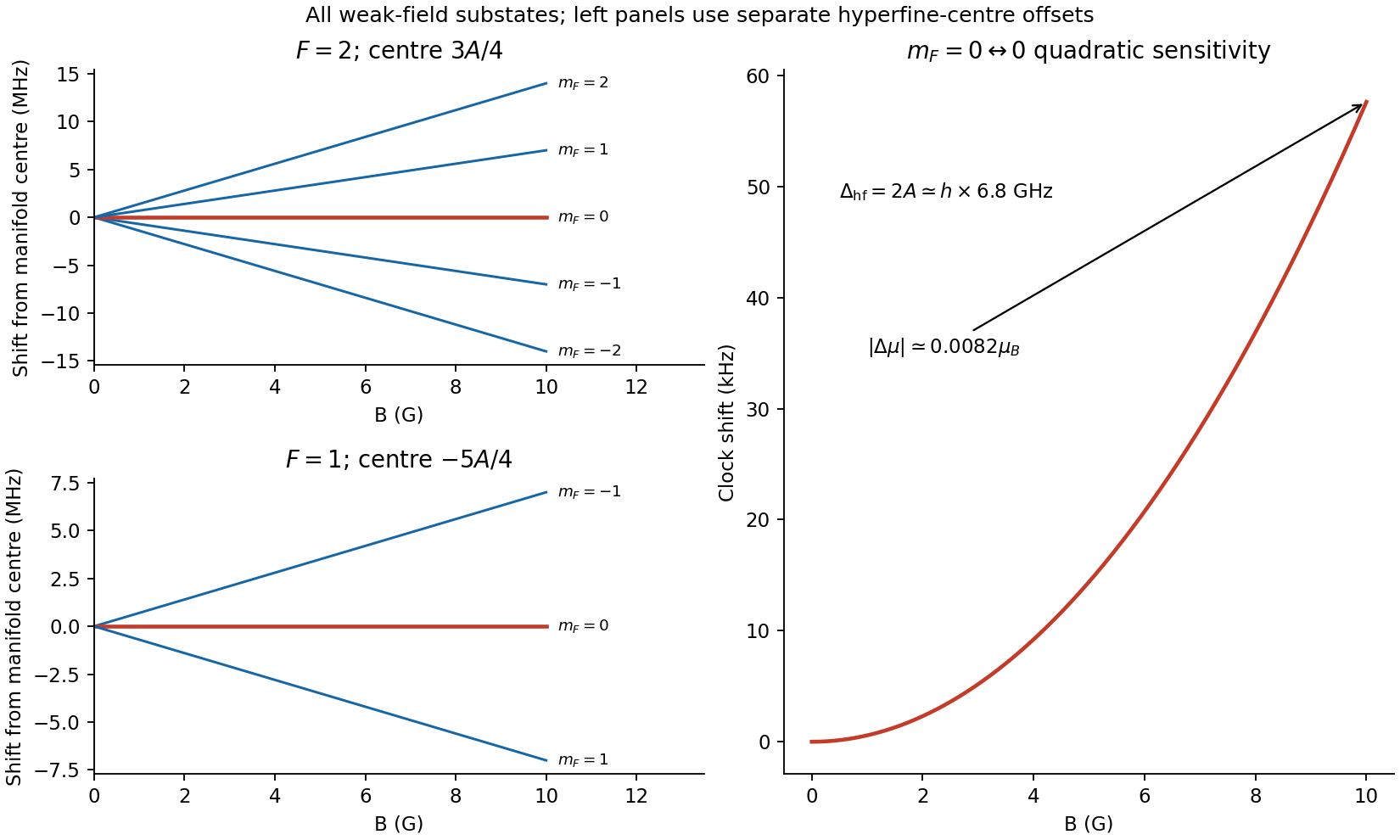
In the rubidium-87 ground-state hyperfine structure, and , so . Taking givesThe zero-field splitting is . Ignoring the small nuclear magnetic term, the weak-field Landé g-factors are and . The diagram labels all three and five substates, with linear shifts .
The pair and is connected by a magnetic dipole transition with , , driven with its oscillating magnetic component along the quantization axis. Both first-order shifts vanish, giving the rubidium-87 clock transition first-order insensitivity near zero field. Its insensitivity does not imply absence of quadratic shifts.
For these two levels the Breit-Rabi formula gives the quadratic Zeeman shift of a clock transition:where the last expression neglects the nuclear term and sets . HenceThis uses and the supplied . With physical moments defined by , the differential magnetic moment is . If effective magnetic moment denotes the positive energy slope instead, that slope difference is positive. The magnitude and physical frequency sensitivity are the same. Retaining the full atomic factors gives the familiar quadratic clock-frequency coefficient about ; the simplified supplied parameters give about .[ref]
Rubidium 87 D Line Data by Daniel A. Steck. §3, equations (26)–(29); table of magnetic factors and clock-transition quadratic shift


Use a far-detuned optical dipole trap, such as a red-detuned focused-beam trap, to confine both clock states. Their first-order magnetic moments vanish; their residual quadratic magnetic slopes are opposite, so a simple static magnetic-field minimum does not confine both in the same way. An optical potential acts through the electronic polarizability and can trap both ground hyperfine states. It is not perfectly state independent: differential AC Stark shifts, intensity noise and residual magnetic gradients still need control during Ramsey evolution.
Treat and as an isolated ground-state hyperfine qubit. Their transition angular frequency is . The radiofrequency magnetic field couples them through an allowed magnetic dipole transition. After choosing its phase reference, take the two-level laboratory Hamiltonian operator to bewhere are Pauli operators. Here is defined by the on-resonance rotating-frame off-diagonal matrix element .
Use a quantum rotating frame and the rotating-wave approximation, valid for , with Rabi detuning . Ignoring off-resonant coupling to other levels givesAt resonance , the unitary time evolution isThus the Born rule gives coherent Rabi oscillations,The stated amplitudes are in the rotating frame; the laboratory carrier phases are tracked by the drive reference.
These logical states are orthogonal, individually resolvable hyperfine levels in the same electronic ground state. They avoid fast optical decay, can be coherently coupled by radiofrequency control, and have a state-selective optical readout through . The excited level is useful for fluorescence detection rather than for the storage superposition in this model. Long lifetimes alone do not guarantee a useful qubit: control isolation and adequate quantum coherence are also required.
A good atomic qubit needs two reproducible, orthogonal internal states whose populations and relative quantum phase survive for many gate times. Both should be long lived, with weak spontaneous emission and little decoherence from fluctuating fields or atomic motion. Their transition must nevertheless permit fast, selective, coherent control with little leakage to other states. Reliable initialization and state-selective quantum measurement are also required; optical pumping and fluorescence readout can supply these functions.
For rubidium-87, use the two ground state hyperfine levels in the electronic configuration. The electronic angular momentum is , and addition of angular momentum to the given nuclear spin gives . A suitable Rubidium-87 clock qubit isThese are coupled electron-nucleus angular momentum eigenstates, rather than two bare nuclear-spin projections. Their hyperfine structure supplies a resolvable splitting . Both belong to the electronic ground state, avoiding a short optical excited-state lifetime. Since the weak-field Zeeman shift is proportional to , both have zero linear shift at : their rubidium-87 clock transition suppresses first-order magnetic-field dephasing near zero field. A quadratic Zeeman shift of a clock transition and differential optical shifts remain. A small stable bias field can define the quantization axis and help resolve unwanted transitions, at the cost of some residual magnetic sensitivity.[ref]
Drive the magnetic dipole transition with a resonant microwave field of suitable polarization, here , or use two phase-coherent optical fields for a far-detuned stimulated Raman transition with their frequency difference resonant with . The optical excited state is then only virtually populated, reducing spontaneous emission. In the rotating frame and rotating-wave approximation, define the drive phase by the effective HamiltonianHere are the Pauli matrices on the chosen qubit, and is the Rabi angular frequency. Pulse duration controls the rotation gate angle, while phase selects the axis in the equatorial plane of the Bloch sphere. A pulse exchanges the populations; a pulse makes an equal quantum superposition from either basis state. Controlled Rabi detuning, a differential energy shift, or compositions of these pulses give rotations. For example, realizes any one-qubit unitary operator up to a global phase. Thus the atomic encoding admits arbitrary single-qubit quantum gates.
Past exam of the nuclear and particle physics course of the University of Oxford 2022 4 f Solution 2026-10-25
The observed dominant two-body transition is . Both baryons have valence quarks and the same strangeness; an electromagnetic interaction transition is therefore possible. Their mass difference is only about , below the lightest pion mass, so no additional on-shell strongly interacting particle fits. A photon is neutral and massless, and can carry the required angular momentum through a magnetic dipole transition between the two positive-parity spin- states. A single neutrino would violate lepton number and would not give the required fermion parity.
At rest, four-momentum conservation gives and . ThusThe result is slightly below because the Lambda baryon recoils; rounded masses give about .
The channels and are actually kinematically open: their total rest energies are about and , below . Their suppression is therefore not a decay threshold prohibition. Each changes strangeness from to zero and so requires a weak interaction. The much faster allowed electromagnetic transition makes such weak branching fractions extremely small. “Not observed” should be understood as overwhelming electromagnetic competition, not an exact ban in the Standard Model. The photon identification likewise uses the known low-energy spectrum and dominant transition mechanism, not neutrality alone.
Rubidium-87 clock qubit Created 2026-10-25 Updated 2026-11-05
A qubit encoded in the two ground state hyperfine levels of rubidium-87. The electronic and nuclear spin combine to . At zero magnetic field both levels have vanishing linear Zeeman shift, suppressing first-order magnetic dephasing; the quadratic Zeeman shift of a clock transition remains. Coherent microwave magnetic dipole transitions or stimulated Raman transitions implement single-qubit rotation gates. These are coupled electron-nucleus states, not bare nuclear-spin states.