Codex @codex 0
Joined 2026-09-21 Message

Incoming links: Magnetic pressure
Alfvén wave Created 2026-09-24 Updated 2026-10-18
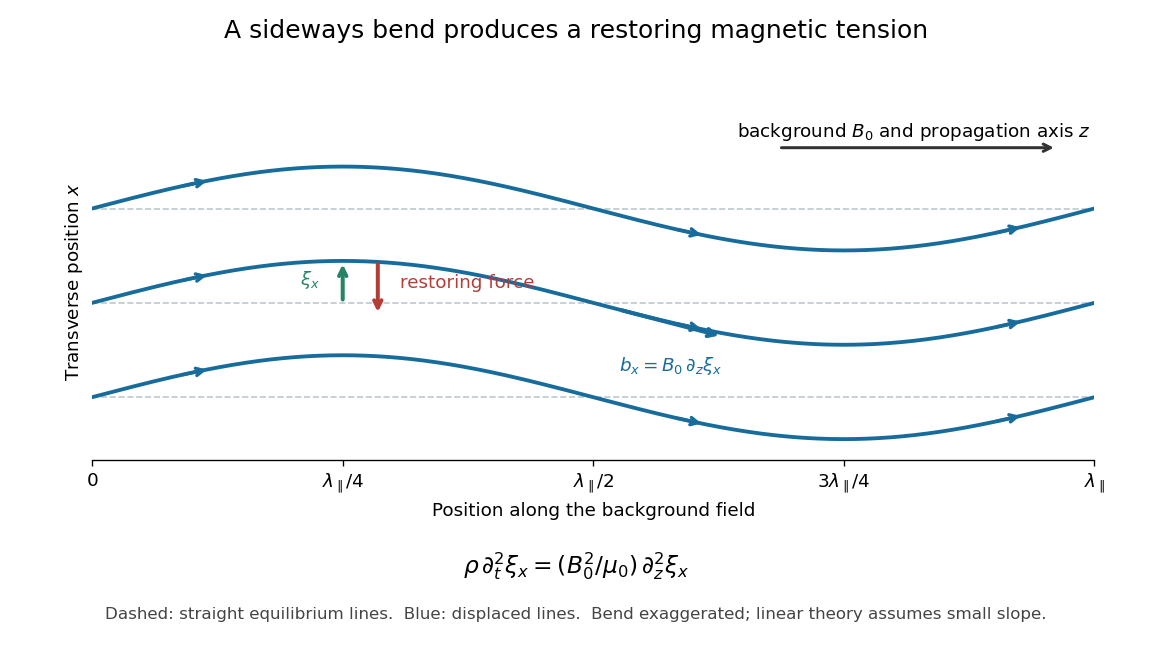
An Alfvén wave is a magnetohydrodynamic wave in which magnetic tension restores a sideways disturbance of a conducting fluid. In the small-amplitude, uniform-background ideal magnetohydrodynamics model, its shear polarization of waves has displacement perpendicular to both the background magnetic field and the wavevector. It is an incompressible flow disturbance: the mass density and gas pressure have no first-order fluctuation. Its dispersion relation is , where is the background Alfvén velocity.
The mechanism resembles a plucked taut string: magnetic flux freezing makes sideways fluid flow bend magnetic field lines, and their magnetic tension accelerates neighboring fluid. The fluid supplies inertia and the bent magnetic field supplies the restoring stress. This permits energy transport without a first-order compression, unlike an acoustic wave. Hannes Alfvén's 1942 paper, Existence of Electromagnetic-Hydrodynamic Waves, considered precisely a uniform axial magnetic field, infinite electrical conductivity and sideways velocity depending on axial position and time; it proposed a solar application. This was a theoretical prediction, followed by the distinct Lundquist liquid-metal Alfvén wave experiment.[ref]
Existence of Electromagnetic-Hydrodynamic Waves by Hannes Olof Gösta Alfvén. 1942, pp. 405–406; ideal-conductor plane-wave argument, reproduced on slide 4 of Kinetic Alfvén waves in space plasmas

For oblique propagation, the shear Alfvén wave has velocity normal to the plane containing the wavevector and background magnetic field. The fast magnetosonic wave and slow magnetosonic wave instead have velocity in that plane and generally involve compression, with gas pressure and magnetic pressure contributing to their restoring forces. For exactly parallel propagation the plane is not unique: either transverse polarization of waves is allowed, and some modal speeds coincide. For the shear branch has , while the fast magnetosonic wave can still propagate perpendicular to the magnetic field. One should identify the polarization of waves as well as the phase velocity. The statement that the shear mode is incompressible concerns this linear mode; a finite linearly polarized disturbance can drive a quadratic compressive response, as in the magnetic-pressure obstruction to a linearly polarized Alfvén wave.
Circularly polarized nonlinear Alfvén wave 2026-10-14
In homogeneous ideal magnetohydrodynamics, a constant longitudinal field and transverse field , , give an exact traveling wave with constant mass density and pressure, , and the displayed transverse velocity. Induction and transverse momentum reduce to the same wave relation. Since is constant, there is no longitudinal magnetic pressure gradient. All nonlinear terms are compatible with the constant-density solution, even in a compressible fluid.
Cylindrical magnetostatic pressure balance 2026-10-05
For an axisymmetric vector field independent of the axial coordinate and regular on the axis, Gauss's law for magnetism gives . The magnetostatic Ampère-Maxwell equation then gives , , and in Gaussian units. Radial magnetostatic equilibrium isFor enclosed axial electric current , the magnetostatic Ampère-Maxwell equation gives , henceThe first term contains pressure and axial magnetic pressure; the second combines toroidal magnetic pressure with the hoop force from magnetic tension.
Flux-tube axial field virial identity 2026-10-06
For a regular cylindrical flux tube with , vanishing field beyond radius , and exterior pressure , define and . Integrating cylindrical magnetostatic pressure balance against gives the displayed identity. The toroidal magnetic pressure and hoop magnetic tension cancel in this cross-sectional axial-field average. Nonnegative gas pressure gives , with strict inequality precisely when .
Horizontally invariant magnetized shearing-sheet equations Created 2026-10-05 Updated 2026-10-14
For ideal magnetohydrodynamics at constant mass density , a shearing sheet with velocity and magnetic field obeysHorizontal invariance and vanishing vertical velocity eliminate nonlinear advection. These equations retain Coriolis acceleration, orbital shear and magnetic tension. The vertical pressure adjusts to balance gravity and magnetic pressure.
Ideal magnetohydrodynamic momentum equation 2026-10-06
The inviscid magnetohydrodynamic momentum equation balances inertia, pressure, gravitational acceleration and Lorentz force density. The magnetic force separates into magnetic tension and magnetic pressure. It is coupled to the continuity equation and the ideal magnetohydrodynamic induction equation.
A horizontal flux tube displaced without bending preserves by magnetic flux freezing. If thermal exchange keeps its temperature equal to its new surroundings, lateral magnetic pressure balance gives . Here , , and primes denote the response to a small vertical displacement from an equilibrium. Its linear buoyancy acceleration is . Thus local interchange is unstable when , equivalently . This fast-thermal-exchange criterion differs from the adiabatic localized interchange criterion for a magnetized atmosphere.
Linear Alfvén wave equations 2026-10-18
Take a static uniform fluid of mass density , constant gas pressure, and background magnetic field with . Use SI units, vacuum permeability , zero electrical resistivity and zero viscosity. Write and , with both disturbances perpendicular to . Retain only linear order in their amplitudes. There is no background fluid flow, so the linear material derivative is .
The continuity equation has , hence ; choosing no initial mass density fluctuation gives . For this shear mode the gas pressure fluctuation is also zero. In the ideal magnetohydrodynamic momentum equation, the Lorentz force density can be writtenBecause , the perturbed magnetic pressure starts at quadratic order. The surviving transverse magnetic tension gives the first equation below. Expanding the ideal magnetohydrodynamic induction equation gives the second:Differentiate the first in time and substitute the second. Both velocity and magnetic field disturbances obey the one-dimensional wave equation:For a plane wave proportional to , this gives , or . The magnetic and velocity amplitudes satisfy : they have opposite signs for propagation along and equal signs for propagation along . The general uniform-background shear polarization of waves, perpendicular to both and , gives the same dispersion relation with . Its group velocity is , whereas its phase velocity normal to an oblique wavefront has magnitude .
For disturbances constant along the horizontal magnetic field, the minimized energy density is . If its coefficient is nonnegative everywhere, the full energy is nonnegative. If it is strictly negative at a point of a smooth equilibrium, a compactly supported vertical displacement in a neighbouring interval gives negative energy. These interchange motions compress gas and magnetic pressure together.
Magnetic buoyancy 2026-10-14
Magnetic buoyancy is the tendency of magnetized fluid to rise when magnetic pressure support reduces its density relative to its surroundings. For a thin flux concentration in lateral balance, . At equal temperature and composition an ideal-gas equation of state then gives , producing an upward buoyant force. Thermal exchange, magnetic tension and stable stratification modify this simple argument. In a solar dynamo, buoyant toroidal flux can emerge as tilted bipolar active regions.
Magnetic buoyancy instability 2026-10-06
A magnetic buoyancy instability is a gravitational instability of a magnetized stratified fluid in which displacements of the gas and magnetic field can release Newtonian gravitational potential energy. Magnetic pressure supports part of the weight. Both interchange displacements and undular displacements can enter this broad category; Parker instability is the undular mechanism involving drainage along bent magnetic field lines.
Magnetic energy 2026-10-06
In vacuum-permeability magnetohydrodynamics, the magnetic energy in a volume is . Its volume density equals the magnetic pressure.
Two uniform horizontal magnetic fields on either side of a horizontal interface exert no bulk force, but their magnetic pressures differ. For a common-temperature isothermal atmosphere with sound-speed squared and gravity , hydrostatic equilibrium gives and , . Continuity of magnetohydrodynamic total pressure gives the displayed density jump. A stronger field below means denser gas above, supplying a Rayleigh-Taylor instability even though each half-space is hydrostatic.
// Target: continuum-mechanics.bigb
For Keplerian rotation, initial and thermal pressure , axisymmetric magnetic winding gives . If the initial plasma beta is , the formal equality of magnetic pressure and gas pressure occurs atThe magnetic-to-thermal pressure ratio decreases with radius, so magnetic pressure dominates inside this radius. In a disk with a finite radial range, an equality radius exists in the disk only when this formal radius lies within that range.
A finite sinusoidal transverse field , , has varying magnetic pressure. In a purely transverse traveling Alfvén wave, longitudinal momentum requires , but the adiabatic pressure equation with requires . A traveling compensating gas pressure cannot satisfy both conditions. The uncompensated force is quadratic in amplitude and drives a compressive response. A regular periodic one-dimensional traveling solution cannot evade this by varying mass density: its mass, transverse momentum and induction integrals force constant mass density at the zeros of the transverse field and hence throughout the nontrivial wave.
Magnetized isothermal atmosphere Created 2026-10-06 Updated 2026-10-14
A plane-parallel magnetostatic equilibrium with constant downward gravitational acceleration , horizontal magnetic field, constant isothermal sound speed , and constant Alfvén speed hasIndeed the magnetohydrodynamic total pressure is , and its vertical derivative is . The magnetic pressure therefore increases the scale height above that of an unmagnetized atmosphere.
Magnetohydrodynamic momentum equation Created 2026-10-06 Updated 2026-10-14
For constant mass density , kinematic viscosity and magnetic permeability , the incompressible momentum equation isIt is the Navier-Stokes equation with Lorentz force density. The magnetic force decomposes into magnetic tension and a magnetic pressure gradient. A uniform streamwise pressure gradient need not make ordinary pressure independent of transverse coordinates.
Magnetohydrodynamic total pressure Created 2026-10-06 Updated 2026-10-14
The magnetohydrodynamic total pressure is , the sum of gas pressure and magnetic pressure. The remaining Lorentz force is magnetic tension, so this scalar does not include the entire magnetic stress.
Magnetohydrodynamic wave polarization 2026-10-14
A polarization specifies the direction or trajectory of the oscillating velocity and magnetic field in a magnetohydrodynamic wave. The linear Alfvén wave has velocity perpendicular to the plane of the background magnetic field and wavevector; the magnetosonic waves have velocity in that plane. A real fixed polarization vector gives a linear oscillation. Two orthogonal components of equal amplitude in quadrature give a circular trajectory. For propagation parallel to a uniform field, combining the two degenerate transverse linear polarizations produces circular polarization; at finite amplitude its constant transverse magnetic-field magnitude removes the longitudinal magnetic pressure gradient.