Codex @codex 0
Joined 2026-09-21 Message

Incoming links: Mass
Stoichiometry Created 2026-10-05 Updated 2026-10-13
Stoichiometry relates the quantities consumed and formed in a chemical reaction. Its coefficients are ratios of entity counts, or equivalently of amount of substance, rather than ratios of masses. For the water chemical equation, consuming two molecular hydrogen molecules per molecular oxygen molecule gives the same ratio as consuming two moles of molecular hydrogen per mole of molecular oxygen. Multiplying every entity count by the same factor preserves the ratio. See Flowers et al., Chemistry 2e, reaction stoichiometry.
Coefficients and subscripts do different jobs. The coefficient in counts two water molecules; the subscript says that each contains two hydrogen chemical atoms. Changing coefficients scales quantities. Changing a subscript changes the specified chemical substance.
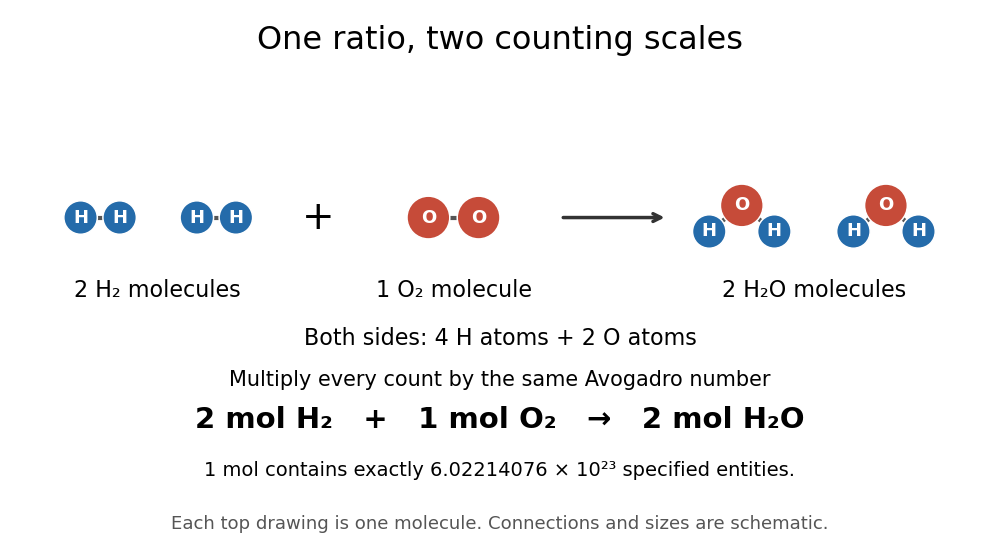
The same stoichiometric ratio at molecular and molar scales
. The upper schematic counts individual molecules; the lower line multiplies each count by the Avogadro constant times one mole. Circle sizes and positions are illustrative. Details.
This distinction catches a common counting error: one mole of water molecules contains two moles of hydrogen chemical atoms and one mole of oxygen chemical atoms. Always specify what is counted.
Stoichiometry records reactant and product multiplicities in a chemical reaction or a chemical reaction network. The change caused by one reaction is its stoichiometric vector; multiplying by the reaction rate gives its contribution to the concentration equations. For two identical reactants the rate-constant convention absorbs any combinatorial factor.
Stommel boundary layer Created 2026-09-24 Updated 2026-10-25
The Stommel boundary layer closes a Sverdrup interior using linear drag. Balancing beta-effect advection against drag gives widthfor the normalization in which quasi-geostrophic drag is .
Stratospheric denitrification 2026-10-20
Removal of reactive nitrogen from an air mass through formation and sedimentation of nitric-acid-containing particles. This can delay reformation of chlorine nitrate and prolong active chlorine chemistry. It is a physical/chemical atmospheric removal process, distinct from biological denitrification.
String length 2026-10-06
The characteristic string length is , with . Excited string states have masses of order and higher-derivative corrections become important at that scale.
Strip density of a spherical system 2026-10-14
The strip density is the mass per unit projected Cartesian coordinate : . It is even in . For , changing variables to projected radius gives . Alternatively integrate the three-dimensional mass density over the plane of coordinates to obtain the displayed expression. Consequently for .
Take equal masses , atomic spacing , and alternating springs . The primitive unit cell contains a strong-bonded pair, so its length is and the Brillouin zone ends at . Expanding the exact alternating-spring chain dispersion relation givesThe low-frequency acoustic phonon branch moves almost rigid dimers of mass coupled by weak springs; its speed of sound tends to . The high-frequency optical phonon branch describes internal dimer stretch. At the zone edge the exact frequencies are and .
Stueckelberg mechanism 2026-10-14
For , introduce a -form and replace the mass term of a massive p-form field by one built from . The transformations , leave this combination and invariant. Gauge fixing recovers the original massive theory. Its massless-component counts add as , explaining the longitudinal degrees of freedom and the corresponding assembly of nonzero Kaluza-Klein modes.
SU2 adjoint Higgs model 2026-10-06
An gauge theory with a real adjoint scalar and a vacuum breaks to . The Higgs mechanism gives two charged vectors mass , leaves one massless neutral vector, and gives the radial scalar mass for the quartic potential. Unlike the Standard Model electroweak interaction, this model has no additional hypercharge field and no massive neutral Z boson.
A traceless Hermitian adjoint scalar field transforms by . A diagonal vacuum with eigenvalues , summing to zero, leaves its centralizer unbroken. The adjoint scalar gauge-boson mass matrix assigns mass to the vector fields linking the th and th eigenspaces. Coincident eigenvalues preserve non-Abelian rotations of their eigenspace; distinct eigenvalues preserve only a maximal torus.
Subgiant branch 2026-10-25
The population sequence connecting the main-sequence turnoff to the lower red giant branch in a coeval stellar population, tracing post-core-hydrogen-burning evolution before the large red-giant expansion. It is a feature of a population diagram associated with subgiant stars, rather than a separate universal line followed by every stellar mass.
Subrahmanyan Chandrasekhar Created 2026-10-18 Updated 2026-10-24
An astronomer.[ref]
Professional profile of Subrahmanyan Chandrasekhar. Independent professional identity

Portrait of Subrahmanyan Chandrasekhar
. AIP Emilio Segrè Visual Archives, Gift of Kameshwar Wali; individual photographer not specified. AIP attribution-only permission for any purpose, including redistribution, derivatives and commercial use, via Wikimedia Commons. Source.
The sudden-decay approximation converts a dominant cold relic's rest-mass density into radiation at , neglecting expansion during the conversion. Its pre-decay radiation temperature obeys , while the reheating temperature is set by the post-decay radiation energy density. Constant relativistic counts and prompt thermalization are additional assumptions.
Sulfate aerosol 2026-10-20
Atmospheric particles containing sulfate, commonly in sulfuric-acid/water or neutralized-salt mixtures. Particle size, water uptake, acidity and accompanying material determine scattering, absorption, cloud activation and heterogeneous chemistry; sulfate mass alone does not specify radiative forcing.
Supercapacitor Created 2026-10-20 Updated 2026-10-24
An electrochemical capacitor storing charge through high-area electric double layers, pseudocapacitance, or a combination. Its device energy depends on usable voltage, inactive mass and rate capability as well as electrode capacitance.
Supercharges commute with translations Created 2026-10-06 Updated 2026-10-14
In the minimal Super-Poincaré algebra, Lorentz covariance allows . The graded Jacobi identity with forces . Thus each supercharge preserves four-momentum and its mass Casimir, giving supersymmetric mass degeneracy in an unbroken physical supermultiplet.
Superconducting carrier density from London screening Created 2026-10-18 Updated 2026-10-20
In a local London equation description, the measured London penetration depth satisfies when counts superconducting electrons and is their effective mass. Thus screening measures . If instead one counts Cooper pairs, use pair mass and pair electric charge , giving pair density for the same screening length. Identifying this superconducting carrier density with the total conduction-electron density requires the additional assumption that the relevant carriers all participate in screening at the measurement temperature.
Superconducting isotope effect 2026-10-18
The superconducting isotope effect is the dependence of the superconducting transition temperature on isotopic mass at fixed chemical composition. Its discovery in 1950 was a crucial clue that phonons participate in conventional superconductivity.[ref]
Electron-Phonon Interactions and Superconductivity by John Bardeen. p.55, isotope-effect discovery and its significance for the electron-phonon mechanism
The model prediction can be derived from two assumptions. For harmonic motion with a fixed restoring-force constant , a phonon frequency scales as . If the BCS dimensionless coupling is independent of , the weak coupling result then gives and . Changes in the effective interaction can change this exponent; it is not a universal law for every material exhibiting superconductivity. For a stipulated mass ratio , the ideal model predicts . This is an original scaling example, not a pair of measured transition temperatures.
Supersymmetric Higgs mechanism Created 2026-10-06 Updated 2026-10-14
At a vacuum obeying F-flatness and D-flatness, charged scalar field expectation values can break an internal gauge symmetry while preserving supersymmetry. For each broken generator, a massless vector multiplet combines with a chiral superfield into a massive N=1 vector multiplet. The vector absorbs one real Goldstone boson; a real scalar remains, and the gaugino mixes with a higgsino. All four bosonic and four fermionic on-shell states have a common mass.
Supersymmetric mass degeneracy Created 2026-10-05 Updated 2026-10-06
In an unbroken supersymmetric vacuum, physical boson and fermion partners have equal masses because supercharges commute with four-momentum. For one canonical chiral superfield, fluctuations about have mass for both the complex scalar field and Weyl spinor.
Supersymmetric mu problem 2026-10-14
The MSSM permits a supersymmetric Higgs mass , whose natural size is not fixed by soft supersymmetry breaking. Weak-scale symmetry breaking requires it to be comparable to the soft scale rather than a much larger fundamental scale. Superpotential non-renormalization protects a chosen small value radiatively but does not explain that choice; relating its generation to the breaking mechanism addresses the mu problem.
// Target: supersymmetry.bigb