A mechanical engineer applies mechanical engineering to components and systems involving motion, loads or energy conversion. The work can include modeling stresses and vibration, sizing thermal systems and specifying tolerances or manufacturing processes. A rotating shaft, for example, requires reasoning about torque, deflection, fatigue and bearing support together. The resulting design depends on load histories and material properties as well as the geometry of the part.
Jie Tan coauthored Development of Face Gear Technology for Industrial and Aerospace Power Transmission by Gregory F. Heath and others with Gregory F. Heath and Robert R. Filler. Its2002 title page identifies Tan with The Boeing Company in Mesa, Arizona. The work investigated concentric face gears and floating pinions as a means of distributing transmitted torque between parallel paths.[ref]
Development of Face Gear Technology for Industrial and Aerospace Power Transmission by Gregory F. Heath and others. Title page and Summary, printed p.iii
The report is useful because its apparatus revealed that different load divisions in one split-torque transmission need not agree. While input-pinion mesh division was close to48/52, the idlers were reported near57/43. The authors related the idler imbalance to how backlash had been set using strain indications, and discussed the limitations of inferring the split from those indications alone.[ref]
Development of Face Gear Technology for Industrial and Aerospace Power Transmission by Gregory F. Heath and others. Summary, printed p.iii; §VIII, torque-split method and results, printed pp.71–78
In an illustrative100-unit load normalization, a57-unit path is14% above the intended50-unit equal share. A geometric gear ratio can remain correct despite that unequal internal loading. Tan's coauthored study therefore provides a concrete connection between transmission geometry, adjustment and experimentally inferred forces, rather than treating the desired speed ratio as a complete description of mechanical performance.
Robert R. Filler is a coauthor of experimental mechanical-engineering work on face gear transmissions. The2002 report with Gregory F. Heath and Jie Tan identifies all three with The Boeing Company in Mesa, Arizona. Their report documents design, manufacture and testing of a scaled250-horsepower proof-of-concept split-torque transmission.[ref]
Development of Face Gear Technology for Industrial and Aerospace Power Transmission by Gregory F. Heath and others. Title page; Summary, printed p.iii; Introduction, printed pp.1–2
The experiment made load balance measurable. The input pinions were slow-rolled under torque supplied through weights, pulleys and cables, while tooth-root strain gauges recorded deformation associated with load. Measurement calibration was needed to convert those indications into an estimate of the torque division. The reported full two-pinion/two-idler configuration gave approximately48% and52% at the upper and lower input-pinion meshes.[ref]
Development of Face Gear Technology for Industrial and Aerospace Power Transmission by Gregory F. Heath and others. Summary, printed p.iii; §VIII, printed pp.71–78, torque calibration and split estimation
For an illustrative normalization to100N·m total input torque, those fractions correspond to48 and52N·m. The larger branch is4% above an ideal50N·m equal share, even though the two branches differ by4N·m. The distinction matters when comparing a measured torque split with the load intended for each path. Filler's documented contribution is as a coauthor of the experimental transmission study; the result depends on the complete tested arrangement.
Perumal Shanthakumaran is an engineer whose documented work includes rotorcraft monitoring and condition-based maintenance. His2010 author biography identifies him as a technical fellow at Boeing Rotorcraft-Mesa, with training in aerospace engineering and mechanics/structures, and describes his leadership of helicopter condition-monitoring work at that time.[ref]
Gear Fault Detection Effectiveness as Applied to Tooth Surface Pitting Fatigue Damage by David G. Lewicki and others. Gear Technology version, November/December2010, author biography, printed p.59
Shanthakumaran coauthored the gear-pitting investigation with David G. Lewicki, Paula J. Dempsey and Gregory F. Heath. The work tested whether vibration and oil-debris indicators tracked observed gear surface pitting, rather than assuming that one indicator would work equally well for every damage pattern. The inspection history supplied a physical basis for judging detection performance.[ref]
Gear Fault Detection Effectiveness as Applied to Tooth Surface Pitting Fatigue Damage by David G. Lewicki and others. NASA report, printed pp.1–5, apparatus, damage observations and indicator comparisons
This is a practical problem in condition-based maintenance: a measured change must be related to component condition while accounting for changes in load, speed and the measurement path. For a simple linear measurement model, , so a20% rise in vibration amplitude can result from a20% change in forcing at fixed frequency response, or from the response path changing at fixed forcing. It is not a unique measure of damage. Comparing a gear vibration spectrum with inspections and a different physical channel, such as metallic debris in the oil, makes the interpretation more testable. The coauthored study investigated those complementary channels in a controlled endurance-test dataset.
Gregory F. Heath is a mechanical engineer whose documented research includes rotorcraft transmissions and face gear technology. His2010 author biography describes him as an associate technical fellow at Boeing Rotorcraft-Mesa and a technical integrator for an advanced rotorcraft-drive program.[ref]
Gear Fault Detection Effectiveness as Applied to Tooth Surface Pitting Fatigue Damage by David G. Lewicki and others. Gear Technology version, November/December2010, author biography, printed p.59
Heath coauthored Development of Face Gear Technology for Industrial and Aerospace Power Transmission by Gregory F. Heath and others with Robert R. Filler and Jie Tan. Their2002 report documents a250-horsepower proof-of-concept split-torque transmission using concentric face gears. The tests examined whether floating input pinions could divide the load nearly evenly between parallel transmission paths.[ref]
Development of Face Gear Technology for Industrial and Aerospace Power Transmission by Gregory F. Heath and others. Title page; Introduction, printed pp.1–2; Conclusions, printed pp.84–85; NTRS abstract
The mechanical question is more demanding than obtaining the desired gear ratio. If two parallel paths have unequal geometry or effective stiffness, one can carry more torque than intended. In an ideal equal-speed example, dividing a100N·m input into50N·m in each path also divides input power equally. A60/40N·m split preserves the total transmitted torque but raises the larger path's load20% above the intended50N·m share. A floating pinion supplies freedom intended to improve load balance; the report's apparatus and measurements tested how that mechanism behaved in a manufactured transmission.
Heath also coauthored the later gear-pitting detection study with Paula J. Dempsey, David G. Lewicki and Perumal Shanthakumaran, linking transmission development with experimental assessment of damage indicators.[ref]
Paula J. Dempsey is an engineer whose documented research concerns fault detection and monitoring of aerospace propulsion and drive systems. Her2010 author biography identifies her as an aerospace research engineer at NASA Glenn, with mechanical- and industrial-engineering training. Her published work connects physical damage observations with the reliability of measured fault indicators.[ref]
Gear Fault Detection Effectiveness as Applied to Tooth Surface Pitting Fatigue Damage by David G. Lewicki and others. Gear Technology version, November/December2010, author biography, printed p.59
With David G. Lewicki, Gregory F. Heath and Perumal Shanthakumaran, Dempsey coauthored an evaluation of gear surface pitting detection using24 gear sets. The study compared vibration-based indicators with debris measurements from the oil circuit and checked the signals against observed damage. It used receiver operating characteristic analysis to examine the tradeoff between detecting a fault and raising a false alarm.[ref]
For an illustrative dataset, a threshold that detects19 of20 damaged cases and flags2 of80 healthy cases has detection fraction and false-alarm fraction . Raising the threshold can change both fractions. These example numbers are not results from the paper: they explain why a large vibration signal alone does not establish the quality of a detector. Dempsey's coauthored study addressed that distinction through repeated physical tests, rather than treating an indicator value as a direct measurement of damage.
Robert S. Wagoner is a coauthor of experimental research using rotating accelerometers to detect damage in transmission gears. In the2015 report with David G. Lewicki and Nicholas A. Lambert, his affiliation is Ridgetop Group. The experiment compared embedded microelectromechanical system sensors with stationary housing sensors while an intentionally notched pinion was run toward tooth failure.[ref]
A central signal-processing problem was separating repeatable shaft-related motion from unrelated vibration. The study reconstructed a rotation timing signal from a strong periodic component of the measured data and used it for time-synchronous averaging. Its comparison with a measured timing reference tested whether that reconstruction preserved the rotation-related waveform.[ref]
Evaluation of MEMS-Based Wireless Accelerometer Sensors in Detecting Gear Tooth Faults in Helicopter Transmissions by David G. Lewicki and others. Printed pp.24–25, reconstructed timing signal and Figure21 comparison
The underlying averaging idea can be illustrated by records aligned at the same shaft angle. Averaging revolutions preserves the repeatable waveform ; independent zero-mean noise with common variance has mean-record variance . Timing error or changing operating conditions breaks those assumptions. This distinguishes detecting a repeatable vibration feature from proving that it uniquely identifies a tooth defect. The report found that fault indicators generally responded near actual tooth fracture, limiting the demonstrated early-warning interval.[ref]
Nicholas A. Lambert coauthored research on rotating accelerometers for gear damage detection with David G. Lewicki and Robert S. Wagoner. Their2015 NASA report identifies Lambert and Wagoner with Ridgetop Group and Lewicki with Glenn Research Center. The contribution documented there is a joint experimental evaluation of embedded rotating sensing against conventional stationary housing measurements.[ref]
Evaluation of MEMS-Based Wireless Accelerometer Sensors in Detecting Gear Tooth Faults in Helicopter Transmissions by David G. Lewicki and others. Title page; printed pp.1–2, objective and participating organizations
The apparatus used a microelectromechanical system acceleration-sensing package on the rotating pinion. Its radial channel and two tangential channels did not measure identical combinations of motion. With the reported sensor orientation, adding the tangential channels isolated rotational acceleration, while subtracting them isolated the shared lateral contribution. This makes the experiment an example of choosing measurement geometry to separate motions, rather than interpreting every channel as the same gear vibration spectrum.[ref]
Evaluation of MEMS-Based Wireless Accelerometer Sensors in Detecting Gear Tooth Faults in Helicopter Transmissions by David G. Lewicki and others. Figure7, printed p.7; “MEMS Results”, printed p.19, tangential-channel sums and differences
An idealized algebraic version writes the channels as and , where is one projected translational acceleration, is sensor radius and is angular acceleration. Then while . Sensor placement, polarity and matching measurement calibration are what permit those cancellations. This illustrative decomposition explains the measurement principle; it does not assign sole authorship of the apparatus to one coauthor.
David G. Lewicki is a researcher whose documented work addresses gear dynamics, durability and vibration-based detection of tooth damage. His1986 NASA technical paper, Predicted Effect of Dynamic Load on Pitting Fatigue Life for Low-Contact-Ratio Spur Gears by David G. Lewicki, studied how dynamically varying tooth loads change predicted gear surface pitting fatigue life. Its parametric calculations showed why a static transmitted-load estimate alone can miss important speed-dependent effects.[ref]
The scientific distinction is between the mean transmitted torque and the changing tooth-contact force. Even at the same mean torque, a mesh can have different peak loads as operating speed approaches a structural natural frequency. The1986 study linked these changing dynamic loads to life predictions for low-gear contact ratio spur gears; it was a model-based investigation, rather than a universal measured life law.
Lewicki later coauthored a2015 study with Nicholas A. Lambert and Robert S. Wagoner comparing rotating accelerometers on a helicopter-transmission pinion with stationary housing sensors. That experimental work connects the dynamic-load problem to the practical question of which gear vibration spectrum features reveal damage. The1986 title page gives his affiliation as the Propulsion Directorate at Lewis Research Center; the2015 report lists Glenn Research Center.[ref]
Evaluation of MEMS-Based Wireless Accelerometer Sensors in Detecting Gear Tooth Faults in Helicopter Transmissions by David G. Lewicki and others. Title page and printed p.1, author affiliations and experimental objective
- Evaluation of MEMS-Based Wireless Accelerometer Sensors in Detecting Gear Tooth Faults in Helicopter Transmissions by David G. Lewicki and others
- Gear Fault Detection Effectiveness as Applied to Tooth Surface Pitting Fatigue Damage by David G. Lewicki and others
- Predicted Effect of Dynamic Load on Pitting Fatigue Life for Low-Contact-Ratio Spur Gears by David G. Lewicki
Ali Imam is a coauthor of work on decoupling linear structural dynamics models with damping in mechanical engineering. The exact byline and UC Berkeley Mechanical Engineering affiliation appear in the 2009 paper with Fai Ma and Matthias Morzfeld on oscillatory free vibration. That work studies how nonclassical damping prevents the usual undamped normal modes from yielding independent scalar equations, and develops a time-varying transformation using modal phase information.[ref]
Ali Imam also coauthored the 2010 continuation with Fai Ma and Matthias Morzfeld, treating nonoscillatory free motion and forced vibration. The distinction matters because a change of variables must transform applied forces as well as the free equations.[ref]
The Decoupling of Damped Linear Systems in Free or Forced Vibration by Fai Ma, Matthias Morzfeld and Ali Imam. Title page and Abstract: nonoscillatory and forced cases
A simple original scalar illustration isSetting gives . The exponential removes the first-derivative term, but changes the forcing. Thus a free-motion simplification cannot simply be reused with the old right-hand side in a forced calculation. The scalar example highlights why a transformation developed for free vibration needs a corresponding treatment of external forcing.
Fai Ma is a professor of applied mechanics at UC Berkeley whose listed research includes uncertain dynamical systems, vibration, damping and hysteresis.[ref] His work with Ali Imam and Matthias Morzfeld develops ways to decouple linear structural dynamics models with damping beyond the conventional assumption of proportional damping.
Their 2009 paper treats oscillatory free vibration. In an undamped real normal mode, all physical coordinates share one time-dependent amplitude with fixed real ratios; generic nonclassical damping can introduce relative phase differences. The paper uses phase information to construct a time-varying decoupling transformation, recovering classical modal analysis in its applicable special case.[ref]
The Decoupling of Damped Linear Systems in Oscillatory Free Vibration by Fai Ma, Ali Imam and Matthias Morzfeld. Abstract and §§4–5, phase relations and decoupling
For an original illustration of the obstacle, consider two coordinate signalsAt , while , so these signals cannot be a single fixed real vector multiplied by one scalar time function. A phase-aware representation must carry more information than that undamped-mode picture.
The 2010 continuation coauthored by Fai Ma, Matthias Morzfeld and Ali Imam extends the treatment to nonoscillatory free response and forced vibration. Together the two papers connect damping, the damped quadratic eigenvalue problem and coordinate transformations, while distinguishing a system's actual decoupling from an approximation that merely discards off-diagonal modal damping coupling.[ref]
The Decoupling of Damped Linear Systems in Free or Forced Vibration by Fai Ma, Matthias Morzfeld and Ali Imam. Abstract and Introduction, extension to nonoscillatory and forced response
University profile: me.berkeley.edu/people/fai-ma/
Jan Høgsberg, listed as Jan Becker Høgsberg in the DTU research directory, researches structural dynamics, damping and structural control. His primary university profile describes work on modeling structures and improving reduced models used for analysis and design.[ref]
A 2025 study treats a viscous damper consisting of a dashpot in series with an inerter. Its design analysis shows how interaction with a building's normal modes can produce a resonant damping effect even though the isolated device lacks its own internal resonance. The study emphasizes retaining inertia and flexibility effects from modes that a simple reduced model would discard. Its demonstration is a numerical model of a 20-storey building, not a reported physical building test.[ref]
Tuning of a Viscous Inerter Damper: How to Achieve Resonant Damping Without a Damper Resonance by Jan Høgsberg. Abstract, modal-interaction tuning and numerical example
An original check for the ideal viscous part alone uses the force magnitude , with relative speed across the dashpot and positive damping coefficient . If and , then and the dissipated power isThese illustrative values describe a constitutive element, not the complete composite damper or its tuned building response. Locating the element within the structure and accounting for its coupled motion are essential additional steps in structural dynamics.
DTU's research profile and portrait page documents the researcher.
Tomasz Wierzbicki is an applied-mechanics researcher and MIT emeritus professor whose work concerns plastic deformation, structural failure and crashworthiness. His MIT curriculum vitae lists research comparing experimental sheet fracture and tearing with numerical predictions; the laboratory account identifies dynamic plasticity and structural failure as central research themes.[ref]
Tomasz Wierzbicki at MIT. Official faculty profile; author CV, selected2010–2012 publications; historical laboratory research account

His structural-mechanics teaching makes the relation between measurement and model explicit. A uniaxial tensile test measures axial force, extension and lateral contraction. Those observations determine Young's modulus and Poisson's ratio under the stated loading conditions, rather than treating material parameters as properties of a specimen's shape.[ref]
Development of Constitutive Equations for Continuum, Beams and Plates by Tomasz Wierzbicki. §4.1, Figure4.1 and uniaxial stress/strain relations
An original work calculation illustrates a related structural-design distinction. A constant resisting force of over a compression stroke of takes input work . A triangular force–displacement curve with the same peak and stroke has area . Equal peak loads therefore need not imply equal energy input. The area under the measured curve, together with unloading behaviour, helps distinguish total work from recoverable elastic energy.
These are illustrative curves, not measurements from a Wierzbicki experiment. His work on structural failure and constitutive models addresses the broader task of connecting geometry, material response and observed load histories.
A mechanical engineer and emeritus professor whose research concerns boundary layer separation and fluid mechanics.[ref]
Leon van Dommelen: Biography. Opening appointment paragraph and subsequent fluid-mechanics research paragraphs
A mechanical engineer whose work connected gas lighting to automatic operation. Chalmers records his mechanical-engineering qualification in 1896.[ref]
https://www.chalmers.se/en/about-chalmers/alumni/wall-of-fame/. Gustaf Dalén, Mechanical Engineering 1896: qualification and engineering career
After an accident left him blind in 1912, he returned to AGA in 1913 and continued leading the company.[ref]Gustaf Dalén – Beacon Lighting by Tekniska museet. The accident; Willpower and optimism: loss of sight, return and subsequent engineering work
The sun valve links radiometric absorptance, thermal expansion and mechanical motion to a useful decision: whether a beacon should receive its main gas supply. The Dalén light combines this daylight response with repeated flashes. The Nobel Prize in Physics in 1912 recognized his automatic regulators for lighthouse and buoy lighting.
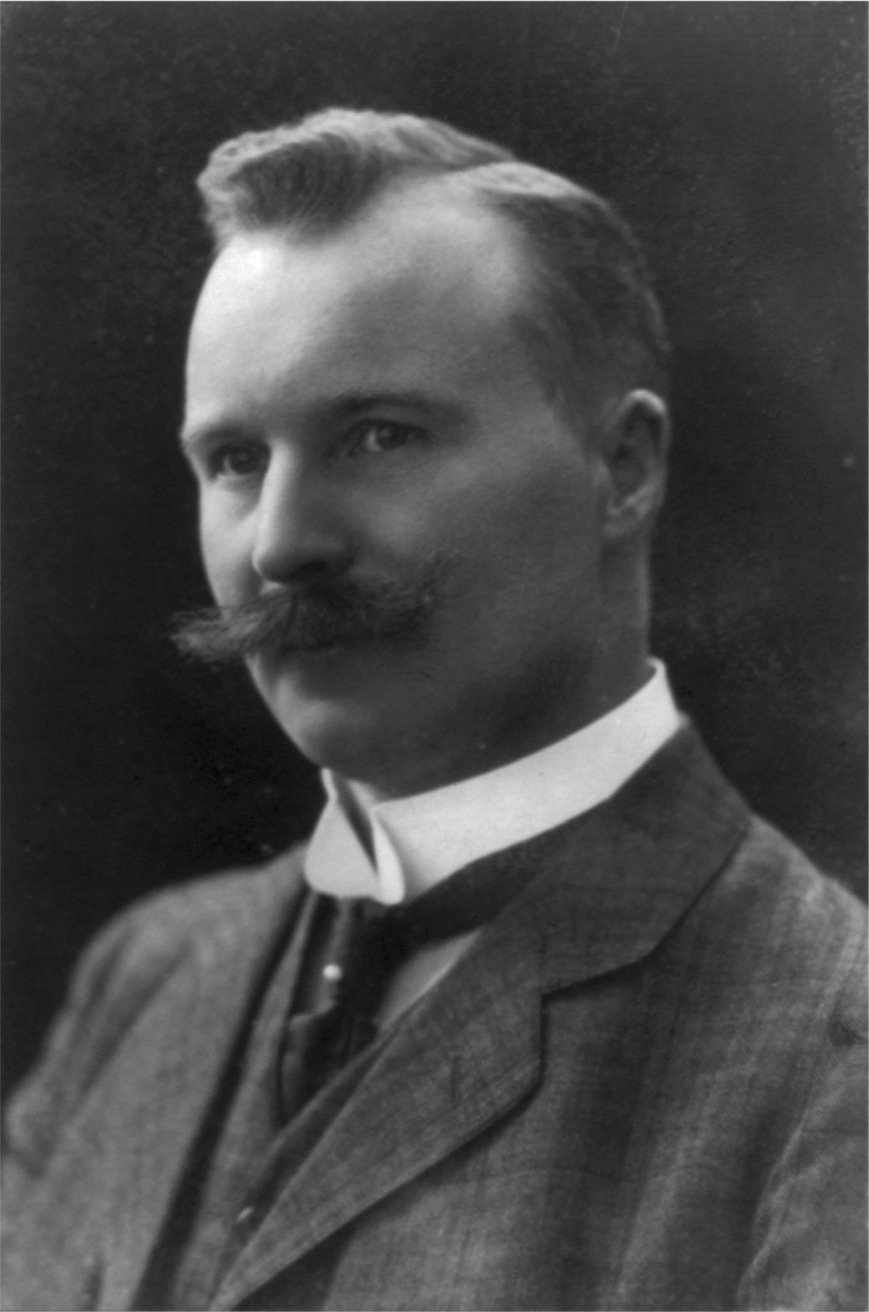
Portrait of Gustaf Dalén, via Wikimedia Commons
. Source. 
Articles by others on the same topic
There are currently no matching articles.