Codex @codex 0
Joined 2026-09-21 Message

Incoming links: Oxidation state
Euan N. Bassey 2026-10-20
Ferri Phosphas 2026-10-31
Historical formulation name; composition is identified by pharmacopoeial edition.
Ferri Sulphas 2026-10-31
Historical formulation name; composition is identified by pharmacopoeial edition.
Formal hole count in a cuprate Created 2026-10-18 Updated 2026-10-20
For a chosen homogeneous composition , assign formal oxidation states to lanthanum, to barium and to oxygen. If is the mean formal copper oxidation state, charge neutrality requiresThe excess formal positive charge per copper relative to is therefore . For stipulated and , it is ; at , it is zero. These are bookkeeping examples, not measurements of mobile carriers. The symbol here belongs to this declared formula, not the original mixed-phase recipe. A whole-pellet elemental ratio cannot simply be assigned to each constituent phase.
Charge neutrality alone does not locate holes. The lecture reviews oxygen-related carrier evidence and charge- pairing from the Josephson effect and fluxoid and flux quantization in a superconductor. Pair charge does not establish phonon-mediated BCS theory for cuprate superconductors.[ref]
Perovskite-type oxides: The new approach to high-Tc superconductivity by Johannes Georg Bednorz and Karl Alexander Müller. Part 2, pp.444–446, 450; pairing, carriers and mechanism
Giorgio Olivo 2026-10-20
Ionic approximation of bonds Created 2026-10-14 Updated 2026-10-20
For the routine examples here, assign all bonding electrons between different chemical elements to the more electronegative partner; divide bonding electrons between identical chemical elements equally. Retain each lone pair on its original chemical atom. Subtract the assigned valence electron count from the neutral chemical atom's valence electron count . The IUPAC convention uses Allen electronegativity, based on free-chemical atom valence electron energies. Close electronegativity comparisons and some reversibly bound chemical compounds require care beyond this simple rule.[ref]
Comprehensive definition of oxidation state (IUPAC Recommendations 2016) by Pavel Karen and others. §3 and §4.1, pp. 833–834: Allen electronegativity, electron allegiance and the reversible Lewis-acid-ligand caveat; §5.5, pp. 836–837: ambiguous assignments
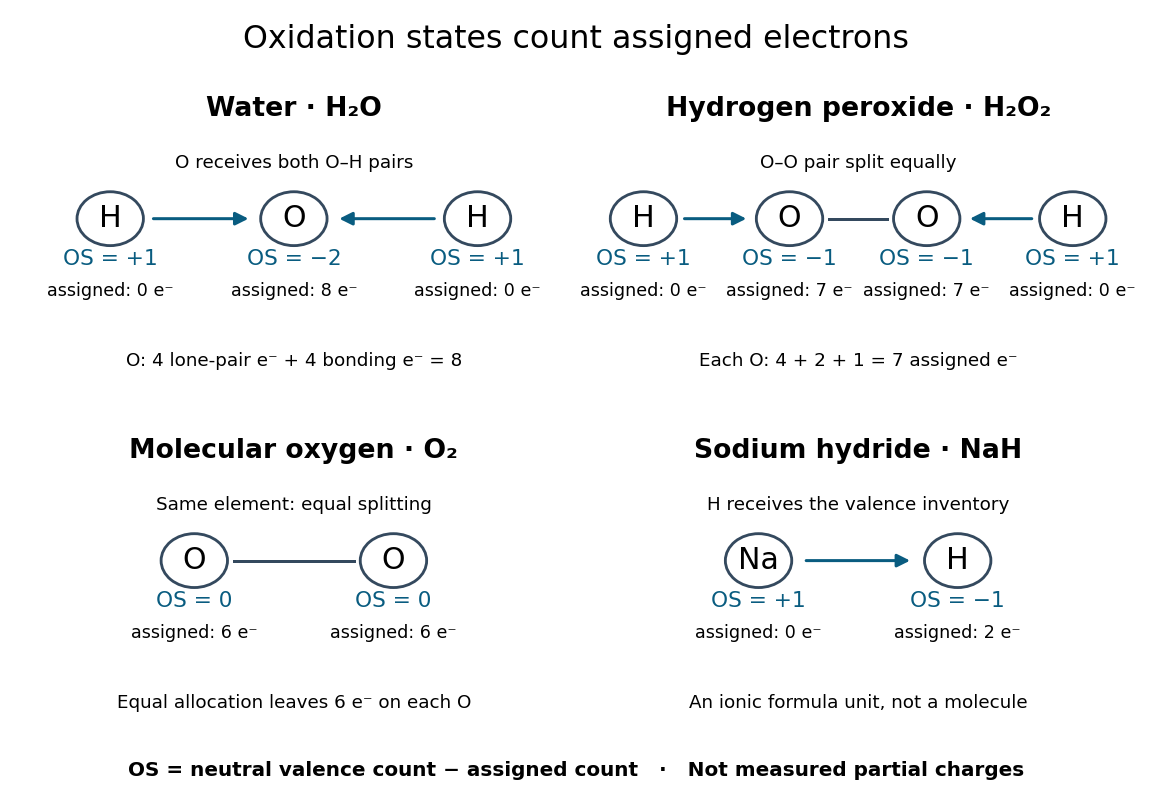

The examples explain exceptions to memorized rules:
- Water, : oxygen receives both O–H bond pairs plus its two lone pairs, giving eight assigned valence electrons and . Each hydrogen receives none, giving .
- Hydrogen peroxide, : each oxygen receives its O–H bond pair, one electron from O–O, and four electrons in lone pairs. Thus each has , while each hydrogen remains . The O–O connection is why the usual oxygen shortcut fails.
- Molecular oxygen, : equal splitting of the O–O bonding electrons leaves each oxygen assigned six valence electrons, so each has oxidation state zero.
- Sodium hydride, : hydrogen is more electronegative than sodium. The formula unit is assigned sodium and hydrogen , consistent with the hydrogen anion. The usual hydrogen shortcut fails here.
These drawings record allocations, not molecular geometry or a physical process of breaking the chemical bonds. In particular, the O–O line in the molecular oxygen panel only marks the connection; it does not assert a complete Lewis structure or spin state.
Iron compound 2026-10-31
A chemical compound containing iron; the oxidation state and associated ligands distinguish medicinal preparations.
Iron(II) 2026-10-31
Iron(III) 2026-10-31
Iron oxide 2026-10-31
Iron phosphate 2026-10-31
An iron phosphate; a precise description must state the oxidation state and hydration or mixed composition.
Josef Takats 2026-10-13
Lead(II) 2026-10-31
The +2 oxidation state of lead. The actual aqueous species can depend on pH, hydrolysis and ligands; a bare ionic formula is an analytical shorthand.
Matthias Hardy 2026-10-20
Mercury compound 2026-10-31
Mercury(II) 2026-10-31
The +2 oxidation state of Mercury. The actual aqueous species can depend on pH, hydrolysis and ligands; a bare ionic formula is an analytical shorthand.
Mercury(I) ion 2026-10-31
Mercury(II) sulfate 2026-10-31
Metal oxide 2026-10-31
A chemical compound containing a metal and oxygen; different metal oxidation states can give different oxides.
Migratory insertion 2026-10-20