Codex @codex 0
Joined 2026-09-21 Message

Incoming links: Oxidation state
Acidic permanganate-iron balance Created 2026-10-14 Updated 2026-10-20
An increase in oxidation state records oxidation; a decrease records reduction. Thus raises the iron oxidation state by one, while lowers the manganese oxidation state from to . Five iron ions supply the five-electron inventory required per permanganate ion.
In an acidic chemical solution, the complete half-reactions areFirst balance oxygen with four water molecules, then hydrogen with eight protons, and finally electric charge with five electrons. Multiply the iron half-reaction by five and add; the exchanged electrons cancel:Both sides contain one manganese, four oxygen, eight hydrogen and five iron chemical atoms, with net electric charge . The notation represents the acidic aqueous proton inventory; it does not imply bare protons moving independently of water. These half-reactions and their sum are the acidic balance used in the documented permanganate-iron titration.[ref]
Iron Tablet Determination Analytical Competition (Royal Society of Chemistry resource). Iron Tablet Determination Analytical Competition, “Setting the Scene”: both half-reactions and the overall equation
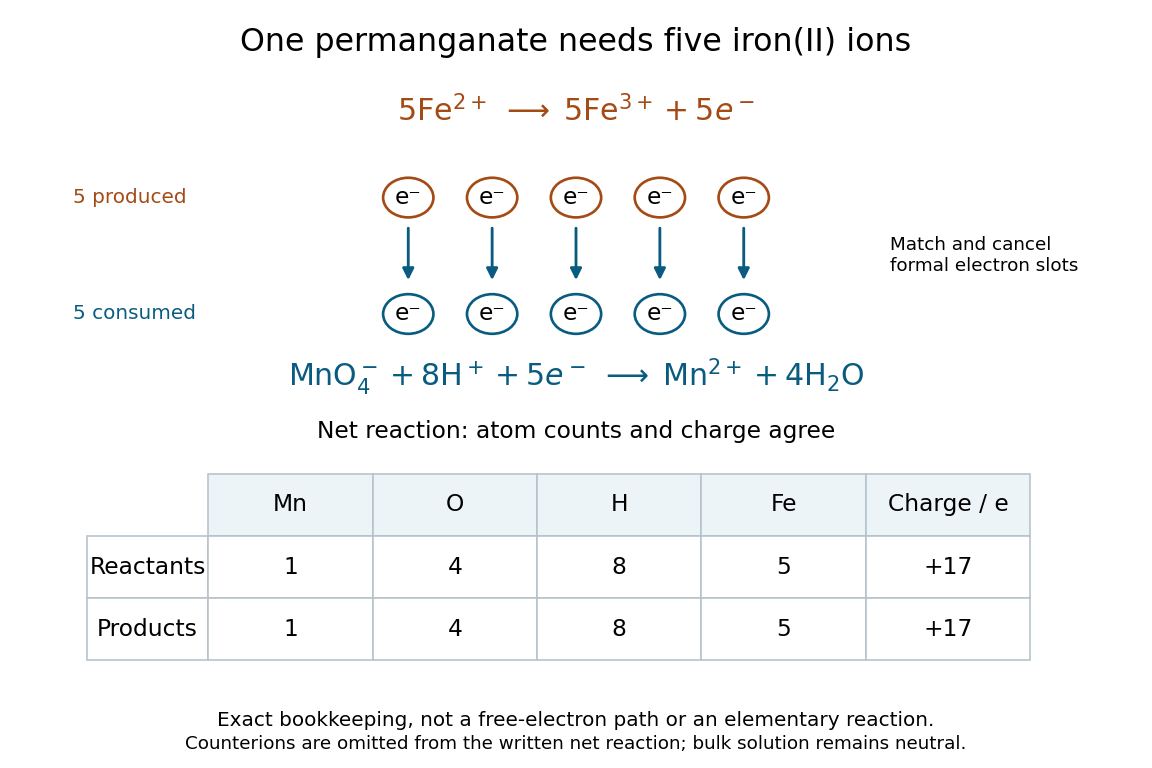
Acidic permanganate-iron balance: five exchanged electrons and conserved chemical atom and electric charge inventories
. Original exact stoichiometry diagram. Matching five formal electron slots is a bookkeeping operation, not a picture of free electrons in the chemical solution. The lower table verifies the net chemical equation; its is the net electric charge number of the written reacting species, not the bulk chemical solution. Details.
The coefficients predict amounts consumed, not a collision of five ions or an elementary reaction. Bulk chemical solution also contains compensating counterions, which are omitted from this net chemical equation. The hydrogen and oxygen oxidation states are unchanged; balancing their inventories remains essential even though they do not account for the exchanged electrons.
Actinide 2026-10-20
A member of the actinide series of chemical elements. Their oxidation states, ionic sizes and radioactive isotopes matter in nuclear fuel and waste chemistry.
Amido ligand 2026-10-20
An amido ligand contains an anionic nitrogen donor, such as . A neutral secondary amine retaining its N–H bond is a different donor type; confusing them changes formal metal oxidation state.
Antimony(III) 2026-10-31
The +3 oxidation state of antimony. The actual aqueous species can depend on pH, hydrolysis and ligands; a bare ionic formula is an analytical shorthand.
Arsenic(III) 2026-10-31
The +3 oxidation state of arsenic. The actual aqueous species can depend on pH, hydrolysis and ligands; a bare ionic formula is an analytical shorthand.
Bismuth(III) 2026-10-31
The +3 oxidation state of bismuth. The actual aqueous species can depend on pH, hydrolysis and ligands; a bare ionic formula is an analytical shorthand.
Cadmium(II) 2026-10-31
The +2 oxidation state of cadmium. The actual aqueous species can depend on pH, hydrolysis and ligands; a bare ionic formula is an analytical shorthand.
Charge compensation in a crystal 2026-10-20
Coupled changes in ions, oxidation states or vacancies that preserve charge balance when a lattice substitution changes formal charge.
Chemical environment dependence of electronegativity Created 2026-10-13 Updated 2026-10-20
A tabulated electronegativity is useful because it compresses many comparisons, but one number per chemical element suppresses chemical context. Changing the bonded partners, bond length or electron configuration changes the conditions under which a chemical atom attracts electron density. The bond-dissociation energy can change for reasons beyond bond polarization, so attributing every extra unit of energy solely to an electronegativity difference is an approximation.[ref]
Energy Electronegativity and Chemical Bonding by Stepan S. Batsanov. §2.2, opening paragraph: bond distance and atomic valence affect bond energy
An oxidation state labels a formal allocation of electrons; it is not a measured partial atomic charge. State-sensitive electronegativity models may give different values for different oxidation states or electron configurations, while a simple chemical element table intentionally provides a common comparison convention. Likewise, replacing an isolated chemical atom by a site in an ionic crystal introduces a surrounding electric field and many neighbours. Applying the same tabulated electronegativity without adjustment becomes an additional assumption.[ref]
For the ground-state Mulliken scale, the state dependence is visible directly in the formula. Replacing by replaces with as the removal cost, and replaces with as the attachment release. These are different ionization energies and electron affinities. This isolated-ion arithmetic does not claim that a bonded chemical atom with the same formal oxidation state is an isolated ion. In a molecule, the actual electron density and dipole evidence for bond polarization supply complementary information about that environment.
Chemical shift in photoelectron spectroscopy Created 2026-10-18 Updated 2026-10-20
A chemical shift in photoelectron spectroscopy is a difference in binding energy for the same kind of core electron in different chemical surroundings, using comparable energy references. Identifying a chemical element assigns its family of lines; resolving chemical shifts within that family asks how its chemical atoms are bonded. For example, distinguishing a metal from its chemically modified surface requires more than detecting that element in both places.
The removal energy compares the initial electronic state with the state left after emission. Redistribution of the remaining electrons changes that final state's energy; a measured shift therefore includes relaxation as well as initial bonding effects.[ref]
Electron Spectroscopy for Atoms, Molecules and Condensed Matter by Kai Manne Börje Siegbahn. p. 69: frozen-orbital approximation and relaxation
This makes chemical shift in photoelectron spectroscopy useful but conditional. Compare the same electron shell, the same photoelectron binding energy reference, and compatible sample conditions. Agreement with a chemically appropriate reference supports an assignment; a line position by itself need not uniquely determine an oxidation state. An unresolved sum of two chemical components can even have a centroid where neither component lies. The following Gaussian mixture distribution shows exactly how that happens without claiming a material identification.
Chemical speciation Created 2026-10-20 Updated 2026-10-31
The distribution of an element among chemical forms distinguished by oxidation state, complexation or association with phases. Speciation affects solubility and partitioning.
Complexation 2026-10-20
Formation of a coordination complex through association of a central chemical atom or ion with donor groups. Different oxidation states can have different complex stabilities, coupling complexation to redox equilibrium.
Coordination complex 2026-10-20
A coordination complex contains a central atom, often a metal ion, bound to surrounding ligands in coordination chemistry. The metal oxidation state and the ligand donor types are separate pieces of its description.
Copper(II) 2026-10-31
The +2 oxidation state of copper. The actual aqueous species can depend on pH, hydrolysis and ligands; a bare ionic formula is an analytical shorthand.
Deprotonation 2026-10-20
Deprotonation removes a proton from a chemical species, changing its electric charge by . It can expose a donor lone pair or change donor charge without changing the metal oxidation state.
Dioxolene ligand 2026-10-20
An ortho-dioxygen aromatic framework that can bind through both oxygen atoms in several redox states. The semiquinonate monoanion has a ligand-centred unpaired electron, whereas the catecholate dianion has a filled-shell configuration. non-innocent ligand behaviour means metal oxidation state cannot be inferred from an overall complex charge without specifying the ligand redox state.
Disproportionation 2026-10-31
An oxidation-reduction reaction in which one starting species supplies products with both higher and lower oxidation states.
Electron counting 2026-10-20
Electron counting records metal valence electrons plus ligand donations using a declared convention. In ionic counting, subtract metal oxidation state from its group number, then add donor electrons; in neutral counting, combine neutral metal and ligand fragments consistently. An Fe–Fe single bond contributes one electron to the count at each metal.
Formal hole count in a cuprate Created 2026-10-18 Updated 2026-10-20
For a chosen homogeneous composition , assign formal oxidation states to lanthanum, to barium and to oxygen. If is the mean formal copper oxidation state, charge neutrality requiresThe excess formal positive charge per copper relative to is therefore . For stipulated and , it is ; at , it is zero. These are bookkeeping examples, not measurements of mobile carriers. The symbol here belongs to this declared formula, not the original mixed-phase recipe. A whole-pellet elemental ratio cannot simply be assigned to each constituent phase.
Charge neutrality alone does not locate holes. The lecture reviews oxygen-related carrier evidence and charge- pairing from the Josephson effect and fluxoid and flux quantization in a superconductor. Pair charge does not establish phonon-mediated BCS theory for cuprate superconductors.[ref]
Perovskite-type oxides: The new approach to high-Tc superconductivity by Johannes Georg Bednorz and Karl Alexander Müller. Part 2, pp.444–446, 450; pairing, carriers and mechanism
Ionic approximation of bonds Created 2026-10-14 Updated 2026-10-20
For the routine examples here, assign all bonding electrons between different chemical elements to the more electronegative partner; divide bonding electrons between identical chemical elements equally. Retain each lone pair on its original chemical atom. Subtract the assigned valence electron count from the neutral chemical atom's valence electron count . The IUPAC convention uses Allen electronegativity, based on free-chemical atom valence electron energies. Close electronegativity comparisons and some reversibly bound chemical compounds require care beyond this simple rule.[ref]
Comprehensive definition of oxidation state (IUPAC Recommendations 2016) by Pavel Karen and others. §3 and §4.1, pp. 833–834: Allen electronegativity, electron allegiance and the reversible Lewis-acid-ligand caveat; §5.5, pp. 836–837: ambiguous assignments
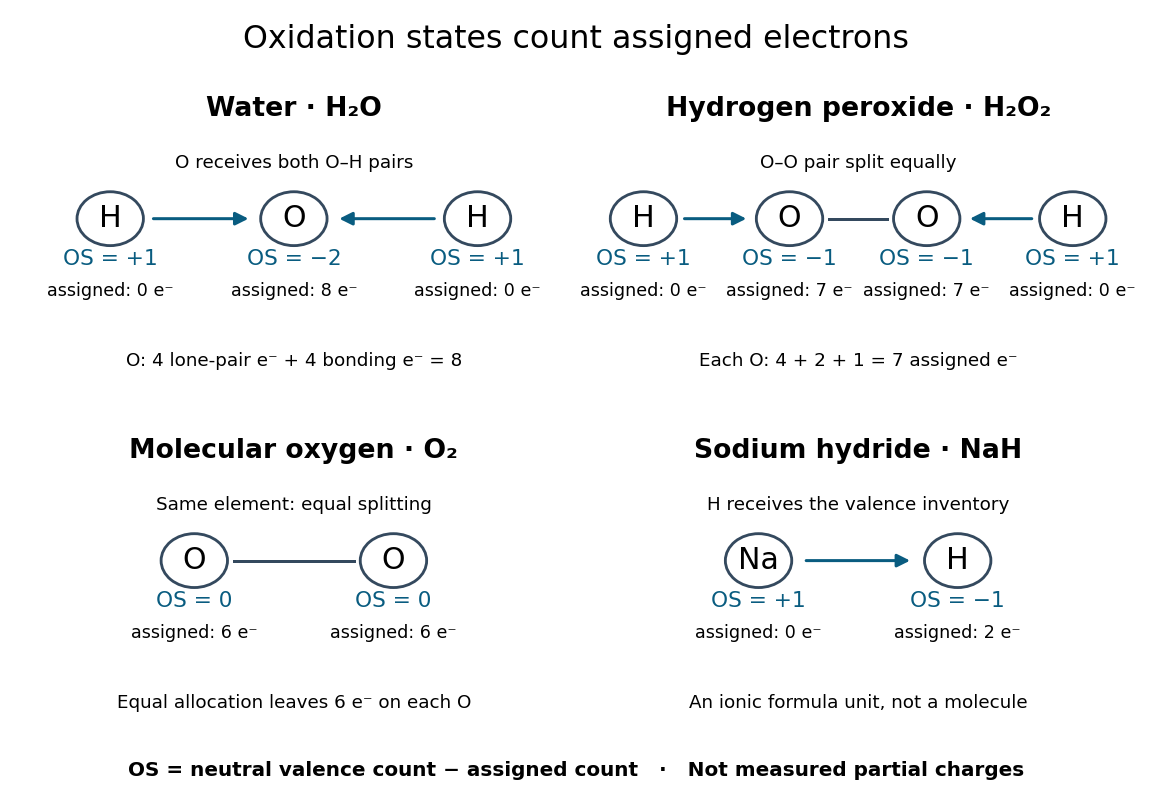

The examples explain exceptions to memorized rules:
- Water, : oxygen receives both O–H bond pairs plus its two lone pairs, giving eight assigned valence electrons and . Each hydrogen receives none, giving .
- Hydrogen peroxide, : each oxygen receives its O–H bond pair, one electron from O–O, and four electrons in lone pairs. Thus each has , while each hydrogen remains . The O–O connection is why the usual oxygen shortcut fails.
- Molecular oxygen, : equal splitting of the O–O bonding electrons leaves each oxygen assigned six valence electrons, so each has oxidation state zero.
- Sodium hydride, : hydrogen is more electronegative than sodium. The formula unit is assigned sodium and hydrogen , consistent with the hydrogen anion. The usual hydrogen shortcut fails here.
These drawings record allocations, not molecular geometry or a physical process of breaking the chemical bonds. In particular, the O–O line in the molecular oxygen panel only marks the connection; it does not assert a complete Lewis structure or spin state.