Let and be the complex plane wave amplitudes and set , . The linearized Euler equations in the rotating frame areHere is pressure per unit mass density, including the centrifugal potential. The last line is incompressibility, not an additional equation of state.
Taking the curl eliminates pressure. For constant and a divergence-free vector field, . Thus the inertial-wave vorticity equation givesApply once more and use . For a nonzero oscillatory amplitude,so the inertial-wave dispersion relation isThe restoring influence is the Coriolis acceleration. In particular . For , the projected linear dynamics have zero frequency; these are steady balanced disturbances rather than the nonzero-frequency branch used in the division above. The spatially uniform mode must be treated separately from this dispersion relation.
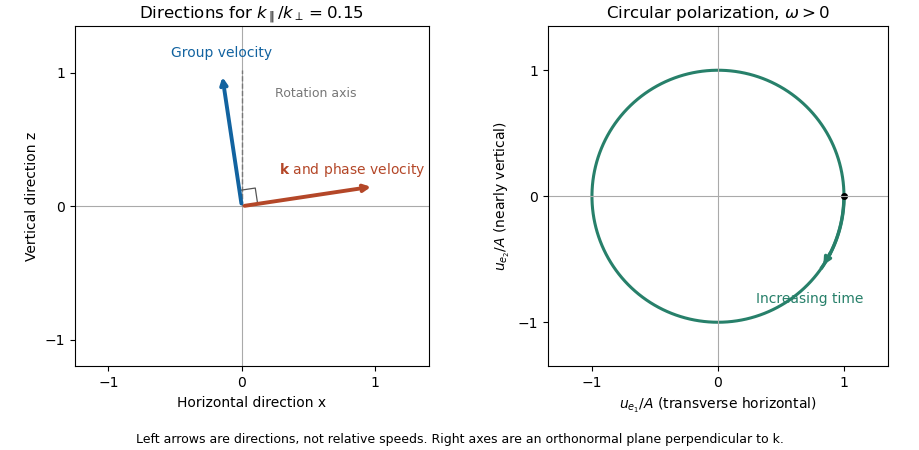
The group velocity, which gives wave-packet and energy propagation, is the gradient of the dispersion relation:For this becomesThus for , energy travels almost along the rotation axis, with a small horizontal component. By contrast, the normal-to-phase-front phase velocity is almost horizontal. Indeed , so these phase and group directions are perpendicular. Specifying which meaning of propagation is intended matters for an inertial wave.
For the wave polarization, incompressibility and the equation in part a giveThe horizontal component parallel to is small, but : the other horizontal and vertical components are in quadrature. More exactly, introduce the orthonormal transverse basisThen . The physical velocity at a fixed point traces a circle in the plane perpendicular to ; its handedness reverses between branches. In the anisotropic limit this plane is nearly vertical. The group velocity and polarization of an inertial wave therefore have quite different geometric roles.

Let and let be the common size of horizontal and vertical velocity perturbations, as found in part b. The linear inertial wave time and nonlinear advection time areThe critical balance in a rapidly rotating fluid is thereforeThe Rossby number is of order . Horizontal geostrophic flow balances the leading pressure gradient against Coriolis acceleration, soThese are dimensionally comparable statements, rather than comparisons of a dimensional frequency with a dimensional velocity. Equivalently, use and as units. ThenThus rotation stays in these units, while the motions evolve on the slower time. Vertical advection is smaller than horizontal advection by .
Write , with , and . At leading horizontal order,Define the stream function , including its horizontally uniform part in this convention. ThenThe next-order incompressibility condition is not zero horizontal divergence:This term has size and is essential: its product with the large rotation rate is a leading contribution to the vertical vorticity equation.
To see that contribution explicitly, write . At the first horizontal inertial order,Taking its vertical curl eliminates . The two-dimensional advection identity and the two divergence orders giveEquivalently the ageostrophic flow satisfieswhose divergence is . This explicitly verifies that the next-order divergence has the required sign.
The vertical momentum equation, at the same slow order, isFinally , where the canonical two-dimensional Poisson bracket is . The reduced equations for an anisotropic rotating fluid areThe omitted vertical-advection, ageostrophic-advection and relative-vorticity stretching terms are smaller by in the equations retained here. Linearizing these equations recovers , the anisotropic limit of part a.
Within the reduced equations for an anisotropic rotating fluid, a flow that remains purely horizontal has and . The second reduced equation therefore requiresThus the retained horizontal motion is two-dimensional. This is a Taylor–Proudman theorem consequence in the slow balanced ordering; setting at only one instant would not suffice, because vertical motion could subsequently develop.
The word “exactly” applies to the reduced model. It is not a theorem for every finite-Rossby number solution satisfying only . For example, the full rotating Euler equation admitsIt is an incompressible flow, has zero nonlinear advection, and obeys . It is purely horizontal but depends on , and can hold. This fast inertial oscillation lies outside the slow anisotropic critical balance used in part c; it shows why that ordering cannot be dropped from the conclusion.
For a uniform axial magnetic field, the anisotropic Shear Alfvén wave is predominantly horizontally polarized, whereas the pseudo-Alfvén wave is predominantly vertically polarized. Without rotation both have characteristic frequency . Pressure projection makes the effective Coriolis acceleration couple these two transverse wave polarization states at the inertial-wave rateThus the useful comparison is not alone, nor anisotropy alone, butIn this limit rotational coupling of shear and pseudo-Alfvén waves is negligible on an Alfvén propagation time, so the two familiar linear polarizations are decoupled to leading order. The factor cancels: simply making both disturbances more anisotropic does not by itself remove their relative rotational coupling.
For a nonlinear reduction one must also make the rotational mixing slow compared with the nonlinear evolution being retained. Under Alfvénic critical balance, , the same inequality gives . Rapid rotation relative to the horizontal nonlinear rate can therefore coexist with leading Alfvénic decoupling in the windowHigh electrical conductivity makes magnetic diffusion slow, and the corresponding inviscid approximation is also assumed. If , rotational and magnetic restoring effects are comparable and the modes are mixed magneto-Coriolis disturbances; in the rotation-dominated limit they separate into fast inertial-like and slow magnetostrophic branches, rather than into independently evolving shear and pseudo-Alfvén polarizations.
At finite amplitude, independence is generally one-way in the usual anisotropic ideal magnetohydrodynamics reduction: the Alfvénic subsystem has no leading feedback from pseudo-Alfvénic perturbations, but it can still advect them. The small rotational-coupling condition removes an additional two-way coupling, rather than all nonlinear advection.
This is an asymptotic finite-timescale statement. The two nonrotating Alfvén polarizations are degenerate, so even a weak nonzero rotational coupling can rotate their superposition over the much longer time . Exact decoupling for arbitrarily long times does not follow from a small ratio alone. The strictly nonpropagating limit is separate.
Use the same constant dynamic viscosity for both incompressible Stokes flows, and let be body force per unit volume. Their equations and Newtonian fluid stress tensor arewhere is the strain-rate tensor. Consider the cross-work fluxBy the product rule,The pressure terms vanish by incompressibility. Symmetry of the stress tensor removes antisymmetric velocity gradient contributions, leaving in both cross terms; they cancel. Apply the divergence theorem, with outward from , and rearrange:This is the Lorentz reciprocal theorem with body forces. It depends on reciprocal linear viscous response in the same fluid; arbitrary unrelated constitutive laws would not supply the cross-term cancellation.
Write the supplied velocity in the radial formAt , and , giving the no-slip boundary condition . At infinity and the supplied gauge-fixed pressure tends to zero. These are the laboratory-frame conditions for a sphere translating through otherwise quiescent fluid.
The exterior Stokes equations can also be checked directly:andTo compute surface traction in translating-sphere Stokes flow, let point from the sphere into the fluid. At the surface, , and . HenceSubstitute into the Newtonian fluid stress tensor. Its viscous contribution to the surface traction is , so the normal part cancels the pressure contribution:The vector is constant over the entire sphere in the stated pressure gauge. Integrating it gives the fluid's drag force on the sphere,This is Stokes's law. On an exterior fluid domain the outward domain normal at its inner boundary is ; that distinction will matter in the reciprocal calculation.
Let be the sphere surface, point from the sphere into the fluid, and writeBecause the prescribed exterior body forces are unchanged, they cancel on subtraction: the disturbance is a homogeneous Stokes flow in the exterior domain. On the sphere the no-slip boundary condition isallowing an arbitrary sphere rotation .
Use as auxiliary flow the translating-sphere solution of part b, with arbitrary test velocity . Its surface velocity is and its surface traction is . Applying the Lorentz reciprocal theorem on the exterior domain gives, after cancelling the common inner-normal minus sign,The outer surface terms vanish for decaying disturbances: velocities are at most , stresses , and the integrated cross-work is .
There are no body forces inside the sphere in the original ambient problem. Thus the smooth ambient stress tensor has zero divergence there, andAlso , so the rotation term drops out of the left side. Consequently the reciprocal identity reduces toSince is arbitrary, the result before imposing mechanical balance isFor a freely suspended sphere with negligible inertia and no applied external force, . Its sphere velocity as a surface average of ambient Stokes flow is thereforeThe implicit force-free condition is essential. More generally, an external force gives . For example, an externally pulled sphere in the zero ambient flow has nonzero velocity, contrary to an unrestricted surface-average-only claim. No torque-free assumption is needed for this translational identity, because the auxiliary surface traction is constant.
The undisturbed ambient solution is smooth and free of body forces throughout the ball . Its Stokes equations implyTaking the divergence gives , and a further Laplacian therefore givesEach velocity component obeys the biharmonic equation in the whole ball.
Expand a component of at the centre and average over . The odd spherical moments vanish, whileThus the spherical mean of a biharmonic function givesThe truncation is exact, not just a small-sphere approximation: all terms containing two or more Laplacians vanish. One can avoid any Taylor-convergence issue by letting . Since is harmonic, its spherical mean is , soIntegrating gives for every admissible .
Combining with the force-free result of part c proves Faxén's first law in the requested form:The force-free qualification carries over. Local absence of ambient body forces and regularity inside the ball are also needed; if forcing or a singularity lies inside it, the harmonic-pressure and biharmonic-mean argument does not apply unchanged.
Articles by others on the same topic
There are currently no matching articles.