Source paper: www.whatdotheyknow.com/request/physics_past_papers_21/response/3037379/attach/2/FOI%20202505%20441%20Response.pdf?cookie_passthrough=1. The original cover dates this paper to 13 June 2017. We use and lattice spacing one. Both printed interaction sums omit grouping parentheses; the solutions explicitly use the symmetric nearest-neighbour interpretation. The unused in question 1 is not treated as an additional interaction.
Put and label the two spin values in the order . Assign each bond its Boltzmann weight,The symmetry of the bond energy makes a real symmetric matrix. For a fixed configuration the product of successive matrix entries is its Boltzmann weight. Summing over all spins and identifying the last index with the first therefore giveswhereThis replaces a sum over configurations by the powers of a two-by-two matrix. For finite bond energies at , every matrix entry is positive, so the Perron–Frobenius theorem gives and . Hence the Helmholtz free energy per spin tends to . A diagonal local observable can be inserted at one site: . Its limiting average is the expectation in the normalized eigenvector of .
The sum needs a stated interpretation. The original equation leaves the second bond outside explicit parentheses, with its index then formally free. The natural translation-invariant, equal-bond interpretation used here is the energy . The subsequently mentioned has no term in that energy, so no magnetic field or single-ion anisotropy is added. Such an extra term would define another model and change the answer.
Let . Sum over each decorating spin before summing over the remaining spins. The decimation of an alternating mixed-spin chain gives the effective transfer matrix:No on-site entropy has been omitted: the term is the weight of the zero decorating spin. The normalized eigenvectors are , with eigenvaluesThere are transfer steps but physical sites, soThe free energy per two-site unit cell is twice this value. At , the formula gives , as required by two states on one sublattice and three on the other. As , the free energy per physical site tends to , the energy of an aligned chain with two satisfied bonds per unit cell. These checks also fix the factor of two in the site count.
Insert at the first undecorated site. In the eigenbasis of the transfer matrix, exchanges and , and both diagonal matrix elements vanish. Explicitly,Thus its large- limit is zero at every fixed . The result is exact even before taking that limit. Equivalently, simultaneous reversal of all spins pairs configurations of equal energy and opposite . Positivity of the transfer matrix at fixed positive temperature prevents a degenerate dominant eigenvalue and spontaneous magnetization in this one-dimensional zero-field chain. Selecting one aligned state at strictly zero temperature is a different order of limits.
Insert the decorating-spin observable into the one bond that contains it. The decorated-spin occupation insertion uses the matrix:The partition function still contains decorating-spin sums; one of them has been replaced by this weighted sum. HenceTaking the dominant eigenvector givesThis is the probability that the decorating site is in either nonzero state. It tends to at high temperature, when its three states are equally likely, and to one at low temperature, when the nonzero aligned states gain bond energy. Unlike the magnetization, this even observable is not forced to vanish by spin reversal.
Interpret the two displayed exchange components as belonging to the common nearest-neighbour sum with coefficient . Write and, for , . The source explicitly fixes but does not separately constrain in this question; keeping covers either field direction.
For classical vectors of length , define . The Cauchy-Schwarz inequality gives , and . Each term is therefore bounded below, soUniform alignment along the field saturates every bound:Equality requires all planar vectors to be parallel with length , and the nonzero field then fixes their direction. At , every uniformly oriented vector in the plane is a classical ground state:A nonuniform configuration cannot improve these simultaneously saturated bond bounds, including on the periodic ring.
The Holstein–Primakoff transformation realizes a spin algebra using bosonic creation operators and bosonic annihilation operators. A boson counts a unit of spin deviation from the local positive quantization axis: with . The square root in supplies the correct spin-ladder matrix elements. In particular,Their commutator is on every physical number state, reproducing the Spin commutation relations. Although the oscillator Fock space is infinite, the physical subspace is onlyThe order of the square root and oscillator operator matters in obtaining these coefficients.
When the spin deviations are dilute, expand the square root in . The leading transverse operators are linear in the bosonic creation operators and bosonic annihilation operators and turn exchange interactions into a quadratic Hamiltonian, which can be diagonalized. Higher powers describe interactions between spin waves. The method therefore organizes corrections by inverse powers of about an ordered classical configuration. Large alone is insufficient: the average depletion must remain small compared with . Possible problems include the occupation constraint after truncation, noncollinear order requiring site-dependent axis rotations, zero modes, and infrared fluctuations that destroy the assumed dilute expansion.
Choose the local positive axis along the classical spin. For nonzero field, a proper rotation isIt preserves the Spin commutation relations and turns the field term into . At zero field choose the classical direction , so . Expanding about the original axis without this rotation would put the reference state away from the classical minimum and would not give a controlled small-deviation expansion.
To the required order,The longitudinal exchange gives on each bond. The transverse exchange givesFinally the field contributes its classical constant and . Each site belongs to two bonds, so after removing the order- constant,These are the order- terms; the discarded products of number operators and the next square-root terms are order for occupations held fixed as . A different transverse-axis phase can reverse the sign of without changing the spectrum, but the sign above follows from the stated rotation and oscillator convention.
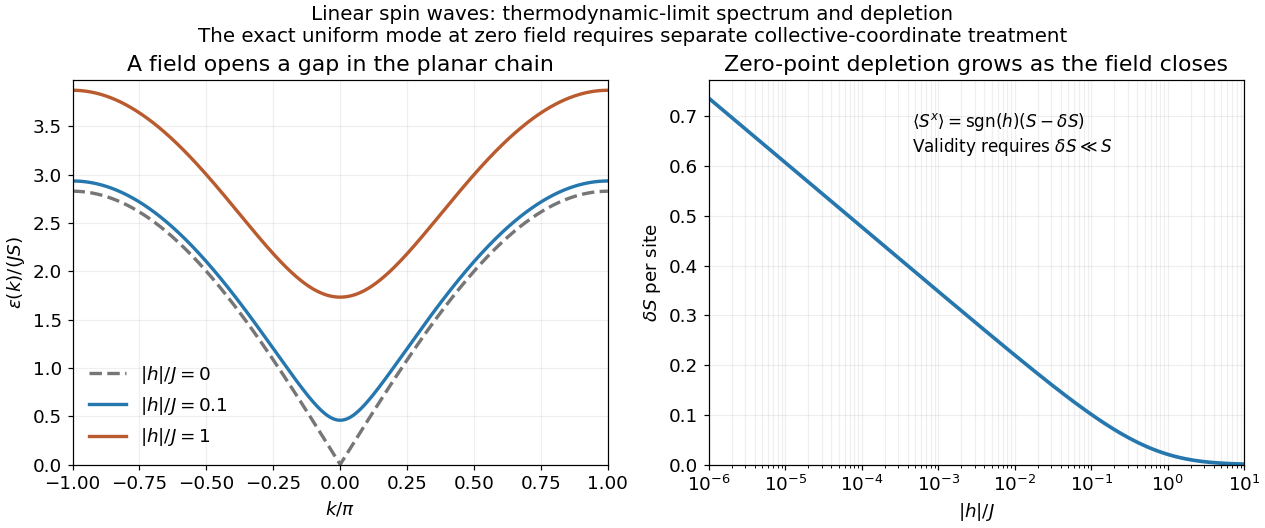
Use the unitary discrete Fourier transformThe transformed operators obey . The hopping terms contribute to the number coefficient. In the pairing sum, the odd sine part cancels between and . ThuswhereThe factor one half in the full momentum sum avoids counting an anomalous pair twice. For , for every allowed momentum. SetReal even angles ensure consistency between opposite momenta, and preserves the canonical commutation relations. The anomalous coefficient becomes . Normal ordering then giveswithThe field-polarized planar ferromagnetic spin wave has energy gap . The momenta run over the whole Brillouin zone once, including the self-inverse momenta and, for even , ; these use single-mode squeezing rather than introducing an extra independent partner.
The zero-field case has a zero-mode obstruction to bosonic Bogoliubov diagonalization. Its nonzero-momentum modes have , but , so no finite squeezing angle exists for the uniform mode. With , its Hamiltonian is , not an identically zero oscillator. For example, its matrix element between the vacuum and the two-boson number state is , whereas would vanish. Consequently the requested oscillator diagonalization is literal for nonzero field; at zero field treat the collective orientation separately or introduce a field regulator before taking a limit.
For nonzero field, the spin-wave ground state is the vacuum of all . The inverse Bogoliubov transformation gives and vanishing one-point oscillator averages. Translational invariance therefore gives the depletionRotating back to the physical axes yields, to the retained spin-wave order,The zero transverse components also follow from rotation by about the physical axis in a symmetry-preserving ground state. The nonzero depletion describes zero-point quantum fluctuations: the original boson vacuum is not the ground state because the anomalous terms create pairs. It is nonnegative and must satisfy for the expansion to be reliable. At strong field it tends to zero, with in the infinite-chain limit.
For fixed , the momentum sum has a finite thermodynamic limit obtained by . At zero field the uniform mode already has no oscillator vacuum, as explained in part d. Even after removing that mode, the nonzero modes behave asThus assigning a finite ordered moment by simply setting in the infinite momentum sum is invalid. The divergence indicates failure of this expansion about a fixed planar orientation; it is not a negative physical magnetization. At finite size an exact zero-field state chosen to have definite total has zero planar one-point magnetization by the continuous rotation symmetry. Establishing its full correlations requires a treatment beyond the divergent ordered-state approximation.

Articles by others on the same topic
There are currently no matching articles.