Assume the vector field and multiplier are continuously differentiable, as required for Green's theorem and uniqueness of trajectories. A nonconstant periodic trajectory of a planar autonomous system is a simple closed orbit: uniqueness prevents crossings, and one traversal can be taken over its least period. Let be its bounded interior. Along the orbit , , soGreen's theorem identifies this with , which is strictly positive by hypothesis, a contradiction. Thus there is no nonconstant periodic orbit. This standard periodic-orbit criterion does not by itself exclude stationary solutions.
For the first concrete system choose . ThenThere are also no equilibria: requires , but then . Consequently it has no periodic solution, including constant ones.
For the second system the origin is outside the domain of the printed vector field. For ,Thus for an admissible initial point with ,where , . These formulas are valid while , in particular for every . Trajectories rotate counterclockwise, spiral outward when , and inward when , approaching the unit circle. On they give , , a periodic orbit with least period . It is an attracting limit cycle. There is no contradiction with the preceding criterion: this vector field is singular at the origin and has the exhibited closed orbit.
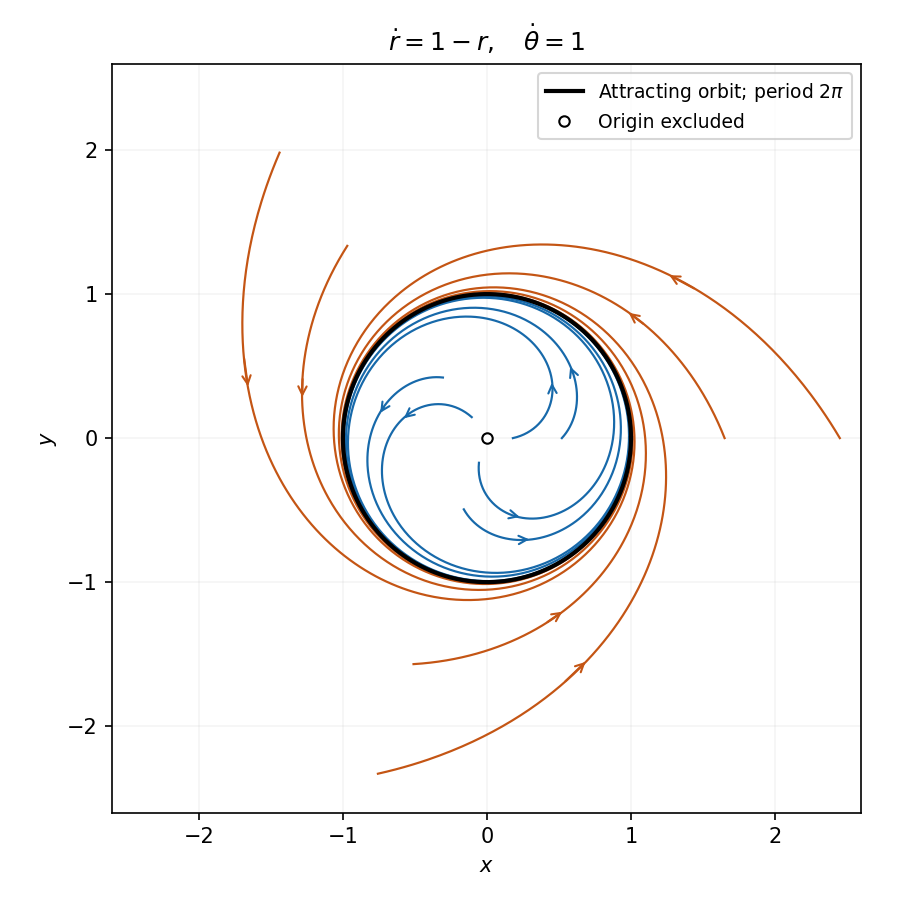
Counterclockwise trajectories approach the attracting unit circle
. Details. 
With parameter along a characteristic curve, the equations areTheir solutions are , and . Thus the projected curve satisfies , as required. Eliminating the parameters givesIndeed and , so , and the initial values hold.
The parameter map has Jacobian one and is globally invertible. Every point whose characteristic curve meets the initial segment therefore lies in the stripThe uniquely determined open region is its interior, with the boundary values determined on the two endpoint characteristic curves. Both signs of are included. Outside the strip, a general solution is with only required for . Smooth perturbations of supported outside that interval produce different solutions with the same prescribed data, proving the stated region is exact.
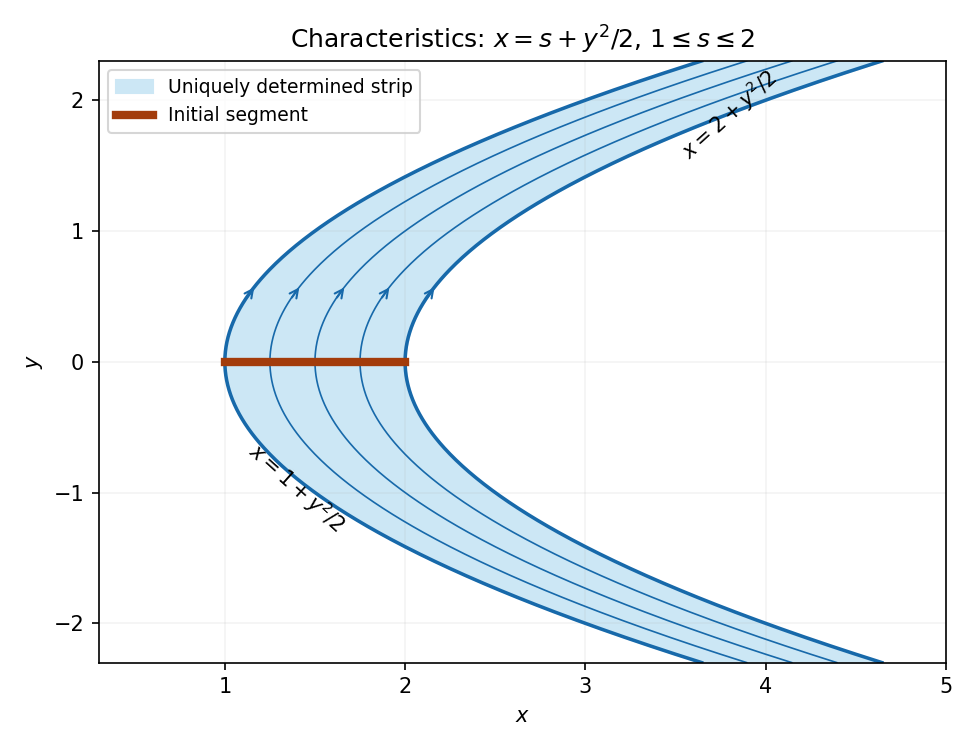
The characteristic strip determined by the entire initial segment
. Details. 
For a function for which the integral converges, the Laplace transform isFor a continuous function of exponential order this exists in a sufficiently far right half-plane. For the first input,This follows by evaluating the exponential antiderivative and using its decay at infinity.
Combining the exponential factors gives
The same integration by parts with replaced by givesFor the remaining unnumbered requests, the derivative and convolution formulas, under the usual convergence hypotheses, areApplying them to the general equation yields and thereforeFor the particular data, , and , soThe four transforms above giveAs a direct check, , , andAdding the last two expressions gives one, verifying the original equation as well as the required limit.
Articles by others on the same topic
There are currently no matching articles.