Put and define the Lagrange interpolation polynomialsTheir denominators are nonzero and . The polynomial has degree at most and vanishes at all distinct scalars, so it is zero. Suppose condition (a) holds, and put . Since is a constant multiple of ,Thus each lies in , and every vector is a sum of such vectors. If with , applying gives , because . Hence the sum is direct, proving (b). Conversely, on each the factor vanishes; the factors commute, so vanishes on every summand and therefore on . This proves the equivalence without invoking primary decomposition.
If and , then , so . Conversely, if each summand is preserved, then on both and act as . They agree on all summands and hence on . Therefore
The dual space is the vector space of linear maps , with pointwise operations. For the given basis define coordinate forms by . These are linear and satisfy . If , evaluation at gives . For every linear form ,so the coordinate forms span the dual and form its dual basis.
In the polynomial example write . ThenThese recover all three coefficients, so they span and, since the dual has dimension three, form a basis. Explicitly the basis dual to isEvaluation on the three monomials verifies the dual-basis identities directly.
An element of an integral domain is an irreducible element when it is nonzero and not a unit, and any factorization has at least one unit factor. The exclusions of zero and units are part of the definition.
An element is a prime element when it is nonzero and not a unit, and implies or . If and is a prime element, assume for example . Cancellation in gives , so is a unit. This proves every prime element is an irreducible element.
In a Euclidean domain, each nonzero ideal has a generator of least Euclidean value: division of another member by that generator leaves a remainder in the ideal of smaller value, so the remainder must vanish. Let be an irreducible element and suppose but . Write . Since , irreducibility says is a unit or is associate to . The second case would give , so is a unit. Hence for some . Multiplying by shows . Thus irreducibles in a Euclidean domain are prime.
For , use the multiplicative integer field norm . Units have field norm one and are exactly . If were a product of nonunits, their norms would be integers greater than one multiplying to four, hence both would have field norm two. But has no integer solution: makes the left side at least seven, and would give . Therefore 2 is an irreducible element.
On the other hand,is divisible by 2, while neither factor is, because divisibility by 2 requires both integer coefficients to be even. Thus 2 is not a prime element in this ring. It is also not a prime element in : , but . In fact is already a nontrivial factorization there.
A function is holomorphic on an open set if it is complex differentiable at every point of that set. At , take difference quotients first along real increments. Their limit is , so and . Along imaginary increments,so and . These limits prove existence of all four partial derivatives and the Cauchy-Riemann equations , .
For the first example, the identity function and the reciprocal function are holomorphic away from zero, so is holomorphic on the given domain, with
Write . For , ,The two Cauchy-Riemann equations would require and simultaneously, impossible when . Thus is not complex differentiable at any nonzero point.
At zero, however,So is complex differentiable at zero, with derivative one, but is not holomorphic on or on any nonempty open subset. Complex differentiability at a single point is weaker than holomorphy in a neighborhood.
Choose a small positively oriented circle about inside the given region. Cauchy's theorem on the region between the two contours givesContinuity makes the last integrand converge uniformly to as . Its limit is , proving the Cauchy integral formula.
The same formula holds with an interior point near . Subtract its value at and divide by :The contour is a positive distance from , so the integrands converge uniformly as . Passing to the limit gives the differentiated formulaOn the unit circle, and , proving the requested identity. Hence the requested integral isThe first integral is . For the second useThe differentiated formula applied to the constant function gives ; the remaining two terms integrate to . Therefore
At a zero , Taylor's theorem gives near . If some coefficient is nonzero, let be the least such index. Then with , and continuity makes nonzero on a smaller disc. Thus is an isolated zero. A limit point of zeros is also a zero by continuity and cannot be isolated, so all Taylor coefficients there vanish and vanishes on a nonempty open disc.
Let be the set of points having a neighborhood on which vanishes. It is nonempty and open. A point in its relative closure either already belongs to or is a limit point of distinct zeros; the preceding argument puts it in in either case. Thus is also relatively closed. Connectedness of gives , proving is identically zero.
For conjugate reflection, the disc is invariant under conjugation, andHence is holomorphic, with derivative . If is real on the real diameter, then for real , . The holomorphic difference therefore has zeros accumulating at zero, and the identity theorem just proved gives on the entire disc.
Assume the vector field and multiplier are continuously differentiable, as required for Green's theorem and uniqueness of trajectories. A nonconstant periodic trajectory of a planar autonomous system is a simple closed orbit: uniqueness prevents crossings, and one traversal can be taken over its least period. Let be its bounded interior. Along the orbit , , soGreen's theorem identifies this with , which is strictly positive by hypothesis, a contradiction. Thus there is no nonconstant periodic orbit. This standard periodic-orbit criterion does not by itself exclude stationary solutions.
For the first concrete system choose . ThenThere are also no equilibria: requires , but then . Consequently it has no periodic solution, including constant ones.
For the second system the origin is outside the domain of the printed vector field. For ,Thus for an admissible initial point with ,where , . These formulas are valid while , in particular for every . Trajectories rotate counterclockwise, spiral outward when , and inward when , approaching the unit circle. On they give , , a periodic orbit with least period . It is an attracting limit cycle. There is no contradiction with the preceding criterion: this vector field is singular at the origin and has the exhibited closed orbit.
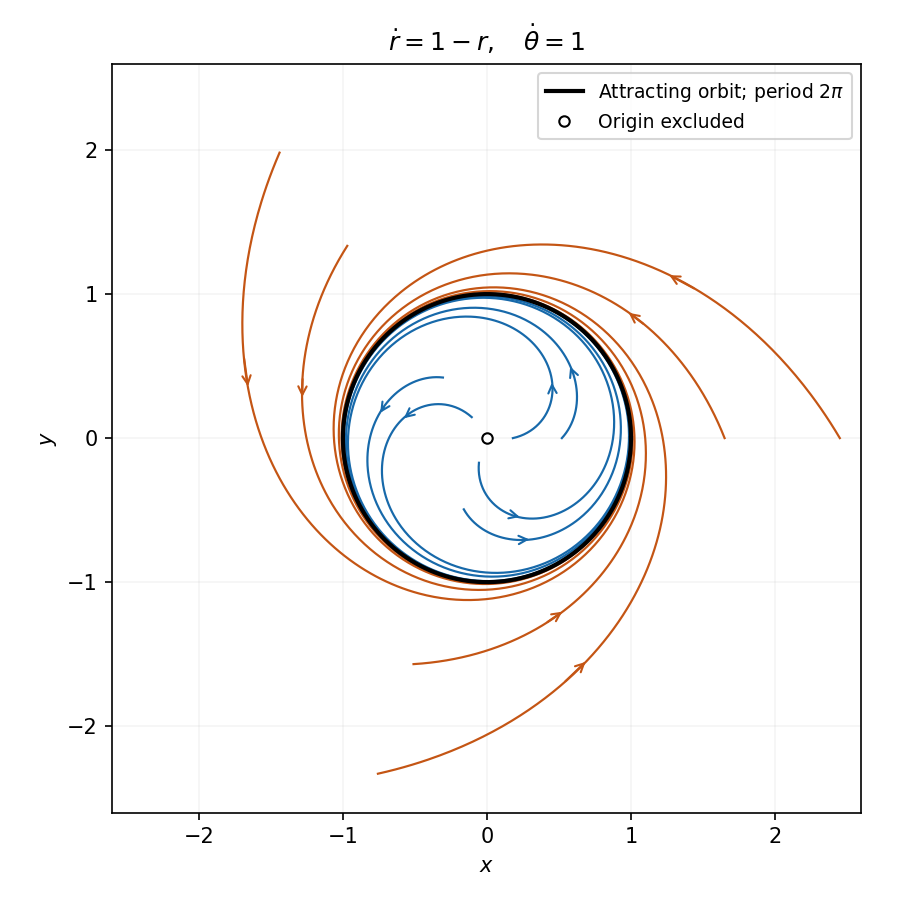
Counterclockwise trajectories approach the attracting unit circle
. Details. 
With parameter along a characteristic curve, the equations areTheir solutions are , and . Thus the projected curve satisfies , as required. Eliminating the parameters givesIndeed and , so , and the initial values hold.
The parameter map has Jacobian one and is globally invertible. Every point whose characteristic curve meets the initial segment therefore lies in the stripThe uniquely determined open region is its interior, with the boundary values determined on the two endpoint characteristic curves. Both signs of are included. Outside the strip, a general solution is with only required for . Smooth perturbations of supported outside that interval produce different solutions with the same prescribed data, proving the stated region is exact.
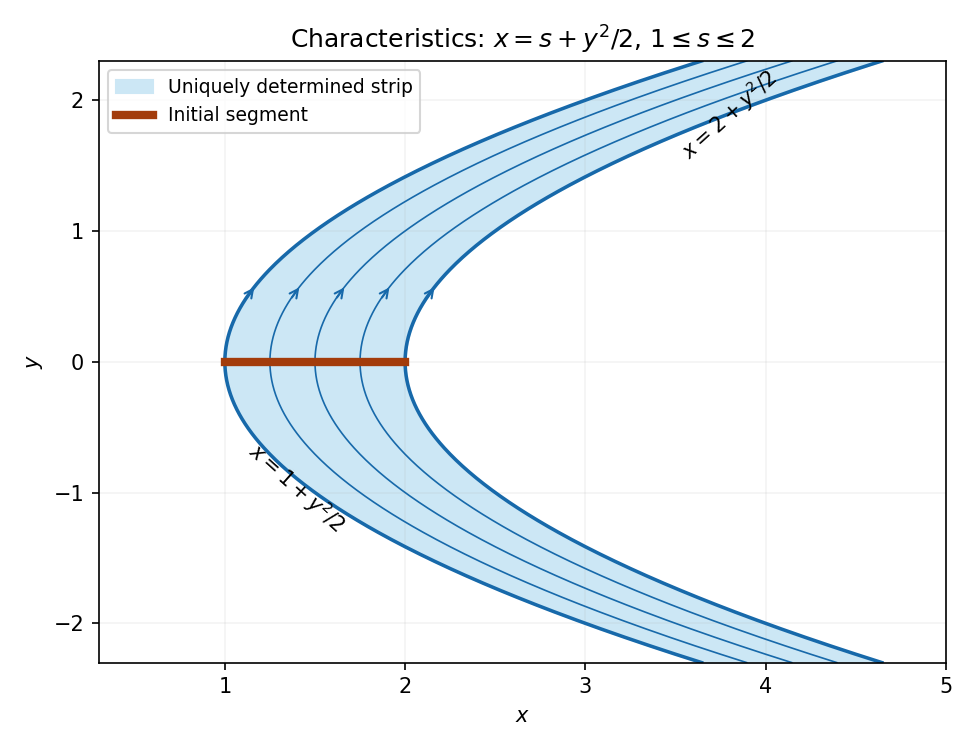
The characteristic strip determined by the entire initial segment
. Details. 
For a function for which the integral converges, the Laplace transform isFor a continuous function of exponential order this exists in a sufficiently far right half-plane. For the first input,This follows by evaluating the exponential antiderivative and using its decay at infinity.
Combining the exponential factors gives
The same integration by parts with replaced by givesFor the remaining unnumbered requests, the derivative and convolution formulas, under the usual convergence hypotheses, areApplying them to the general equation yields and thereforeFor the particular data, , and , soThe four transforms above giveAs a direct check, , , andAdding the last two expressions gives one, verifying the original equation as well as the required limit.
Articles by others on the same topic
There are currently no matching articles.