In bacterial transcription initiation, the RNA polymerase holoenzyme uses a promoter-specific sigma factor to recognize promoter elements and form a closed DNA-bound complex. Subsequent local DNA melting opens a transcription bubble, positioning the template strand in the active site: this is an open promoter complex. The enzyme can then initiate RNA synthesis and escape into elongation. LacI, the lac repressor, binds the lac operator overlapping or close to the promoter and can prevent productive promoter binding or its progression to an open complex; operator arrangement and DNA looping can strengthen repression. One should not assume every repressor acts at exactly the same microscopic step.
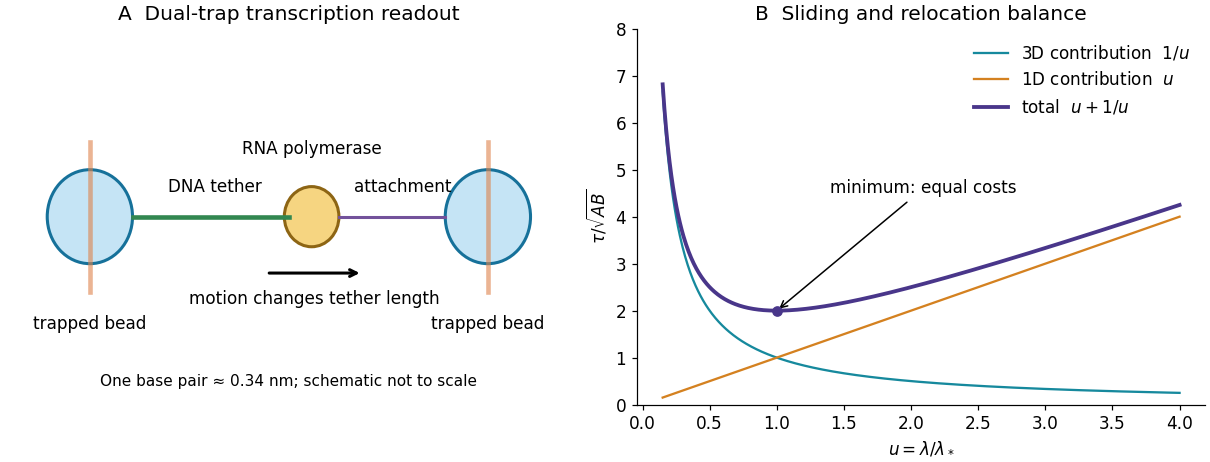
A high-resolution optical tweezers assay mechanically connects one trapped bead to RNA polymerase and another bead to an upstream or downstream DNA handle. Polymerase motion changes the tether length; measuring bead displacement and the calibrated restoring force reports elongation under a known load. A feedback force clamp can keep that load approximately constant. Reversing the tether geometry permits assisting and opposing loads. The left panel below shows the mechanical arrangement rather than a copied apparatus image.
A base-pair advance is only about along B-form DNA. Resolving that increment requires exceptional mechanical stability, suppression of drift and laser-pointing noise, calibration of trap and tether compliance, and sufficient temporal sampling to separate steps from thermal bead fluctuations. Position histograms, dwell detection and their spatial correlations can expose a repeated increment; one should also test nucleotide-dependent motion, pauses and backtracking. Stabilized dual-trap measurements combined with transcription-product analysis established approximately one base-pair advance per incorporated nucleotide.[ref]
Direct observation of base-pair stepping by RNA polymerase by Elio A. Abbondanzieri and others. Single-molecule displacement measurement and independent gel analysis supporting one-base-pair stepping

Treat the target as a stationary perfectly absorbing sphere of reaction radius , surrounded by an effectively uniform reservoir of protein number density . At steady state the radial diffusion equation givesThe inward capture rate per target is the integral of the Fick's first law:For dilute independent targets of number density , the volume association rate is , soThis is the Smoluchowski association rate, in volume per time because the concentrations are number densities. If the target also diffuses, use the relative diffusion coefficient . Orientation constraints, incomplete absorption and chromosome geometry can reduce the actual association rate relative to this ideal collision limit.
The given sphere has radius . The Stokes–Einstein relation at an illustrative givesFor well-mixed independent searchers in cell volume , the target-arrival rate is . The corresponding mean first arrival time isThe source does not fix , the reaction radius or temperature. For an order-of-magnitude estimate, a bacterial volume around and reaction radius – give about –. A 20-base-pair B-form site is about long, supporting a nanometre-scale capture radius but not uniquely defining its spherical value. The estimate is the ideal diffusion-limited time, not a measured intracellular search time: nonspecific binding, orientational matching, crowding and limited accessibility are excluded.
If the outcome is the first successful binding to any operator, ten well-separated functionally independent unoccupied targets give ten times the total capture rate. Henceor roughly – for the estimates above. This assumes nonoverlapping capture zones and no significant depletion before the first event. The first-arrival time at one designated operator is not divided by ten merely because other sites are added, and filling all ten sites is a different occupancy problem.
The term is the bulk-diffusion search cost: increasing the effective length of DNA searched after each encounter enlarges the useful capture region and reduces this contribution. The term is the accumulated sliding cost. Approximately DNA landing-and-sliding episodes, each taking order , give . These are scaling estimates; geometric constants and correlated revisits are omitted by the supplied model.
Thus the facilitated target search is slow as , because too little sequence is examined per encounter, and slow at very large , because sliding and repeated local exploration take too long. A finite intermediate minimum balances 1D scanning against 3D relocation. The right panel of the figure in solution shows the two contributions and their sum. The model requires a useful range of sliding lengths below the full chromosome length, finite positive diffusion coefficients and effective relocation between episodes; it is not a claim that arbitrarily large is physically available.
Write and . Then , soThereforeAt the optimum, the two contributions are equal. Expressing the optimal sliding length directly in terms of the minimum time givesThese relations concern the optimal point; a general nonminimal time can correspond to two different sliding lengths. A geometric or kinetic restriction on the allowed sliding length can instead place the optimum at a boundary.
Use a short inducer pulse to release DNA-bound fluorescent LacI, then remove extracellular IPTG rapidly and start the search clock after washout. The supplied entry, binding and dissociation times imply a synchronization uncertainty of order a few tenths of a second, which must be measured and separated from the search latency. If rebinding is faster than that dead time, the protocol alone cannot resolve the true mean without a kinetic correction or faster triggering.
Image individual cells rapidly enough to distinguish freely diffusing proteins from a persistent immobilized fluorescent spot at the single operator. Prelocate that locus from an independent position marker or a previous binding event. Score the first specific capture after each reset; controls lacking a functional target distinguish stable operator binding from nonspecific DNA residence. Correct for localization error, bleaching, blinking, missed brief events and target motion, and verify that the fluorescent tag does not substantially change the search kinetics.
With four independent freely searching molecules, each having an approximately exponential single-molecule target-arrival time of mean , the first-arrival survival isThus report both the observed first capture among four and the inferred mean for one searcher. If the number of visible available molecules varies, use and account for censoring rather than blindly multiplying by four. Repeated resets and many cells estimate the distribution; deviations from an exponential test the independent well-mixed approximation. The rapid inducer manipulation defines a synchronization strategy, not an assumption that all subsequent intracellular search paths are identical.
Articles by others on the same topic
There are currently no matching articles.