Place the carbon and sulfur nuclei on a line separated by , with masses and . The center of mass lies between them and closer to the heavier sulfur nucleus. In the linear rigid rotor approximation, remains fixed while the molecule rotates.
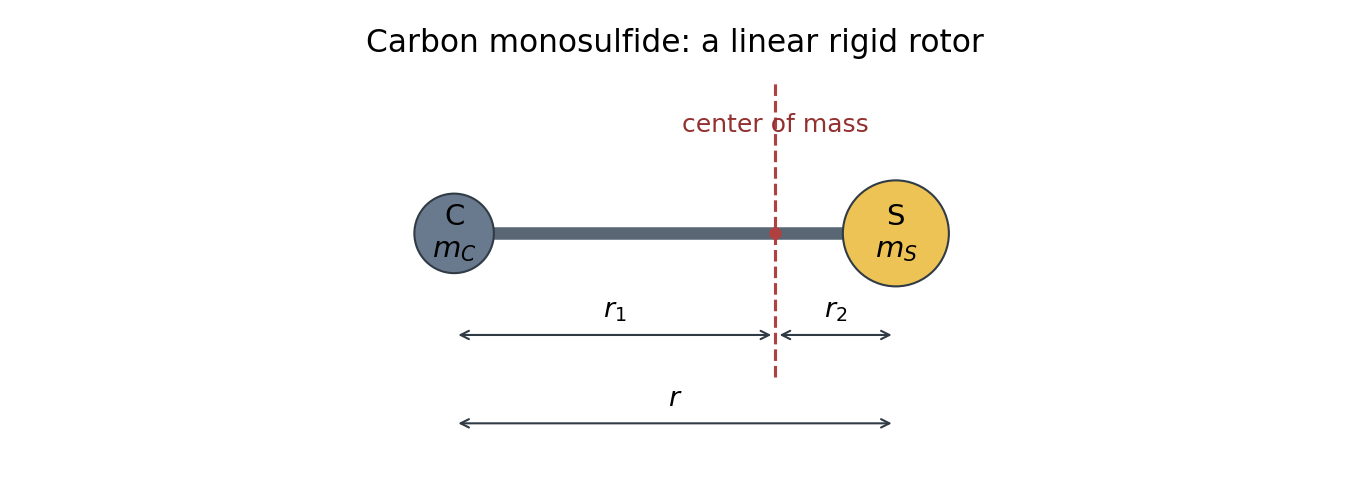
Original carbon monosulfide rotor diagram showing masses, bond length and distances from the center of mass
. Details. Measure from the carbon nucleus toward the sulfur nucleus. The definition of the center of mass givesTherefore the requested distance isThe other distance is , consistent with .
For an axis through the center of mass perpendicular to the bond, the point-mass moment of inertia isThe prefactor is the reduced mass ; this is the standard reduction of a two-body linear rigid rotor to .
Using the stipulated integer isotope masses givesThe rotational constant in wavenumber units isHere must be expressed in when is in SI units. Equivalently calculate in first, then divide by in .
The rotational state populations start at . Their statistical weight factor initially favors higher , while the Boltzmann factor eventually suppresses them, producing one maximum followed by a tail tending to zero. The physically allowed values occur at integer ; a continuous curve only guides the eye.
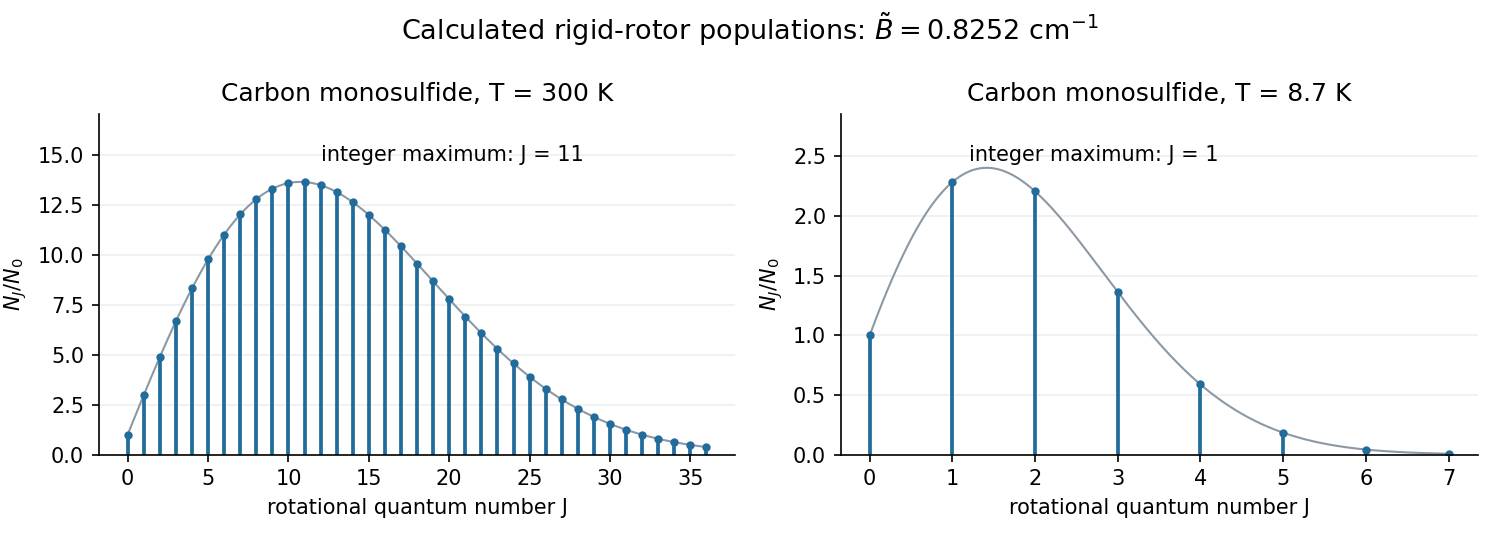


Set , the rotational temperature. For a continuous nonnegative variable ,Equating this derivative to zero gives the most populated rotational levelThe second derivative is , so this is a maximum when . At lower temperatures the constrained continuous maximum is . For the physical integer maximum compare the nearby allowed levels explicitly.
The calculated rotational constant gives . At room temperature, taken as , the continuous maximum is ; comparing the adjacent integer populations gives . Taking instead gives and the same integer answer.
At , . In particular,and , so . The integer comparison avoids treating a noninteger angular momentum quantum number as a physical state.
Low rotational energy spacings can be excited in cold interstellar gas when electronic and most vibrational excitations are frozen out. A polar molecule such as carbon monosulfide has allowed electric dipole transition lines whose frequencies depend on its moment of inertia, providing a distinctive pattern for rotational spectral line assignment. Several matching spectral lines and their isotope shifts give a much stronger identification than one coincidence. The method is especially effective for polar species; a molecule without a permanent electric dipole moment lacks an ordinary pure electric-dipole rotational spectrum.
Articles by others on the same topic
There are currently no matching articles.