Here is absolute pressure, is volume, is amount of substance in moles, is the molar gas constant and is absolute thermodynamic temperature in kelvin. This is the ideal gas law; consistent SI units give pressure in pascals, volume in cubic metres and in .
The ideal gas model takes the particles' own volume to be negligible compared with the container volume and neglects intermolecular interactions except during idealized elastic collisions. These assumptions remove excluded-volume and attractive-force corrections to the ideal gas law. A classical dilute gas also requires that quantum-statistical effects be negligible, but the first two are the requested mechanical assumptions.
The standard enthalpy of formation is the enthalpy change on forming exactly one mole of the specified compound in its stated standard state from its constituent chemical elements in their reference states at the same specified temperature. The reference states are normally the stable elemental forms at the standard pressure. A standard state does not itself mean 298 K; temperature must be stated separately.
The Clausius statement of the second law forbids a cyclic device whose sole effect is transfer of heat from a colder thermal reservoir to a hotter one. The Kelvin-Planck statement of the second law forbids a cyclic device whose sole effect is complete conversion of heat drawn from a single thermal reservoir into work. These are equivalent formulations of the Second law of thermodynamics; an ordinary refrigerator is allowed because supplied work is an additional effect.
For , reversing the standard formation reaction gives . Thus decomposition is thermodynamically favoured under the corresponding standard conditions. benzene persists because it is kinetically stable on the laboratory timescale. Breaking and reorganizing its bonding framework requires access to high-activation energy pathways, and suitable reactive intermediates or catalysts are absent under ordinary storage conditions. A negative Gibbs free energy change specifies the favoured thermodynamic direction, not a rapid reaction rate; thermal energy does not automatically overcome a large barrier.
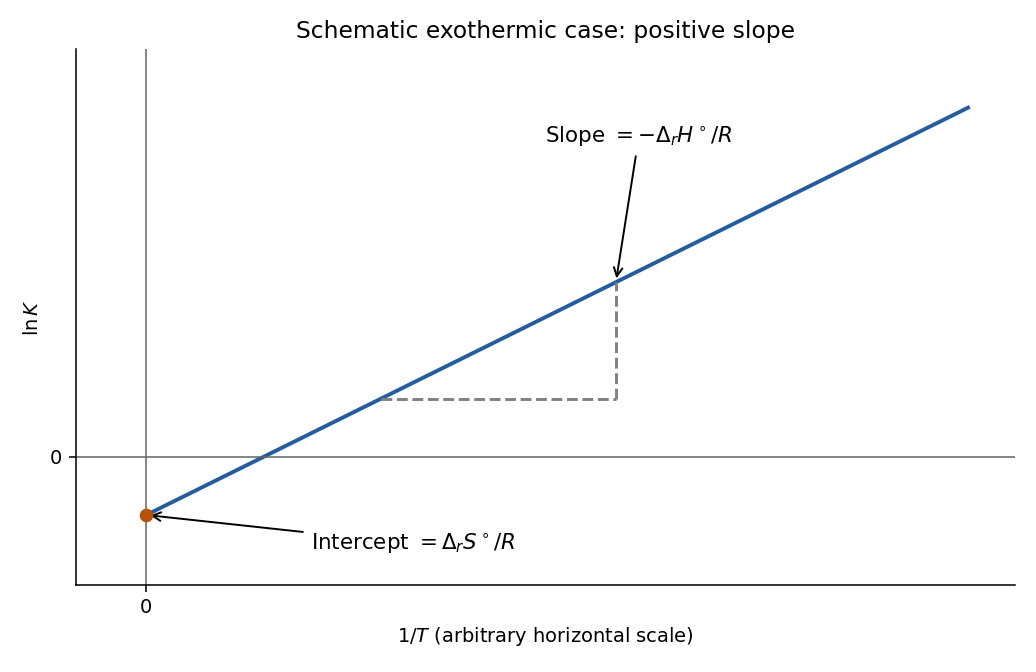
Combining with the equilibrium relation givesIf reaction enthalpy and reaction entropy are approximately constant over the measurement interval, a plot of against is straight, with slope and intercept . An exothermic reaction therefore has a positive slope. In the more general local form, the Gibbs–Helmholtz equation giveswhich is the Van't Hoff equation without assuming a constant enthalpy.
Use a dimensionless equilibrium constant built from thermodynamic activities. Measure sufficiently separated temperatures after verifying true equilibrium, and avoid phase changes or a changing chemical reaction. Temperature-dependent heat capacities cause curvature: the fitted straight-line slope then estimates an interval-dependent enthalpy. Small errors in the equilibrium measurements can produce large slope errors over a narrow range. The entropy intercept is particularly sensitive because requires distant extrapolation, and slope/intercept errors are correlated. A numerical line through a few points is not, by itself, evidence that all these assumptions hold.

The exponential function makes modest Gibbs free energy differences correspond to extreme equilibrium ratios. At 298 K, ; for example,The minor equilibrium component may therefore lie below detection, or a species' required thermodynamic activity may be experimentally inaccessible. Apparently complete conversion supplies a bound on , rather than an accurate finite value. Additionally, some reactions do not reach chemical equilibrium within a practicable observation time because of kinetic barriers. The thermodynamic identity still holds even when direct room-temperature determination of both sides of the equilibrium ratio fails.
Articles by others on the same topic
There are currently no matching articles.