Developmental science, Part I, Trinity Term 2022: 20 April, 09:30 BST; one hour writing time. These independent essays answer all five printed options and use an evidence cutoff of 20 April 2022. Later findings are not used to answer the historical paper.
Course: Developmental science course of the year 2 of the psychology (experimental) course of the University of Oxford. Public source: Oxford-supplied archive, member a16818w1.pdf.[ref]
Developmental science, Part I, 2022 by University of Oxford. Cover and question page, A16818W1
Executive functions should contribute most when learning or assessment requires keeping several pieces of information active, suppressing an attractive error, coordinating successive operations or changing strategy. This predicts particularly strong links with multistep mathematics, mathematical problem solving and reading comprehension, alongside classroom engagement and following instructions. It predicts a smaller direct contribution to well-practised fact retrieval or fluent decoding once those operations are automated. That is a task-demand hypothesis, not a claim that every mathematics score must correlate more strongly with executive functions than every literacy score.
Working memory maintains goals and intermediate results: a child doing a subtraction with borrowing must retain both the original problem and its updated intermediate state. Inhibitory control helps suppress a larger-number answer that is tempting but irrelevant, or a familiar operation when the problem requires another. Cognitive flexibility supports switching between representations or abandoning an unsuccessful strategy. In reading, maintaining earlier propositions and rejecting an initially plausible interpretation should matter especially for comprehension and inference; knowledge of letter–sound correspondences is not itself an executive function. Repeated practice can change which process is the bottleneck, so developmental stage and familiarity matter.
Historically, the unity-and-diversity framework helped replace an undifferentiated “executive ability” with correlated but distinguishable processes. Akira Miyake and colleagues used several tasks per proposed component and latent variable analysis to separate common executive variance from individual task demands. Their influential study tested adults: its factor structure cannot simply be assumed to describe preschool children. It nevertheless supplies a crucial methodological lesson. A single executive task measures the intended control process together with perception, language, motor speed and task-specific strategies. Treating a raw score as a pure capacity risks attributing the wrong source of variance to school achievement.[ref]
More directly, Clancy Blair and Rachel Peters Razza followed 141 children from low-income homes, measuring preschool self-regulation and later kindergarten mathematics and literacy. Their inhibition measure required children to tap once when the experimenter tapped twice and twice after one tap: the apparatus is simple, but the rule requires suppressing imitation and maintaining an opposite response mapping. Inhibitory control was associated with emerging mathematics and reading after accounting for intelligence. This supports the importance of regulation during early learning, but the design was observational, not random assignment to different inhibitory capacities. Shared language, family circumstances or classroom experience could influence both performances.[ref]
Relating effortful control, executive function, and false belief understanding to emerging math and literacy ability in kindergarten by Clancy Blair and Rachel Peters Razza. Child Development 78, 647–663; Measures and academic-outcome regressions
Lucy Cragg and colleagues provided a more differentiated mathematical analysis. Their sample of 293 participants aged eight to twenty-five completed executive tasks and measures of factual knowledge, procedures and conceptual understanding. Working memory had both an association with overall mathematics and indirect associations through mathematical component skills; inhibition measured in a numerical context was linked to factual and procedural knowledge. This is more informative than treating “mathematics” as one outcome. However, statistical mediation in an age-spanning observational sample does not establish that changing the putative mediator would change attainment. Numerically framed executive tasks can also share content with the achievement measures, increasing the apparent specificity of the association.[ref]
Direct and indirect influences of executive functions on mathematics achievement by Lucy Cragg and others. Cognition 162, 12–26; abstract, executive-function battery and mediation models
Kate Cain and colleagues supply a corresponding literacy result. In assessments at ages eight, nine and eleven, working memory and comprehension components such as inference and monitoring predicted reading comprehension after controls for word reading and verbal ability. Sentence-span and digit-working-memory measures helped avoid defining the entire construct by one task. This supports a contribution beyond decoding, but the reported concurrent relations at successive ages are not an experimental demonstration of causal direction; comprehension itself can affect performance on verbally loaded memory tasks.[ref]
Children's reading comprehension ability: concurrent prediction by working memory, verbal ability, and component skills by Kate Cain and others. Journal of Educational Psychology 96, 31–42; longitudinal assessments at eight, nine and eleven years, concurrent prediction models
Evidence across populations qualifies the temptation to make executive functions the master explanation of achievement. Greg J. Duncan and colleagues compared six longitudinal datasets while controlling earlier child skills and family background. School-entry mathematics and reading were strong predictors of subsequent attainment; attention added prediction, whereas several socioemotional measures did not. Attention ratings are not interchangeable with laboratory inhibition or working memory measures. The result supports a classroom-regulation pathway while showing that already acquired domain knowledge remains central. Learning also exercises executive control, so baseline-adjusted longitudinal associations do not eliminate reciprocal influence or unmeasured confounding.[ref]
School readiness and later achievement by Greg J. Duncan and others. Developmental Psychology 43, 1428–1446; abstract and cross-dataset models; corrected version
Intervention offers a sharper causal test, but its target and outcome must be distinguished. Darren L. Dunning and colleagues randomly allocated seven- to nine-year-olds with low working memory to adaptive computerised training, low-load nonadaptive training or no training. The adaptive condition improved several untrained working memory tests, with some gains maintained over time, but did not produce corresponding academic or classroom-analogue benefits. The active comparison helps separate memory-load effects from attention, computer practice and expectations. Crucially, improvement on an untrained but structurally similar memory test is near transfer; improved reading or mathematics would be far transfer. One does not entail the other.[ref]
Does working memory training lead to generalized improvements in children with low working memory? by Darren L. Dunning and others. Developmental Science 16, 915–925; three-arm randomised trial, Results and Discussion
This trial does not show that working memory is irrelevant to achievement. A resource can constrain performance even when practising isolated tasks fails to change how it is deployed in a classroom. Nor does one intervention test all executive components, age groups or teaching methods. It does undermine the stronger inference from correlation to a promise that generic executive training will raise school attainment. Supporting instruction through shorter directions, external reminders and staged problems can reduce executive demands; whether any particular classroom support improves learning still requires an appropriately controlled outcome study.
The most defensible answer is therefore conditional and specific. Executive differences are especially plausible influences on managing novel, attentionally demanding, multistep learning and demonstrating that learning under load. They operate alongside knowledge, language, motivation and opportunity. Strong evidence would combine reliable multi-task executive measures, differentiated academic outcomes, repeated measurements with comparable meaning across ages, and interventions with active controls and delayed achievement tests. Existing prospective and experimental evidence supports executive functions as contributors to learning, while limiting claims that they are a single cause of educational success.
Calling childhood amnesia a myth is defensible only if the supposed myth is that infants cannot form lasting memories, or that adults' earliest reported age is an exact biological boundary. Neither proposition is warranted. It does not follow that the relative scarcity of accessible autobiographical memories from early childhood is imaginary. The central distinction is between forming a memory, retaining information, retrieving it with particular cues, reporting it verbally and assigning it a date. Evidence about one stage cannot automatically settle the others.
An important methodological change was the development of tests that do not ask infants to narrate an event. Carolyn Rovee-Collier and colleagues trained three-month-olds to move a crib mobile through footkicking. A ribbon-linked mobile provides a visible consequence of the infant's action; retention can then be assessed with the mobile present but no longer moving contingently. Elevated kicking relative to a pretraining baseline indicates retention of the learned relation, rather than a verbal report. In their 1980 study, a brief reminder exposure twenty-four hours before testing reinstated performance after delays of two or four weeks, despite the usual loss of the trained response after a much shorter interval. This directly challenges an account equating an initial failure to perform with complete erasure of the earlier experience.[ref]
Reactivation of infant memory by Carolyn Rovee-Collier and others. Science 208, 1159–1161; mobile conditioning, reminder and retention experiments
The inference has limits. Reminder controls must show that the exposure does not simply teach an untrained infant the response, and changes in general activity must be separated from memory-specific kicking. More fundamentally, memory for an action–outcome contingency is not equivalent to an adult's consciously recollected autobiographical episode. A demonstration of infant learning refutes global incapacity to remember; it does not prove that the adult can later re-experience that mobile episode as part of a personal life history. Reactivation under a matching cue also need not imply spontaneous retrieval without that cue.
Gabrielle Simcock and Harlene Hayne brought the verbal-report problem into a more naturalistic event. Young children experienced a novel “Magic Shrinking Machine”: interacting with an apparatus produced apparently smaller versions of toys. Vocabulary was measured when the event occurred and again after a delay; later tests included verbal recall, photograph recognition and behavioural reenactment. Children could retain event information nonverbally while failing to describe aspects for which they had lacked productive vocabulary at encoding, even after their vocabulary expanded. The design provides known event content and an opportunity to compare different response formats. It shows how a later verbal interview can underestimate retained information.[ref]
Breaking the barrier? Children fail to translate their preverbal memories into language by Gabrielle Simcock and Harlene Hayne. Psychological Science 13, 225–231; Magic Shrinking Machine, verbal and nonverbal tests
It would still be too strong to infer intact, adult-like episodic memory hidden behind a purely linguistic barrier. Recognition supplies information unavailable in free recall, and reenactment can exploit familiar objects and motor routines. Unequal performance may therefore reflect unequal cue support as well as representational format. The appropriate conclusion is that reporting limitations contribute to apparent amnesia, not that every unreported early event survives unchanged. Prospective tests should separately vary cue reinstatement and response modality rather than interpreting all nonverbal successes as full autobiographical recollection.
Memory dating provides another challenge to a sharp boundary. Qi Wang and Carole Peterson followed a small group of children across an eight-year interval, asking for their earliest memories and their estimated ages at those events. Some of the same events remained reportable but were assigned progressively later ages. This forward telescoping can make an early-life period seem empty when surviving memories have migrated out of it on a retrospective timeline. Repeatedly following individual events is more informative than comparing different people's single earliest-memory reports. However, substantial attrition and uncertain initial dates limit the inference: a change in reported date does not establish the objectively correct date or show that dating error explains all missing memories.[ref]
The fate of childhood memories by Qi Wang and Carole Peterson. Frontiers in Psychology 6, 2038; initial, two-year and eight-year memory dating interviews
The strongest reason to reject the blanket “myth” claim comes from prospective evidence of actual loss of access. Patricia J. Bauer and Marina Larkina documented conversations about specific events when children were three, then interviewed different subgroups at ages five to nine. Five- to seven-year-olds recalled at least sixty per cent of those early events, whereas eight- and nine-year-olds recalled fewer than forty per cent. Thus memories that demonstrably existed in childhood later became unavailable to the interview procedure. Older children's surviving narratives could be richer even while fewer events remained accessible: increasing narrative skill and increasing loss of early memories are compatible.[ref]
The onset of childhood amnesia in childhood by Patricia J. Bauer and Marina Larkina. Memory 22, 907–924; age-three interviews and prospective follow-ups at ages five to nine
That study does not isolate a single neural cause. Longer retention intervals accompany older test ages, parent–child conversations are themselves retrieval practice, and forgotten-at-test does not mean physically erased. Nevertheless, it rules out explaining the entire phenomenon as failure to encode in the first place, and it cannot be dismissed as adults merely misdating every surviving memory. The outcome to explain is a developmental distribution of accessibility produced over time.
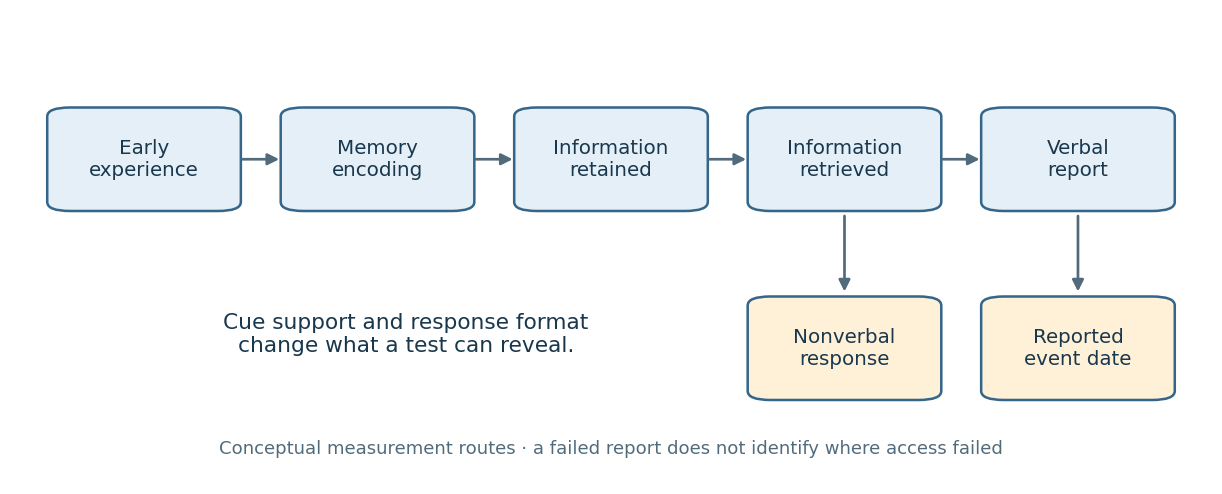

This framework yields clear discriminating predictions. A retrieval account predicts improvement when appropriate cues are reinstated without teaching new event content. A verbal-expression account predicts better nonverbal than verbal performance when language at encoding is limited. A dating account predicts shifts in the age assigned to an otherwise recognisable event. A forgetting account predicts loss of access to prospectively documented events. These mechanisms can coexist, so success for one is not a refutation of all the others.
By the 2022 evidence base, childhood amnesia should therefore be treated as a genuine pattern of sparse later autobiographical access whose boundaries and mechanisms are often oversimplified. The myths are a memoryless infancy, a universal discontinuity at one birthday and the assumption that an unsuccessful verbal report proves no retained information. Rejecting those myths makes the phenomenon more precise; it does not abolish the explanatory problem.
Greater transparency and reproducibility have changed developmental psychology's estimates, measurement practices and theoretical confidence, but have not simply replaced a collection of “true” findings with “false” ones. Computational reproducibility asks whether the same data and documented analysis yield the same result. Scientific replication asks what happens with new observations. Preregistration makes planned tests distinguishable from exploratory choices; open materials permit checking whether ostensibly similar studies actually use the same procedure. None of these, by itself, guarantees construct validity or representative sampling.
The marshmallow task illustrates a substantive change in interpretation. Walter Mischel's early experiments offered preschoolers a smaller immediate reward or a preferred delayed reward and manipulated how attention was directed during waiting. Distraction increased delay. The original experimental programme therefore already showed sensitivity to cognitive strategy and setting, rather than a fixed quantity of virtue revealed by a treat. Later predictive associations are a different claim from those immediate experimental effects.[ref]
Cognitive and attentional mechanisms in delay of gratification by Walter Mischel and others. Journal of Personality and Social Psychology 21, 204–218; experimental manipulations of attention during waiting
Tyler W. Watts and colleagues revisited long-term prediction in a larger and more diverse cohort. Their 2018 conceptual replication used a waiting task at fifty-four months and adolescent achievement outcomes. Associations were substantially reduced after adjustment for family background, early cognitive abilities and the home environment; much of the achievement difference was concentrated at the lowest waiting times. An important measurement difference was the seven-minute ceiling, rather than treating all waiting tasks as interchangeable. These results weaken a simple causal story in which training a preschooler to wait longer should, by itself, transform later attainment. They do not show that self-regulation never matters, because adjustment can remove both confounding and potentially meaningful pathways.[ref]
Revisiting the marshmallow test by Tyler W. Watts and others. Psychological Science 29, 1159–1177; Delay of gratification measure, adjusted models and measurement limitations
Celeste Kidd and colleagues supplied experimental evidence for one alternative mechanism: environmental reliability. Before the waiting task, children encountered an adult who either fulfilled or failed promises about appealing materials. Children subsequently waited longer after reliable experiences. The observation matters because apparent “poor self-control” can be an understandable response to expecting that a promised reward will not arrive. This small experiment supports contextual causation under its own conditions, not a claim that all socioeconomic differences in waiting are caused by trust. Together, the studies shift the target from an isolated child trait to the interaction between control, expectations and circumstances.[ref]
Rational snacking by Celeste Kidd and others. Cognition 126, 109–114; reliable versus unreliable experimenter manipulation
Neonatal imitation illustrates why replicability also depends on the inferential contrast. Andrew N. Meltzoff and M. Keith Moore's 1977 report described very young infants matching facial and manual gestures. In this paradigm an adult models an action and infant responses are recorded and coded; the crucial question is whether the infant produces a given action preferentially after its matching model, not merely whether the action occurs. An increase in tongue protrusion after interesting stimulation is insufficient unless appropriate nonmatching controls exclude general arousal or exploration.[ref]
Imitation of facial and manual gestures by human neonates by Andrew N. Meltzoff and M. Keith Moore. Science 198, 75–78; modelled facial/manual actions and coded infant responses
Janine Oostenbroek and colleagues tested 106 infants longitudinally with nine social and two nonsocial models at one, three, six and nine weeks. Their broad comparisons did not support model-specific imitation, although restricted cross-sections could resemble earlier positive findings. This challenged a general innate-imitation account and highlighted the consequences of selecting particular gestures, ages and contrasts after observing results. Yet the study's breadth also created substantive questions about fatigue, presentation and how each action was scored.[ref]
Comprehensive longitudinal study challenges the existence of neonatal imitation in humans by Janine Oostenbroek and others. Current Biology 26, 1334–1338; nine social and two nonsocial models across four ages
The subsequent requested-data reanalysis by Meltzoff and colleagues reported tongue-protrusion matching under pooled-control contrasts and criticised features of the elicitation and scoring procedures. That was not an independent replication: it reused the same observations. It nevertheless shows the scientific value of access to raw data. The disagreement became one about estimands, comparison sets and measurement sensitivity that another preregistered experiment could adjudicate, rather than an unsupported declaration that one team must be wrong. Evidence for one gesture would also not automatically vindicate a broad, domain-specific imitation mechanism.[ref]
Re-examination of Oostenbroek et al. (2016): evidence for neonatal imitation of tongue protrusion by Andrew N. Meltzoff and others. Developmental Science 21, e12609; requested raw data, pooled-control tongue-protrusion analyses and design criticisms
ManyBabies 1 provides a constructive counterexample to the notion that open developmental research only dismantles effects. In a Registered report, an international collaboration used common speech stimuli and prespecified analyses to test infant-directed versus adult-directed speech preferences. The final sample included 2,329 infants from 67 laboratories. A preference for infant-directed speech survived, while its magnitude varied with age, language experience and measurement method. Laboratories used central fixation, head-turn preference or eye tracking procedures, making methodological variability an object of analysis. The result supports a reproducible average preference without treating the same effect size as universal for every infant or cultural setting.[ref]
Quantifying sources of variability in infancy research using the infant-directed-speech preference by The ManyBabies Consortium. Advances in Methods and Practices in Psychological Science 3, 24–52; Participants, preregistered analyses and Discussion
Several changes to our understanding follow. First, an established group-level tendency can coexist with weak prediction for an individual child. Secondly, stimulus choice, stopping rules, exclusions and coding decisions can change what has actually been measured. Thirdly, heterogeneous outcomes can identify theoretically useful boundary conditions, but a moderator discovered after a failure needs a new test rather than serving as an unlimited excuse. Finally, openly available null results reduce selective visibility of successful studies, improving the evidential base used to build developmental accounts.
The causal claim about reform itself should remain modest. Larger samples, broader recruitment and better controls often accompany transparency, so a change in an estimate cannot be attributed uniquely to preregistration. A perfectly reproducible analysis can reproduce a biased model, and an underpowered replication may be inconclusive. Reliability and measurement equivalence are especially important for looking-time and single-trial child tasks; independent coding and predefined exclusion rules help, but do not establish the intended psychological construct. Open child data also require appropriate consent and controlled access where identification is possible; useful transparency need not mean publishing recognisable videos.
By 2022, these developments justified a more conditional developmental science: waiting reflects more than a decontextualised trait; claims of newborn action matching require precise controls; and an infant speech preference can be robust while method-sensitive. The main advance is a tighter connection between a theoretical claim, an explicitly defined measure and evidence that others can inspect or independently test. Transparency changes what can be learned from disagreement, while replication establishes how far a finding travels.
Performance factors affect both the expression of an existing understanding and, potentially, the experiences through which that understanding emerges. These are different causal claims. An expression account says that a child represents an agent's mistaken belief but fails to demonstrate it because the task overloads language, memory, response selection or inhibition. An emergence account says that developing those capacities helps construct increasingly flexible representations of belief. The same association between executive control and false belief performance is compatible with either account; a discriminating argument must examine manipulations, time course and transfer.
The classic unexpected-transfer procedure, associated with Heinz Wimmer and Josef Perner's 1983 study, makes the diagnostic contrast clear. A protagonist leaves an object in one location, does not witness its displacement, and returns. Predicting the protagonist's initial search requires distinguishing the protagonist's representation from the child's own knowledge of reality. A traditional failure might reflect treating belief as reality, but it might also reflect misunderstanding the request, forgetting the agent's informational access or selecting the salient actual location. Memory and reality-control questions help verify story comprehension without eliminating every demand of coordinating the representations.[ref]
Beliefs about beliefs by Heinz Wimmer and Josef Perner. Cognition 13, 103–128; unexpected-transfer stories
Conversational evidence particularly supports expression. Michael Siegal and Karen Beattie clarified that the question concerned where the protagonist would look first. Three-year-olds were more successful when the intended initial-search interpretation was made explicit. A child answering the actual location to an ambiguous request may be giving helpful advice about where to find the object, rather than revealing an inability to represent a mistaken belief. Because the conceptual relation can remain unchanged while wording changes, the result demonstrates a task contribution. It does not establish that every younger child's standard-task error has that pragmatic origin.[ref]
Where to look first for children's knowledge of false beliefs by Michael Siegal and Karen Beattie. Cognition 38, 1–12; initial-search wording manipulation
Peipei Setoh and colleagues separated two concurrent demands in a picture-book procedure. Two-and-a-half-year-olds followed an illustrated search story in which the object was taken away, reducing the lure of a known competing location. Interspersed “where” practice questions about familiar pictures reduced response-generation demands without directly teaching a false belief answer. In the first experiment, 25 of 32 children selected the belief-consistent container. Further experiments varied the practice procedure; when inhibitory demands were increased, response practice was insufficient. The conjunction is informative: failure can result from interacting demands, so removing one demand need not rescue performance if another remains high.[ref]
Two-and-a-half-year-olds succeed at a traditional false-belief task with reduced processing demands by Peipei Setoh and others. PNAS 113, 13360–13365; Experiments 1–4 and picture-book apparatus
These findings make a purely stage-like inference from standard failure to complete conceptual absence untenable. However, scaffolded success does not prove fully adult-like, context-independent competence. A modified task may supply external support that is part of the solution, and repeated practice may change strategy during the test. Strong expression evidence preserves the false-belief-versus-reality contrast, avoids location cueing and response coaching, and tests transfer to new agents, stories and response formats. Task simplification that removes the need to represent another person's mistaken belief would not be diagnostic.
Nonverbal infant studies extend the argument but increase the measurement burden. Kristine H. Onishi and Renée Baillargeon used a staged apparatus containing green and yellow boxes and a hidden toy. The actor's visual access to the toy's movements produced true- or false belief conditions, after which she reached into a box. Fifteen-month-olds looked longer at belief-incongruent reaches. The factorial manipulation is more informative than a single surprising action because it distinguishes the infant's knowledge of the toy's location from what the actor witnessed. Removing the verbal question is consistent with an expression limitation in older traditional tasks.[ref]
Do 15-month-old infants understand false beliefs? by Kristine H. Onishi and Renée Baillargeon. Science 308, 255–258; green/yellow boxes, true- and false-belief induction and test reaches
Nevertheless, looking longer is an indirect dependent measure. Belief attribution must be distinguished from remembered action–location associations, novelty and other expectations about behaviour. Sebastian Dörrenberg and colleagues tested four nonverbal measures in 66 twenty-four-month-olds. Anticipatory looking and interaction results did not reproduce earlier effects, other measures showed order-sensitive evidence, and there were no systematic intertask correlations. This does not demonstrate that infants lack every belief-related expectation. It weakens the claim that all such measures reveal a single, robustly measured competence already complete in infancy. Low individual-level reliability can itself attenuate intertask correlations, so absence of convergence is a warning about the measures, not decisive proof of conceptual absence.[ref]
How (not) to measure infant theory of mind by Sebastian Dörrenberg and others. Cognitive Development 46, 12–30; four measures in 66 two-year-olds, abstract and convergent-validity analyses
Evidence for emergence is stronger when developing another capacity changes performance beyond an immediate response aid. Courtney Melinda Hale and Helen Tager-Flusberg randomly assigned sixty preschoolers who failed initial false belief and complement tests to training on false belief, sentential complements or relative clauses. Complement training improved both the trained language skill and several theory of mind posttests; relative-clause training did not produce the same transfer. Complement syntax can represent a report such as “she says that the toy is in the box” without requiring the embedded proposition to be true, providing a plausible representational tool. But false belief training improved theory of mind scores without improving complements, so the study does not establish that mastery of that syntax is a necessary prerequisite.[ref]
The influence of language on theory of mind by Courtney Melinda Hale and Helen Tager-Flusberg. Developmental Science 6, 346–359; random allocation to complement, false-belief or relative-clause training
The emergence interpretation must also be calibrated. The posttests followed training over a short interval, so improved coordination or access remains an alternative to a new concept. More persuasive evidence would show retained gains across untrained measures and environments, with reliable baseline assessment. Conversely, an expression-only theory cannot explain every developmental change merely by labelling poor performance a load effect: it must specify the required representation, quantify the demands and predict when targeted reductions should help or fail.
An integrated account is therefore best supported. Language and executive control can enable children to acquire, compare and discuss conflicting perspectives over development; the same capacities then determine whether a representation can be accessed and translated into the demanded answer on a particular trial. A low-load success establishes an ability under supportive conditions. A later high-load success demonstrates more independent and flexible deployment, which is itself a developmental achievement. Short-term demand manipulations primarily test expression; longitudinal and training designs can constrain emergence, provided they separate conceptual change from strategy and practice. The evidence supports contributions from both rather than an unrestricted conclusion of either complete competence from infancy or wholly absent understanding before conventional task success.
Children detect distributional structure at several levels: variation within speech sounds, sequential relations that help identify word-sized units, dependencies across intervening words, and word–referent co-occurrences across scenes. These findings challenge the claim that language is acquired without powerful learning from experience. They do not, by themselves, show that linguistic representations, perceptual constraints or specialised learning biases are dispensable. A learning algorithm and the representations over which it operates are different parts of an explanation.
At the phonetic level, Jessica Maye and colleagues familiarised six- and eight-month-olds with tokens from a speech-sound continuum. Exposure concentrated near one region or around two regions, creating unimodal versus bimodal frequency distributions. Only the bimodally exposed group subsequently discriminated the tested endpoints. Holding the range of speech sounds while changing their frequency profile gives a causal manipulation of distributional input, supporting a mechanism through which experience could tune phonetic categories. Endpoint discrimination is still not equivalent to acquiring the full phoneme inventory of a natural language, and infants' prior perceptual organisation constrains what distributions are available to learn.[ref]
Infant sensitivity to distributional information can affect phonetic discrimination by Jessica Maye and others. Cognition 82, B101–B111; unimodal/bimodal speech-sound exposure and discrimination
At the word-boundary level, Jenny R. Saffran and colleagues exposed eight-month-olds for two minutes to a continuous artificial speech stream with repeated trisyllabic units but no pauses marking their boundaries. A head-turn preference procedure then measured responses to familiar units and comparison sequences. Infants differentiated units supported by the stream's sequential regularities. The arrangement matters: after a central light attracted attention, a side light and loudspeaker supported a controlled measure of how long the infant maintained orientation. Masking sound for the accompanying adult and observer reduced inadvertent cueing. This made a nonverbal test of sequence learning possible well before children could explain a segmentation strategy.[ref]
Statistical learning by 8-month-old infants by Jenny R. Saffran and others. Science 274, 1926–1928; two-minute artificial-speech exposure and head-turn preference tests
The relevant statistic can be expressed as the conditional probability of the next syllable given the current one. High predictability within a recurring unit and lower predictability across units can supply boundary information. This is a candidate computation, not a claim that infants explicitly calculate numerical fractions. Association strength, chunk formation or predictive processing can produce related behavioural discrimination, and a preference test alone may not identify which algorithm was used. Recognition of a recurrent sound sequence also does not yet make it a meaningful word.
Rebecca L. Gómez extended learning beyond adjacent pairs. Adults and eighteen-month-olds heard three-element artificial-language strings whose first and last elements were related while the middle element varied. Adjacent dependencies were matched between the languages; the discriminating information lay in the nonadjacent relation. Greater variability in the middle position helped reveal the invariant outer relation. This shows that variability can improve learning rather than merely introducing noise, and that distributional sensitivity can extend over an intervening element. It remains a constrained sequence-learning result, not a demonstration that infants have induced hierarchical syntax or every long-distance dependency of natural grammar.[ref]
Variability and detection of invariant structure by Rebecca L. Gómez. Psychological Science 13, 431–436; three-element artificial-language strings, middle-element variability and nonadjacent dependencies
At the lexical–semantic interface, Linda B. Smith and Chen Yu presented twelve- and fourteen-month-olds with ambiguous picture–word situations. A single encounter contained two objects and two words, so it did not uniquely specify which word referred to which object. Across encounters, the correct word–object pairings recurred more consistently. At test, a spoken label elicited greater looking to its associated target than to a distractor. Accumulating evidence across individually ambiguous scenes therefore supports learning several mappings without a uniquely informative naming event on each trial. The result does not show whether each infant maintained competing associations or tested a single candidate hypothesis, and the controlled visual scenes simplify the attentional problem of everyday word learning.[ref]
Infants rapidly learn word-referent mappings via cross-situational statistics by Linda B. Smith and Chen Yu. Cognition 106, 1558–1568; ambiguous word/picture pairings and target-versus-distractor looking
These levels address different uncertainty problems. A distribution over acoustic tokens can alter discriminability; a sequence distribution can identify recurring units; nonadjacent relations can support dependency learning; cross-situational co-occurrence can link forms to referents. None entails that the others are solved automatically. To explain a natural language, an account must specify how learners select relevant features, integrate conflicting cues, remember the necessary history and move from surface regularities to productive representations. Successful learning of a small artificial input establishes capacity under those conditions, not that the available natural input necessarily suffices for every proposed grammatical generalisation.
Evidence against exclusive linguistic specialisation comes from transfer of the statistical problem to nonlinguistic materials. In a 1999 study, Saffran and colleagues arranged tones into continuous streams with analogous boundary structure. Eight-month-olds and adults segmented those streams using their regularities. Thus the relevant capacity is not restricted to syllables. This supports a domain-general contribution but does not prove identical neural implementation, equal learnability for every stimulus class or the absence of specialisation elsewhere in language.[ref]
Statistical learning of tone sequences by human infants and adults by Jenny R. Saffran and others. Cognition 70, 27–52; nonlinguistic tone-stream segmentation by infants and adults
The strongest version of an encapsulated linguistic module, if it claims that such acquisition cannot exploit general sequence learning, must accommodate this evidence or be revised. A weaker linguistic toolkit can remain compatible with it. Constraints on representations, attention to particular acoustic dimensions, biases about possible dependencies and socially guided selection of referents can determine the input on which an otherwise general learner operates. Experience can also produce increasing specialisation, so a specialised mature system does not entail a fully specified innate one. Conversely, learning some regularities early does not demonstrate a blank slate: a learner needs a perceptual space, memory and inductive assumptions before any frequency can be counted.
To distinguish these accounts, studies should compare linguistic and carefully matched nonlinguistic materials, separate frequency from conditional predictability, test generalisation to new items, and establish which cues children actually exploit in less constrained settings. A model that fits a familiarisation preference but cannot learn or generalise beyond that particular stream has not explained language acquisition. Evidence of reliable cross-domain learning constrains claims of exclusivity; evidence for selective biases constrains an unrestricted domain-general model. By 2022, the warranted position was to retain distributional learning as a demonstrated part of the toolkit while treating the scope, representational format and degree of specialisation as empirical questions.
Articles by others on the same topic
There are currently no matching articles.