Put and , with . The chain rule givesFor a nonzero pulse the wave equation on a string therefore requiresIt is not a solution for arbitrary ; the zero pulse is the trivial exception. Here is linear mass density, and is tension. With , the maximum lies at , so the Gaussian function translates towards decreasing by between the two times. Its amplitude and width stay constant.
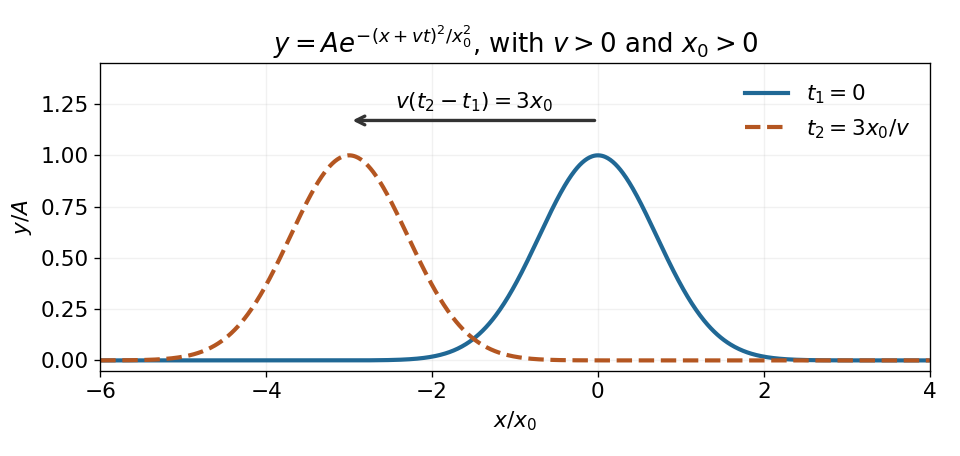
Original sketch of the Gaussian pulse translating to the left at constant speed
. Details. 
A reference string segment has mass and transverse velocity . Its kinetic energy is . In the small-slope approximation its extra arc length isThe work against constant tension supplies the corresponding elastic potential energy . To quadratic order, the energy density per unit reference length is thereforeFor the travelling wave , the wave equation implies . Its kinetic energy density and elastic energy density are equal, soThe energy per wavelength of a transverse string wave comes from integration over any full wavelength :The printed expression for energy per wavelength is missing a factor . Its right-hand side is the mean energy density, with units of energy per length. For a concrete counterexample within the small-slope regime, take , , and . Then and direct integration gives , whereas the printed right-hand side is . It cannot equal an energy.
For the reflection of a string wave from a freely moving endpoint mass, let , and use the complex time-harmonic wave conventionThe string pulls its endpoint toward negative , so its transverse force on the attached mass is . Newton's second law gives the boundary condition . Substitution yieldsHere is the characteristic impedance of a stretched string. Since the incident and reflected waves share the same string, their mean power ratio is the squared modulus of this displacement reflection coefficient:There is no remaining fraction of the mean incident energy: the freely moving mass provides no dissipation and no onward transmission channel. It exchanges kinetic energy with the string during each cycle but has zero mean absorbed power. Indeed the energy flux of a transverse string wave satisfieswhose cycle average is zero. As checks, gives , the free-end reflection of a transverse string wave, while at fixed gives , the fixed-end limit.
Articles by others on the same topic
There are currently no matching articles.