In this two-pool calcium model, is the cytosolic calcium ion concentration, and measures calcium in an intracellular store, such as the endoplasmic reticulum. The variables in these balances are expressed using compatible effective volumes, so internal transfers enter their two equations with equal and opposite signs. If actual compartment concentrations use different reference volumes, the corresponding volume ratio must first be included in their balances.
The flux pumps calcium from the cytosol into the store, releases it back, and is passive store leakage back to the cytosol. The external input supplies cytosolic calcium, while exports it from the biological cell. Thus have units of inverse time and all five fluxes have units of concentration per time. Their directions can be sketched asAdding the two ordinary differential equations verifies the total calcium balanceInternal uptake, release and leakage redistribute calcium; only the exchanges across the cell membrane change this total. In particular any equilibrium must have when .
Choose positive reference concentrations and a reference flux , and defineOverdots now mean derivatives with respect to the dimensionless time . The store balance becomesThe total balance becomes . ThereforeandThe reference quantities are scale choices, not additional kinetic variables; typically the response functions supply natural saturation concentrations and a maximal uptake flux. The identity checks the nondimensionalization. A small means store exchange is fast compared with external cytosolic removal.
At any equilibrium, the first balance gives and the second gives . For every fixed ,andThe intermediate value theorem and strict monotonicity give precisely one positive root for each . Since , the implicit function theorem makes this a smooth nullcline. For every , therefore,is the unique positive equilibrium. Graphically, draw the vertical line through the given graph: it meets the graph once, even on its steep descending section. This vertical line is the condition for simultaneous stationarity; the full nullcline at finite is actually .
Eliminate from the first equation before linearization:All partial derivatives below are evaluated at . The Jacobian matrix isIts trace and determinant areBy linear stability of a planar equilibrium, a positive trace makes both real eigenvalues positive or gives a complex pair with positive real part. The equilibrium is consequently unstable precisely whenA negative trace gives asymptotic stability; equality leaves a purely imaginary pair and requires a separate nonlinear bifurcation calculation. In particular, the unique positive equilibrium is never a saddle equilibrium.
Differentiate the identity using the chain rule:Substitution into the trace givesBecause , the exact instability condition isFor fixed and fixed equilibrium location, the correction tends to zero with . To leading order this isThus instability requires the descending nullcline to be steeper than a line of slope . The sign of the finite- correction makes the exact unstable interval slightly smaller. Since can make small, the approximation quantitatively requires at the point in question; merely comparing with one can be insufficient.
On the descending part of the graph, mark the two tangency points whereChoose the crossings that enclose the portion with . For fixed strictly between these values and sufficiently small , the unique equilibrium is a repelling equilibrium by part (e). The endpoints here are leading singular limit values; at finite the boundaries instead solve and approach these tangencies when the crossings are nondegenerate.
There is a necessary qualification: such an interval exists only when is large enough that the descending graph actually attains slopes below . If , one needs . The supplied graph has a very steep descending section, but an arbitrarily small positive need not satisfy this condition. For , numerical evaluation gives , so the leading threshold is . A graph alone does not remove this parameter restriction.
The fast motion is especially informative. In fast time ,At leading order is constant, so fast paths are straight lines with slope . Along such a line, the fast eigenvalue at the nullcline isIt is negative on the two outer attracting segments and positive on the intervening repelling segment. The tangencies defining are consequently the fold points of a critical manifold when it is expressed in the coordinates . They are not generally the maximum and minimum of itself.
For , slow motion on an attracting segment followsOn the left attracting segment this moves towards increasing ; on the right attracting segment it moves towards decreasing . Each segment ends at a tangency and is followed by a fast jump along a line of slope to the other attracting segment. This constructs the limiting relaxation oscillation. The figure uses , for which and ; the marked endpoints change with .
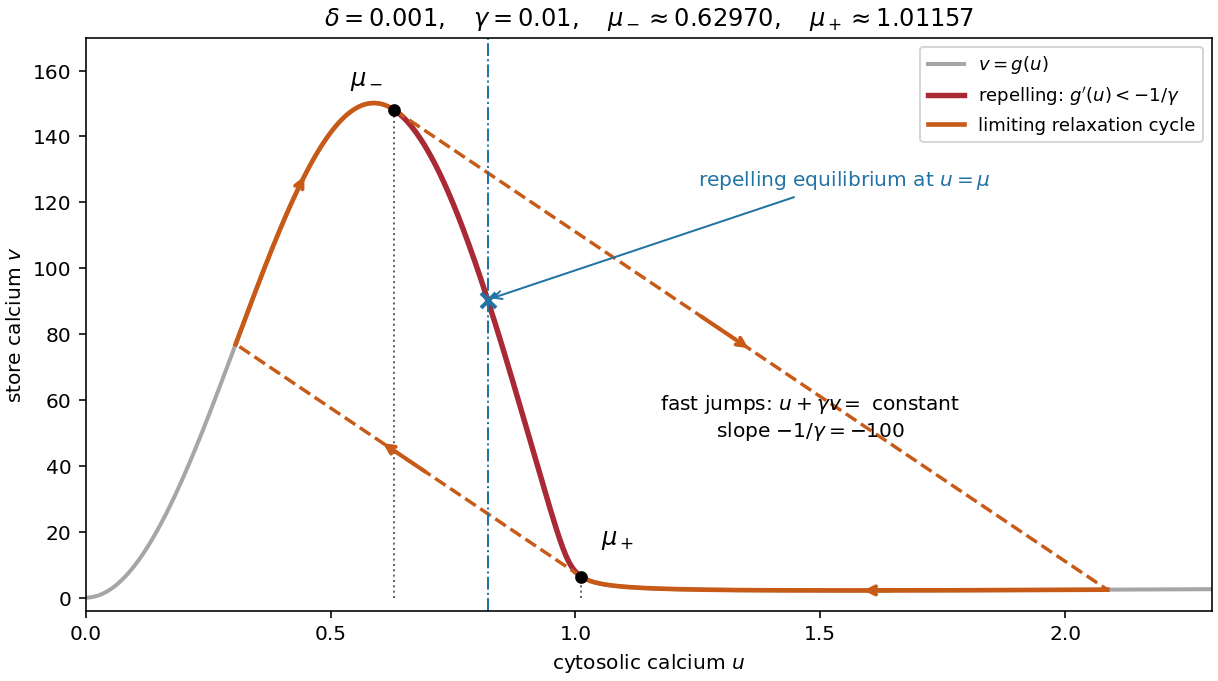

To justify existence of a periodic orbit of the full planar system, rather than just draw a formal cycle, first establish a compact trapping region. The positive quadrant is forward invariant: at , , and at , . MoreoverChoose above the initial store value. Since when ,Thus the rectangle , is a positively invariant set if and the initial point lies inside it. Every forward solution is bounded. There are no equilibria on its axes for , and its sole interior equilibrium is a hyperbolic equilibrium point with both eigenvalues having positive real parts in the strict unstable range. A sufficiently small neighborhood of this repelling equilibrium has outward flow; deleting it leaves a compact trapping region with no equilibria. The Poincaré-Bendixson theorem then supplies a periodic orbit.
Hence periodic solutions exist throughout the strict unstable interval, interpreted with the finite- correction above. This argument establishes existence, without asserting uniqueness, the criticality of possible endpoint Hopf bifurcations, or absence of coexisting periodic orbits outside the interval.
Articles by others on the same topic
There are currently no matching articles.