Assume constant mass density, a prismatic channel, approximately uniform cross-sectional velocity , a hydrostatic pressure distribution, small bed slope , and no lateral inflow. Integrating mass conservation over a slice of length gives , hence .
Let be the hydrostatic first moment, where is the actual free-surface depth. The downstream momentum balance isUsing reduces its left side to . For a fixed prismatic cross-section, , so . Therefore the exact depth-averaged result isHere hydraulic radius converts perimeter shear stress into force per unit fluid volume. The printed notation yields the requested equation if it denotes this hydraulic pressure head, whose derivative equals .
The geometrical definition printed in the next part needs care. Triangular-channel hydrostatic pressure head gives the factor explicitly. For the stated symmetric triangular notch, the actual depth is , whereas its printed is . Indeed and , giving . Thus the equation with precisely the printed geometrical has pressure term . A first-principles derivation cannot remove that factor. The subsequent intended scaling can be carried out algebraically using the printed convention, as below, or with the pressure scale doubled for the actual triangular channel.
Write , , where the given geometry givesTake a Chézy drag law and restrict to downstream flow . Choose an area scale , length scale , and speed scale satisfyingThis makes gravitational driving and drag equal in the reference uniform steady flow. Dividing the printed momentum equation by givesMass conservation retains . In this notation is the square of the velocity-to-gravity-wave-speed ratio based on the chosen depth scale; authors sometimes instead denote its square root by Froude number. If the actual triangular pressure head from the preceding solution is used, replace by in both parameter definitions. The displayed dimensionless form remains the same, with consistently redefined parameters.
First neglect inertia relative to the pressure correction, requiring for smooth fields on these scales. The positive velocity isMultiplying by area gives the discharge . HenceThe leading equation is a nonlinear kinematic wave equation. The pressure correction has positive diffusion coefficient for and smooths steep gradients. Dropped terms are and inertial terms on the assumed scales; sufficiently thin fronts require a separate balance rather than an unrestricted Taylor expansion.
Let the original area be and the increased upstream area be . At , the conservation law flux is strictly convex. Characteristics behind the increase travel faster than those ahead, forming an admissible shock wave. Rankine-Hugoniot conditions give its speedAt the idealized hydrograph jumps from to at . With positive , the diffusion term spreads the rise over a finite interval. The hydrograph is rounded, with an earlier small response and a later approach to the new discharge, rather than an instantaneous jump.
The physical cause is the longitudinal pressure gradient: a local increase in depth influences neighbouring sections and redistributes water before pure downstream transport would deliver a discontinuity. For a small increase, linearization about has speed and diffusivity . The smooth curve in the figure is the exact half-line step response for this linearized advection-diffusion equation; it illustrates the shape without claiming to solve a large nonlinear jump exactly.
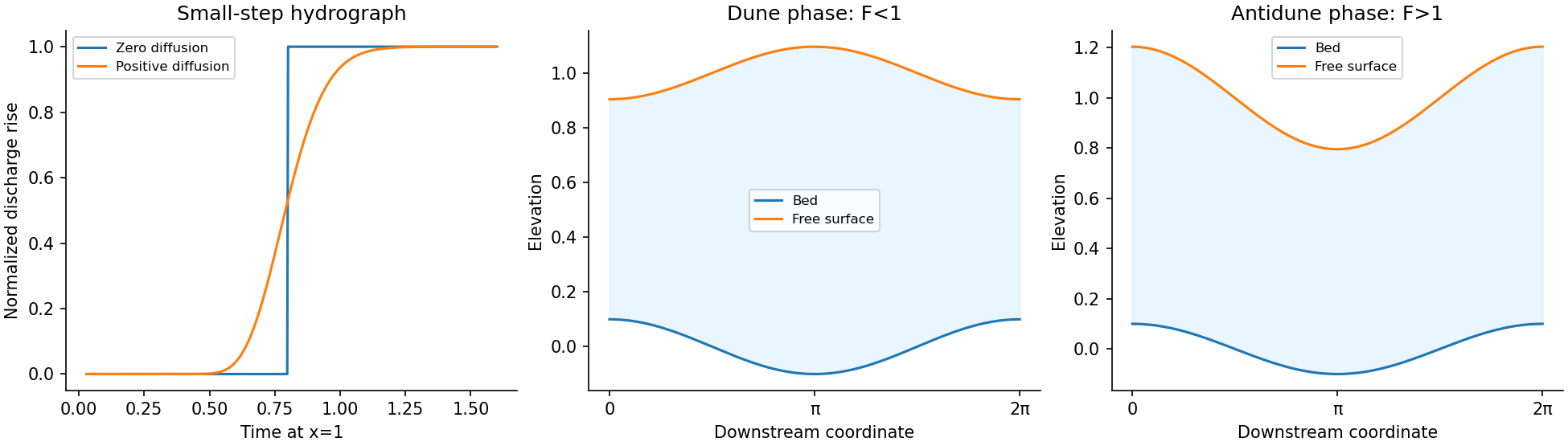
Sharp and diffused downstream hydrographs, with subcritical and supercritical bed-surface phases
. Details. 
The water mass conservation equation inherited from the earlier model is . It is essential: without it the printed displayed equations are not closed. Take the slow bed branch , and perturb the uniform state by , , , and . For , mass conservation gives and .
Put ; the extra comes from linearizing . The linearized momentum and suspended-sediment equations areEliminating gives the dispersion relationAway from , for fixed nonzero and negligible ,Thus growth requires . For , any gives an unstable branch; for growth would require . A physically increasing erosion function therefore gives the supercritical instability in this simplified model, rather than proving growth of ordinary subcritical dunes. Retaining drag giveswhich shows its stabilizing correction and the need to reconsider the limit near critical flow.
The negative bed-to-surface ratio for subcritical flow means bed crests lie beneath surface troughs: the dune phase relation. Its positive sign for supercritical flow gives aligned crests: an antidune. In the unstable supercritical case the imaginary part gives upstream migration, since . The figure shows these two phase relations. They identify the bedforms but do not by themselves establish growth. The qualitative limitation of the suspended-sediment mechanism is also discussed in the official [ref]
https://people.maths.ox.ac.uk/hewitt/publications/C5_11_notes.pdf. Mathematical Geoscience notes, pages 41–42
. Articles by others on the same topic
There are currently no matching articles.