Let be the Kuhn length, the number of statistical segments, and their effective excluded volume. We first assume a good-solvent, strongly confined self-avoiding walk, rather than an ideal chain. A confinement blob contains links and has diameter in the simple scaling model. Therefore . Distant blobs cannot freely pass through one another in a narrow tube, so the blobs form an axial string. The de Gennes confinement scaling is consequentlyThe free energy is of order per blob, not the energy of stretching a straight elastic rod.
The role of solvent and chain thickness can be made explicit by a Flory approximation: an axial extension costs an entropic term , while the confined number density gives an interaction term . Minimizing their sum gives , henceFor a thin statistical segment of effective diameter , instead gives . Thus the simpler answer implicitly fixes the excluded volume; the DNA thickness and ionic environment can matter quantitatively.
Both blob arguments require and , where in the simple good-solvent model. The printed comparison with alone does not ensure confinement relative to the unconfined coil. If , the tube barely perturbs the coil. An ideal chain without excluded volume has axial spread of order and does not acquire the extensive extension of a nonoverlapping blob string. These are distinct physical regimes, not changes to a numerical prefactor.
A slit of height leaves two unrestricted directions. Its three-dimensional blobs now form a planar self-avoiding walk, whose size exponent is . The polymer coil in slit confinement therefore has in-plane sizeThere is no uniquely preferred axial direction, and the chain is a coil rather than the one-dimensional blob string of a tube. Including a segment excluded volume , the Flory approximation is . Its minimum satisfies , agreeing with the displayed scaling when .
If “two-dimensional channel” instead means an intrinsically planar chain confined to a strip of width , a blob is already two-dimensional: , and the blobs form a one-dimensional string. That different geometry gives . Stating which transverse direction is removed is essential. In either geometry the blob description requires many blobs and a width below the free-coil size.
Approximate the gap by steady Couette flow, neglecting edge effects and additional losses from membrane deformation. Its velocity gradient is , so the shear stress is . The force on the gliding bacterium and the rate of viscous dissipation areThe same power follows by integrating over gap volume . In SI units, , , and . ThusAn energy needs a duration or distance: for in seconds, equivalently for travel distance . Moving one micrometre takes one second and dissipates . This is the mechanical cost of the sheared film. A numerical biological efficiency would additionally require the motor's input power and the losses associated with its peristaltic actuation.
Let be the contact radius of the adhering neutrophil. Indentation is of order , so the elastic strain is of order within a region of volume . The elastic energy is consequently , while adhesion lowers the energy by order . Balancing these terms givesThis estimate requires weak adhesion, .
For an adhesive-cell rolling threshold, assume peeling the rear bonds dissipates work of order per unit contact area. Rolling through angle sweeps contact area of order , giving resisting moment . A surrounding fluid of dynamic viscosity supplies a moment of order . Equating moments yieldsA dimensionless numerical coefficient depends on the contact and near-wall Stokes flow. Fluid viscosity is indispensable to a rate estimate, even though the contact model alone specifies only .
A perfectly reversible elastic adhesive contact does not lose net energy when an unchanged contact footprint translates. It therefore does not, by itself, justify a finite rolling threshold. The above estimate assumes adhesive hysteresis or irreversible bond peeling. If equilibrium adhesion is but the work lost during peeling and rebinding is , retain and replace by only in the resisting moment: .
Write for the filament bending modulus and for the filament torsional stiffness, so that the energy per unit length is . For one circular filament,where is the second moment of area, the polar moment, the shear modulus, and Poisson's ratio. Numerical twisting constants cannot be fixed by Young's modulus alone without specifying .
For a filled sliding bundle, . Filaments share the centerline curvature but slide instead of accumulating the additional axial strains of a bonded cross-section. Their bending energies add: . If end constraints impose the same material twist on every filament, their torsional energies also add: .
For a bonded, one-filament-thick circular tube, the wall thickness is of order . Its moments are and , giving and . For a bonded filled rod, and , giving and . Packing fractions and the convention for tube radius affect constants, not these powers.
There is an important qualification to bending and torsion of filament bundles: free axial sliding does not specify whether each filament can also spin freely. If both spin and slip are unconstrained, the common-material-twist calculation is not forced by the geometry. A helix of small twist rate has centerline curvature of order , so its bending energy starts at , not . A nonzero linear collective torsional stiffness then requires additional end, contact, or spin constraints.
The compressive tip force is limited by Euler buckling of an elastic filament. With unsupported length and filament bending modulus ,For a hollow microtubule, use rather than the solid-cylinder value. For a clamped seed and a moment-free tip free to slide along the wall, linearized angle balance is , with and . Its first nonzero solution has , hence . A different tip constraint changes this coefficient.
Increasing the unsupported length decreases that threshold. For growth against a wall at fixed projected gap , polymerization-driven cantilever postbuckling gives a more direct quantitative statement. The inextensible elastica obeys . Multiplying by and using the zero tip moment givesPut and substitute . Integrating arc length and its horizontal projection giveswhere the complete elliptic integrals are and . Using and gives , and thereforeThus the initial postbuckling force decreases as more contour is inserted. This result describes the weakly buckled branch before overhang, further wall contact, or altered tip constraints invalidate the model. It is a mechanical force law; a chemical force limit from polymerization can impose a smaller force.
Set , , and . To keep dimensions and the thermal amplitude explicit, write the force covariance as . The printed unit coefficient is a choice of noise normalization, not a general dimensional thermal force. Assume the initial velocity is independent of the future white noise. The Underdamped Langevin dynamics has integrating-factor solutionTaking its expectation and using the delta covariance in the double integral givesHere the noise contribution is . The equipartition theorem requires the long-time value . Consequently the fluctuation-dissipation relation for a Langevin particle isWith an initially thermal velocity, and , so the velocity variance is stationary. If one insists on the printed coefficient in dimensional units, the model has temperature fixed by in those units; it cannot describe arbitrary temperature while retaining that coefficient.
Take . Integrating the velocity solution givesThe initial/noise cross term vanishes under the independence assumption. Evaluating the remaining integral yields the general integrated Ornstein-Uhlenbeck displacementUse the thermal initial velocity and the fluctuation-dissipation relation for a Langevin particle. With diffusion coefficient , this simplifies toFor , expansion gives : displacement is initially , so the particle is ballistic. For , , hence the leading behavior is one-dimensional diffusion with .
The ballistic conclusion depends on the initial state. For a particle prepared exactly at rest, , the first expression gives at very short times. A thermal initial velocity, or a nonzero initial velocity variance, is required for the stated mean-square law. It should not be replaced silently by a zero-velocity initial condition.
The numerical contour length is , and . Begin with a three-dimensional freely jointed chain in which each chemical monomer is also an independent statistical link of length . This neglects excluded volume, hydrodynamic effects on equilibrium statistics, and stretching of the chemical backbone.
An applied force gives a one-link canonical partition functionThe mean extension is . Expanding the Langevin function at small force gives . The three-dimensional entropic chain stiffness is thusThe unforced root-mean-square end-to-end distance is , not the contour length. This response is entropic straightening of a fluctuating coil. Axial stretching of a straight material rod instead has stiffness , and is a different phenomenon. Aqueous solvent does not by itself prove ideal-chain statistics: a good-solvent self-avoiding walk has a different coil size and susceptibility. The estimate above states explicitly the model under which the supplied link data suffice.
For a three-dimensional worm-like chain, the tangent correlation length is , where is the filament bending modulus. The measured persistence length therefore givesRepresent the actin filament as an isotropic solid circular cylinder with diameter . Its second moment of area is . Since ,This is an effective Young's modulus within the given continuum cross-sectional model; the numerical diameter and persistence length must not be replaced by unrelated typical biological values.
The same measurement corrects the independent-link approximation: the Kuhn length is , with . Thus the long-chain entropic stiffness is , and the root-mean-square end-to-end distance is . For comparison, the material axial stiffness is , using . The corrected coil response remains much softer than axial backbone stretching.
An optical tweezers force requires the change in optical momentum. Define the optical momentum efficiency by , with all ray geometry and medium-index factors absorbed in and the vacuum light speed. The specified relative refractive index does not determine without bead size and the beam's convergence, waist, and ray directions. A unique exact force is therefore not supplied by these data.
Retaining the entropic stiffness from part (a), the parameterized answer isUsing the persistence-length-corrected worm-like chain instead gives in its small-force regime.
For a definite scale estimate, take the weak-contrast optical momentum change to be . This gives , for part (a)'s model, or for the corrected chain. These are estimates with an explicitly chosen ray-momentum efficiency, not a universal formula for a transparent trapped sphere.
Another illustrative optical model makes the uncertainty visible: normal-incidence Fresnel reflectance is . An effective reflector with in the simple momentum convention gives and extensions or , respectively. A refracting bead in a focused beam is not just that reflector; entry and exit rays also transfer momentum. Neither estimate eliminates the missing optical geometry.
The extension must be compared with the actual contour length, . For the illustrative force and the persistence-length-corrected chain, and . Both are small, so the small-force Langevin function expansion and entropic-extension approximation are consistent. Although the mean extension greatly exceeds the unforced millimetre-scale coil size, it remains far below the maximum contour length; that does not violate the model.
The material axial elongation at this force would be only , illustrating that most of the predicted coil extension is orientation and straightening rather than stretching the backbone. Thus the order-of-magnitude entropic response is internally reasonable within the ideal-chain assumptions, but its numerical optical-force prediction is not unique. Solvent-dependent excluded volume, the unusually large stated contour length, actual trap geometry, and surface interactions all matter to an experimental interpretation.
The viscosity converts to , and the translation speed is . Mechanical power is . The hydrodynamic drag models for a polymer show why a conformation assumption is necessary.
For a largely aligned slender filament translating along its axis in unbounded fluid, useWith , , so . The required force is about , andTransverse translation has roughly twice the leading logarithmic drag. This estimate treats the entire contour as an aligned slender body, assumes creeping flow, and omits bead drag, wall corrections, and additional motor losses. It is not a drag formula for an unstretched coil.
For an alternative nondraining coil, approximate the hydrodynamic radius by its radius of gyration, . The Stokes drag law gives and . A freely draining toy model that sums spherical-monomer drags of radius instead gives . Hydrodynamic interactions are suppressed in this last model. These distinct answers explain the need to specify conformation and hydrodynamic coupling; the stated data do not select a unique one.
The printed diagram and the word “parallel” describe a Kelvin-Voigt model, not a series Maxwell fluid. In the depicted model both elements have displacement and their forces add:For and the convention ,The storage modulus and loss modulus here are element stiffnesses with units ; conversion to stress/strain moduli requires a geometric factor. If “response” instead denotes displacement per force, it is the compliance . Specifying which ratio is used removes that convention ambiguity. The mean dissipated power is , confirming the positive loss sign for .
For completeness, the actual series Maxwell fluid analogue has a common force and additive spring/dashpot extensions. Thus . With ,These different functions cannot both describe the printed parallel arrangement. The distinction also changes the elastic beam's response to a constant load.
Let be downward deflection, , with . Take a uniform circular elastic beam, , small slopes, and linear material response. Write for its axial elastic modulus and for its axial viscous coefficient; these are material quantities, not the solvent viscosity. The extension of the printed parallel model has moment lawWith mass per unit length , transverse momentum balance in the interior isThe free-tip conditions are and with this downward-positive convention; the clamp supplies the remaining reactions.
Neglecting inertia gives . Twice integrating the moment law with the clamp conditions givesFor a step and an initially relaxed elastic beam, Kelvin-Voigt cantilever creep isThus the equivalent tip spring and dashpot are and .
If the intended material is instead a true series Maxwell fluid, its moment satisfies . Together with momentum balance , this gives the full interior equation , with the moment law retained for boundary and initial conditions. In the quasistatic limit,This Maxwell cantilever creep has an initial elastic jump followed by linear creep, not a finite plateau. The jump is the ideal massless step-load limit; inertia resolves the transient. A two-element series model has no nonzero relaxed modulus, so “Maxwell solid” is not an additional specification of a solid with finite long-time stiffness. Such a solid would need an additional spring. The small-deflection approximation requires and eventually fails for unbounded creep.
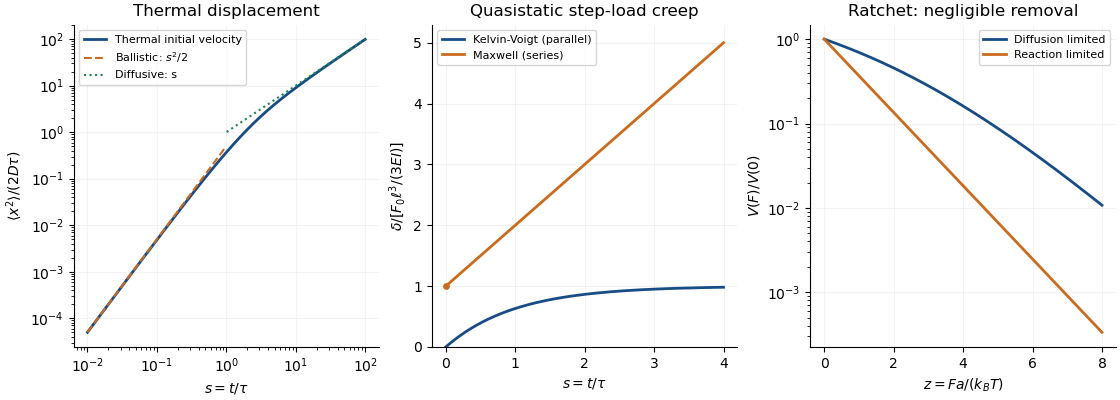
Thermal displacement crossover, parallel and series elastic beam creep, and diffusion-limited versus reaction-limited ratchet slowdown
. Details. 
Model the polymerization Brownian ratchet by a rigid tip and a Brownian load. Let be the elementary load advance, its drag coefficient, and its diffusion coefficient. For a spherical load, , but no load radius is specified, so the rate is naturally expressed in terms of . Assume addition is effectively instantaneous once the gap reaches , and removal is negligible. The gap reflects at zero, first arrival at causes insertion, and insertion resets it to zero.
With no opposing force, the mean first-passage time satisfies , , . Integration gives . One advance per passage givesThe advance-event rate is , while is a length per time.
A constant resisting force produces drift . The diffusion-limited Brownian ratchet with constant load now satisfiesAn integrating factor gives . Integrating again from to gives , where . ThereforeAt weak load the ratio is ; at large load . Replacing the whole force dependence by would discard the first-passage kinetics of this regime.
For two staggered strands that alternately advance the leading tip by half a monomer, and . Two aligned strands, as schematically drawn, do not automatically have that half-step: an advance may be , with the other strand filling the same layer afterward. Use the same geometrical step in the passage problem and in converting event rate to velocity. The limiting formula assumes negligible removal, rigid tips, an overdamped load with constant drag, and fast insertion compared with . With appreciable removal or additional internal strand states, the renewal reset model must be replaced by a coupled gap/reaction process.
Write for the effective unloaded addition rate and for the removal rate of the same elementary tip step . If the supplied on-rate is a bimolecular rate constant, then , with monomer concentration ; if it already denotes an event rate, use . Assume gap diffusion is much faster than chemical events, removal is force-independent, and the monomer bath is maintained.
Under a positive constant resisting force, the load equilibrates in the potential above a reflecting tip. The normalized Boltzmann distribution is for , where . The fraction of time with room to insert isSteric gating reduces addition to ; each addition advances by and each removal retreats by . The reaction-limited polymerization Brownian ratchet therefore hasFor , the stall force is . Equivalently, the available chemical free energy per effective step is , and stall balances . A half-monomer step requires rates defined for that half-step, not automatically single-strand monomer rates with a gratuitous factor of two.
At exactly zero force a load on an unbounded half-line has no normalizable equilibrium gap density. The unloaded expression is the limit, or the usual freely available-gap approximation with a weak positional confinement. For a positive load the equilibration time must remain short compared with reaction times. Load inertia, filament bending, monomer depletion, and force-dependent bond rupture have been excluded. For arbitrary finite reaction and diffusion rates one must solve the joint gap dynamics rather than attach to the diffusion-limited first-passage formula: a removal changes the gap and the distribution from which the next addition starts.
Articles by others on the same topic
There are currently no matching articles.