After complete ionization, each hydrogen nucleus supplies one ion and one electron, while each helium-4 nucleus supplies one ion and two electrons. Neglecting the small metal mass fraction and putting , the mean molecular weight therefore satisfiesUse stellar homology to compare models with common dimensionless profiles. The stellar mass conservation equation, stellar hydrostatic equation and ideal gas law giveThe radiative diffusion in a star equation then gives . Inserting the specified opacity yields . Independently, integrating the stellar energy-generation rate over the mass gives . Equating these in stellar thermal equilibrium gives the radiative homology with fifth-power hydrogen burning and inverse-cubic opacity:At fixed solar mass these reduce to and . The stellar homology approximation, rather than merely the local power laws, is what permits these relations between whole stars.
Equal luminosities imply . Thusso to one significant figure. Retaining the unrounded hydrogen mass fraction when comparing central temperatures givesThe first model has the higher central temperature.
For homogeneous hydrogen burning at fixed , fuel conservation gives . Since and , the homogeneous fuel-depletion luminosity feedback obeysIntegration with the initial mean molecular weight givesThis idealized stellar evolution law stops when ; it does not predict a physically attainable infinite luminosity. Indeed at fuel exhaustion, giving , strictly before the formal singularity.
Write for the direction cosine and for the radiative transfer source function. Integrating the radiative transfer equation over solid angle givesRadiative equilibrium makes the radiative flux constant, so .
For , the radiation-field moments areConsequently the Eddington closure approximation holds. Substituting into the radiative transfer equation, with , gives . Equality for every requires and , with . The stipulated inward hemispheric radiative flux at the surface isPutting this equal to zero fixes , hence . Using and the effective temperature definition gives the grey atmosphere lawThe positivity limitation of a linear Eddington intensity matters here: the formal surface intensity is negative for . Thus this angular ansatz gives the requested Eddington surface boundary condition for approximate moments; vanishing integrated inward flux is not an exact, nonnegative, pointwise no-incoming radiation field.
Neglecting radiation pressure, the stellar hydrostatic equation and the definition of optical depth give hydrostatic equilibrium in optical depth, . Since , putting givesTaking and , the grey-atmosphere pressure with power-law opacity is thereforeThe pressure formula printed in the PDF is missing the factor . Differentiating its right-hand side would otherwise give . For the correct limit is .
At the specified matching location, the luminosity relation makes , hence , and . Multiplying the corrected pressure relation by givesThis agrees with the PDF's final surface boundary condition for a power-law-opacity grey atmosphere. It also extends to negative wherever the model applies; at , its continuous limit is .
For Roche-lobe overflow, . Cubing the Roche lobe approximation and using the donor's mass-radius relation givesKepler's third law therefore yields the Roche-lobe period-mass relation for a linear donor radius law:The component distances from the centre of mass are and . Summing their angular momenta gives the circular-binary orbital angular momentumDuring conservative binary mass transfer, and . Logarithmic differentiation at constant angular momentum gives . Thus the Roche-lobe radius response exponent givesTheir difference is . Since the donor loses mass, this is positive for : the donor shrinks relative to its Roche lobe, so transfer shuts off without an external driver. The Roche lobe itself expands only for ; for it shrinks more slowly than the donor.
Gravitational-wave emission from a binary system provides such a driver: the orbit emits gravitational waves carrying energy and angular momentum, and the shrinking Roche lobe can maintain contact. Allowing , the binary mass-transfer contact equation becomesIt gives a negative transfer rate for .
For the classical nova, assume isotropic re-emission from a binary star: ejecta carry the accretor's specific angular momentum . The eruption lasts many orbital periods, so the orbit responds approximately adiabatically and remains nearly circular; an instantaneous asymmetric kick would be a different model. To first order,Differentiating the circular-binary orbital angular momentum formula during the ejection givesThe accompanying Roche lobe change is thereforeThe donor does not change mass in the eruption and moves inside its expanded Roche lobe: this is nova-induced binary detachment.
Put for the constant external loss. During detachment the component masses are fixed, so the Roche lobe shrinks at fractional rate . Closing the fractional gap takes . During the subsequent semidetached binary phase, the binary mass-transfer contact equation gives , so accumulating the next eruption's mass takes . ConsequentlyBoth times are evaluated to first order in , with the same equilibrium donor mass-radius relation; changes of and the transfer rate within one cycle affect higher orders.
A star of roughly solar stellar composition begins on the zero-age main sequence with a hot convective core, a mostly radiative envelope, and hydrogen burning dominated by the CNO cycle. The strong temperature dependence of the CNO cycle concentrates the stellar energy-generation rate near the centre, helping produce the convective core. Core mixing replenishes hydrogen within that region; it does not homogenize the entire star. The nuclear fuel supply gives a stellar nuclear timescale of order years. For a numerical comparison, Table 2 of Ekström et al.'s solar-metallicity models gives core hydrogen burning lifetimes of about and million years for nonrotating and rotating models, respectively.
After central hydrogen exhaustion, an inert helium core contracts and heats through Kelvin-Helmholtz contraction, while a hydrogen-burning shell supplies the growing luminosity. The envelope expands and cools: the track crosses the Hertzsprung gap toward the red giant region. Its deepening convective envelope causes first dredge-up, bringing material altered by hydrogen burning to the surface. The rapid structural crossing has a thermal timescale, roughly – years for a star of this mass, rather than the full stellar nuclear timescale; an estimate follows from the Kelvin-Helmholtz cooling time with the evolving radius and luminosity.
The helium core reaches ignition before becoming strongly supported by electron degeneracy pressure. Thus a normal star starts core helium burning without the helium flash characteristic of lower-mass stars. The Triple-alpha process produces carbon-12, and carbon-12 alpha capture produces oxygen-16; these reactions build a carbon-oxygen core. There is a convective core and continued hydrogen-burning shell activity. Core helium burning lasts order years: the same model table gives approximately and million years. The changing core and envelope structure can produce a blue loop in the Hertzsprung-Russell diagram; its extent depends on stellar composition, mixing and stellar rotation.
After central helium exhaustion, the carbon-oxygen core contracts and becomes increasingly supported by electron degeneracy pressure. A helium-burning shell forms above it, beneath the hydrogen-burning shell. The star returns to a cool, luminous Asymptotic giant branch configuration. On this early branch, helium-burning shell activity is an important energy source; the overlying hydrogen-burning shell can weaken during readjustment and resume later. At this mass, a deepening convective envelope can cause second dredge-up. This shell-supported evolution to the first AGB thermal pulse takes order years, with model-dependent duration. As the helium-burning shell becomes sufficiently thin, the thin-shell instability ends steady shell burning and marks the onset of AGB thermal pulses.
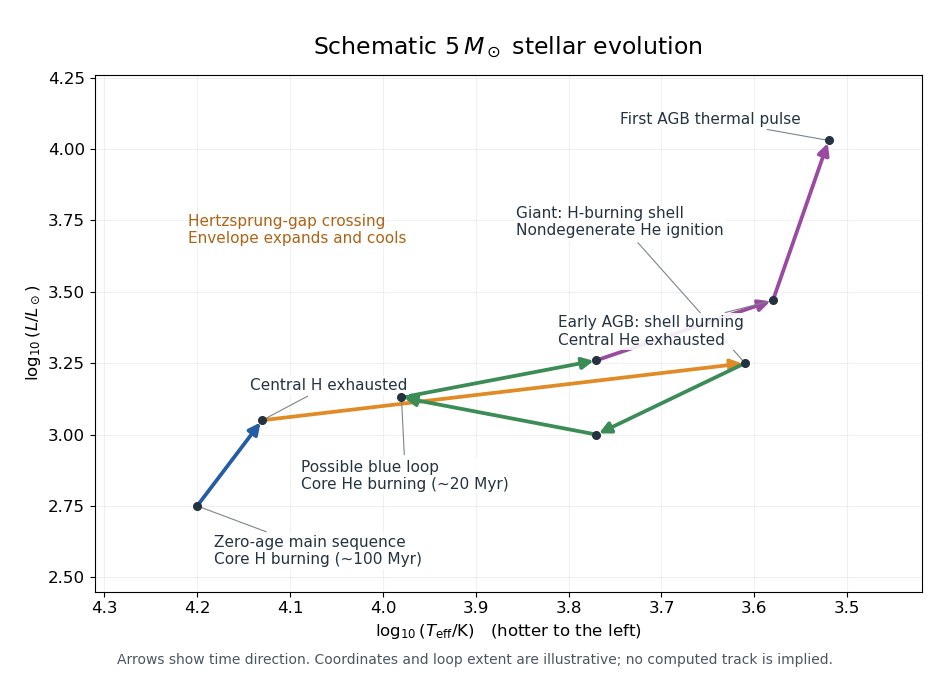

The original sketch shows the direction of stellar evolution, with higher effective temperature to the left. It illustrates a possible blue loop; its coordinates and loop shape are schematic, rather than a computed stellar model. The stages before the first AGB thermal pulse are the requested track; the later remnant evolution is described below.
In the usual final evolution, stellar winds and an AGB superwind remove the envelope before the carbon-oxygen core can ignite substantial carbon burning. Once shell fuel is exhausted, the exposed core contracts and heats, potentially ionizing the expelled gas as a planetary nebula, and finally becomes a carbon-oxygen white dwarf that loses its stored thermal energy by cooling. The relevant competition is between the AGB envelope-loss and core-growth timescales, not just the total initial mass.
Much higher late-stage mass loss strips the envelope sooner, shortens the Asymptotic giant branch phase, and allows less core growth, usually producing a smaller carbon-oxygen white dwarf. Much lower mass loss prolongs shell burning and permits greater core growth. In an extreme hypothetical case, retention of the envelope could let a degenerate carbon-oxygen core approach the Chandrasekhar mass and undergo explosive carbon burning: the proposed type 1.5 supernova channel. This is not an inevitable fate for a star. Doherty et al.'s evolutionary calculations emphasize the uncertainty of that channel and find that their adopted mass loss removes carbon-oxygen envelopes before such ignition. If carbon burning instead proceeds without disruption, the possible further evolution depends on the resulting core and continued envelope retention; lowering mass loss alone does not establish an electron-capture supernova outcome.
Articles by others on the same topic
There are currently no matching articles.