Use base-two logarithms and the convention . Write and for . The conditional entropy is the average of the information entropies of these conditional laws:The careful form of Gibbs inequality is that, for two probability mass functions on a common countable set,where a term with gives . Equality holds exactly when . This is the nonnegativity of relative entropy.
First suppose . For every of positive probability, implies . Averaging the cross-entropies givesAll the summands here are nonnegative, so interchanging the sums is valid, and each conditional cross-entropy is finite. Applying Gibbs inequality to each shows that is at most its cross-entropy. Subtracting and averaging therefore givesEvery term on the right is nonnegative. The equality in the entropy conditioning inequality is thus equivalent to for all , which is exactly factorization of the joint probability mass function. Consequently
For arbitrary countable discrete random variables, the inequality remains valid in : the case is immediate. The finite-entropy condition is necessary for the usual equality characterization. For example, let for , with the normalizing constant, and let be an independent fair bit. The series defining the probability mass function converges, whereas its information entropy diverges like . Then and are dependent, but . In the infinite case, equality means precisely that the conditional entropy is also infinite; it does not imply independent random variables.
Introduce a selector with Bernoulli distribution of parameter , and construct by taking its conditional law given to be , and its conditional law given to be . No prescribed joint law of is needed. Summing over the selector gives the desired mixture probability mass function. The conditional entropy isSince conditioning cannot increase information entropy,This proves the concavity of information entropy. The argument also covers infinite information entropies with the convention that a zero mixing weight contributes zero. At or , the mixture is the corresponding original law and equality is immediate.
Fix . Take independent random variables and . Their convolution isby the binomial theorem. Thus has Poisson distribution with parameter . Conditioning on only translates , so . The entropy monotonicity under independent addition yields .
In fact the inequality is strict. The covariance is positive, so and are not independent random variables. Their information entropies are finite, and the equality criterion from part (a) excludes equality. Therefore the Poisson entropy monotonicity gives the stronger conclusion
For an -dimensional random vector with a density and finite differential entropy in bits, define its entropy power by . The entropy power inequality states that for independent such random vectors,Here the sum's differential entropy must be defined, with permitted.
Since , the mean value theorem makes strictly increasing. Its image is an interval , and its inverse on has derivative . The density change of variables givesThis does not require to map onto all of . Taking logarithms at and then expected values proves the differential entropy under an increasing transformation:The two finite expectations in the assumptions justify splitting the expectation and imply that the transformed differential entropy is finite.
To derive the product inequality, assume that and are finite and that the differential entropy of the logarithmic sum is defined. Set , using natural logarithms for this transformation while measuring differential entropy in bits. On the positive half-line the derivative of is , so the same density argument givesThe are independent random variables, and the one-dimensional entropy power inequality yieldsSince , another change of variables givesMultiplying the entropy power inequality by proves the multiplicative entropy power inequality:
The printed positivity and density assumptions alone do not ensure that the quantities in this last formula exist. For a concrete example, let have the standard Cauchy distribution and put . Thenis a density, but is undefined because its positive and negative parts both diverge. Two independent copies satisfy the printed hypotheses but leave undefined. The product inequality therefore needs the finiteness or well-definedness conditions used above.
Write for the largest number of codewords in a binary length- code with minimum Hamming distance at least . The volume of a Hamming ball does not depend on its centre and isFor the Hamming bound, put . The radius- Hamming balls around distinct codewords are disjoint: a point belonging to two such balls would, by the triangle inequality for Hamming distance, put their centres at distance at most . Counting points in the binary cube therefore gives
For the Gilbert–Varshamov bound, choose a code maximal under inclusion among those with minimum Hamming distance at least , for example by successively adding any allowable word. Its radius- Hamming balls cover the cube. Otherwise an uncovered word would be at distance at least from every codeword and could be added, contradicting maximality. ThusThe lower bound is an existence assertion about a suitable code, while the upper bound holds for every such code. Together they give
Let be the binary entropy. For ,The assumed Hamming ball volume exponent applies also to any integer radii with . Indeed, for each small these radii eventually lie between and . monotonicity of sandwiches its normalized logarithm between limits and ; continuity then lets tend to zero. Consequently the asymptotic Gilbert–Varshamov bound and asymptotic Hamming bound have respective exponential scalesEquivalently, the optimal code rate satisfiesThese are bounds on the rate, not a claim that the optimal rate has a known limit or equals either endpoint.
The Shannon second coding theorem says that a memoryless channel permits transmission at any fixed code rate with error probability tending to zero as block length tends to infinity. Conversely, a sequence of codes with error probability tending to zero cannot have a limiting rate above . The channel capacity, in bits per use, isFor a finite discrete memoryless channel with transition probabilities , the supremum is a maximum and its mutual information isFor a general memoryless channel, mutual information is the relative entropy of the joint input-output law with respect to the product of its marginal laws; the same supremum is taken over the admissible input laws.
For the binary symmetric channel, write with independent noise having Bernoulli distribution of parameter . Given either input bit, the output conditional entropy is . ThusAn input with uniform distribution makes the output have uniform distribution, attaining . The binary symmetric channel capacity is therefore
To correct every pattern of errors by nearest-codeword decoding, it suffices to have minimum Hamming distance : the corresponding radius- Hamming balls are disjoint. For , the relative distance tends to , so the asymptotic Gilbert–Varshamov bound guarantees code rate at least in the limit. Therefore its immediate strict-rate guarantee isThe binary entropy is strictly increasing from zero to one on , since on . Let denote the inverse on this interval. The asymptotic condition becomes
There is also a finite-length boundary refinement for the precise requirement of correcting errors. If , then each weight for is at least . Expanding gives the entropy bound for a Hamming ballThe case follows directly from . Taking and using monotonicity of the binary entropy, the Gilbert–Varshamov bound yieldsThus the worst-case correction guarantee from the Gilbert–Varshamov bound even includes for the exact radius , with the number of messages rounded to an integer when necessary. No positive-rate guarantee of this form is obtained for ; one must not extend the increasing-entropy calculation past . Failure of this sufficient bound does not rule out better codes.
By contrast, the Shannon second coding theorem gives vanishing error probability on the binary symmetric channel wheneverThe factor of two comes from demanding disjoint correction balls for every error pattern of a prescribed weight. This is a worst-case distance requirement, and the Gilbert–Varshamov bound is itself only a sufficient existence bound. The Shannon second coding theorem controls the probability of decoding failure for the random channel; rare bad patterns may remain.
Finally, the number of actual errors has binomial distribution with mean . Correcting exactly its mean does not itself imply error probability tending to zero. To get that conclusion from the distance construction when , choose with and , and correct errors. The weak law of large numbers then makes the probability of exceeding the correction radius tend to zero.
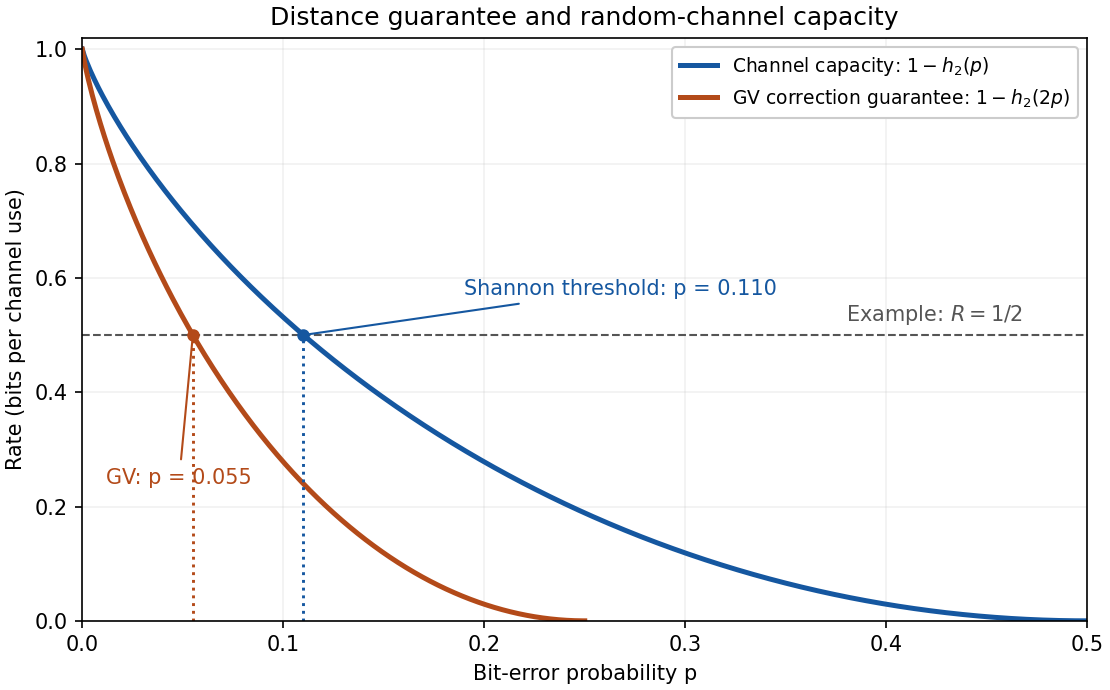
Binary symmetric channel capacity and Gilbert–Varshamov worst-case correction rate
. Details. 
Work over the finite field . The given factorization shows that divides , so it generates a length- cyclic code . Since , the vectors represented byform a basis: their distinct leading degrees prove their linear independence, and every multiple of representing a polynomial of degree below has a multiplier of degree at most . Hence is a binary linear code of dimension , containing codewords. The generator has Hamming weight seven, so the minimum Hamming distance of a linear code satisfies .
The BCH bound used here is the following consecutive-root theorem. If a length- cyclic code over , with relatively prime to , has a generator polynomial of a cyclic code vanishing at for a primitive th root , then its minimum Hamming distance is at least .
Choose a root of in an algebraic closure of . The factorization implies , while in , so . As is prime, has order . The Frobenius endomorphism preserves the roots of a polynomial with coefficients in : . Thus every is a root. In particular, shows thatare roots of . These four consecutive roots give by the BCH bound. A further argument is needed to exclude weights five and six.
Put . Cancelling in the supplied factorization gives . In the quotient ring , is invertible and every cyclic shift of equals . Since ,The coefficient of in this circular product is , the binary inner product of the coefficient vector of with a cyclic shift of itself. Every coefficient of is one. The circular autocorrelation of the binary Golay generator therefore implies that all pairs of basis rows , including equal rows, satisfy
Each has Hamming weight seven. Append its parity bit, which is one, and write . The extended rows have Hamming weight eight and satisfy . Their linear span is precisely the parity extension of , because the appended coordinate is the linear functional equal to the sum of all coordinates.
These extended generators produce a doubly even code. To prove this rather than assume it, useAll the extended generators have weights divisible by four. A sum of previous generators is orthogonal to the next generator, so the intersection size in this identity is even. Induction proves that every word in has Hamming weight divisible by four; this is the orthogonal generators of doubly even codes argument.
An original word of weight five acquires a parity bit and has extended weight six, while a word of weight six acquires a zero parity bit and still has extended weight six. Both contradict divisibility by four. Together with the BCH bound and the weight-seven generator, this completes the BCH and parity-extension proof of the binary Golay distance:
Articles by others on the same topic
There are currently no matching articles.