The limiting polynomial has a double root at , so two roots require a Puiseux series. For positive , put and . Substitution and dominant balance giveThus and . The two finite roots have the three-term asymptotic expansionsThis is square-root splitting of a double polynomial root. For negative , the same formulas apply with a chosen complex square root and describe a complex conjugate pair.
The third root is a divergent algebraic root in a singular perturbation. Set : the equation for is . Its nonzero limiting root is . Substituting yields and , henceAs an independent check, Vieta formulas give the sum of roots as : the two finite-root expansions sum to , giving the same large-root expansion.
For fixed , write and . The maximum of the integrand occurs at , andHere is the required endpoint Laplace method derivation. Outside a fixed neighborhood of zero, the integrand is exponentially smaller than . Inside that neighborhood, use . The quadratic term gives and the higher terms vanish in the scaled limit. The Gaussian integral on the half-line is , soThis is the Hyperbolic Debye asymptotic for Legendre polynomials. At the endpoint the integrand is identically one, giving exactly.
The localization width in the Laplace method is . It becomes order one when , so the Legendre boundary layer at x equals one has . With and fixed ,uniformly in . The boundary-layer answer is thereforeThis real integral representation of the modified Bessel function I0 gives one at , agreeing with the endpoint value. Applying the same endpoint Laplace method to the integral for gives . Thus, as , the inner result is . The outer result has precisely this limit in the overlap . This proves both matches rather than extending the fixed- formula directly to .
For the derivatives, the power series suggests their leading orders. To justify differentiation, expand the original integral itself near . Its first three even cosine moments giveOdd cosine moments vanish, and higher even moments start at cubic order. Expanding at yieldsFor large , the graph starts at with a very large positive slope and positive curvature. It rises through the boundary layer and then follows the rapidly increasing outer asymptotic expansion. The sketch below shows both scales.
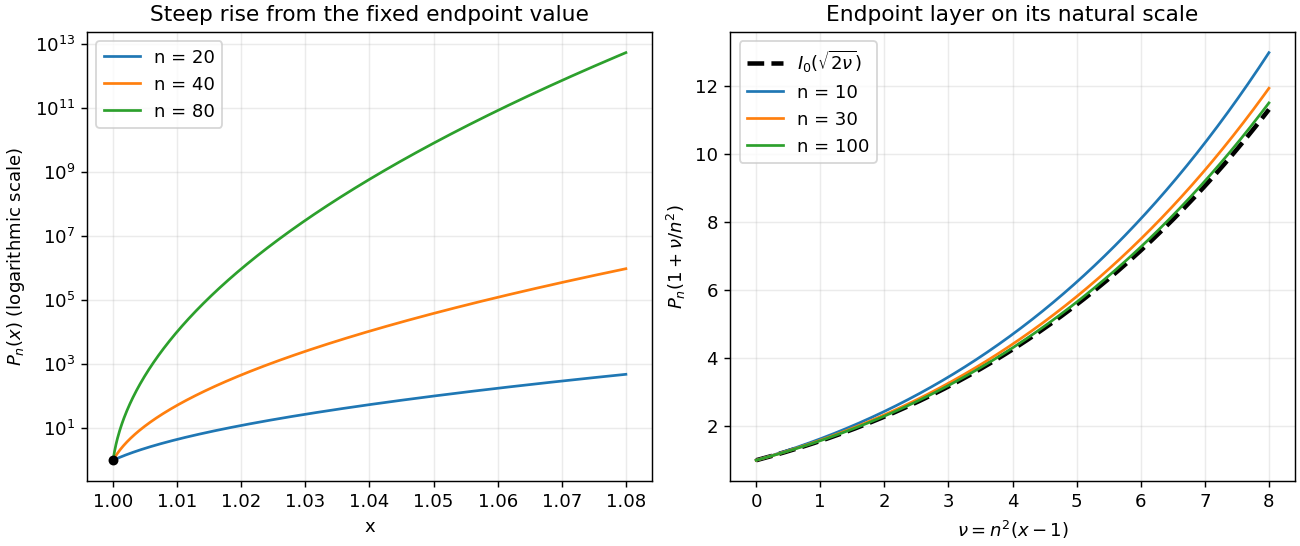
Large-degree Legendre functions and their n-squared endpoint scaling
. Details. 
The method of multiple scales applies when a small perturbation acts cumulatively over a long time, as in weakly perturbed harmonic oscillators or slowly modulated waves. A regular asymptotic expansion can contain secular terms, such as , which cease to be small on the time scale of interest. Introduce independent fast and slow times, for example and , and allow the leading amplitude and phase to depend on . The solvability condition in the method of multiple scales removes resonant forcing at each order and determines that slow evolution. For the Mathieu equation, these amplitude equations reveal parametric resonance and its instability intervals.
Set and use the method of multiple scales:Since , the first correction satisfiesThe resonant cosine and sine coefficients must vanish to avoid secular terms. Using the product-to-sum formulas givesThe remaining forcing has frequency and permits the bounded particular correction . The two slow amplitudes carry the two arbitrary constants of the original equation.
For an explicit general leading solution, putThe matrix exponential givesThe error is uniform on bounded intervals of , for bounded initial data. When is imaginary this expression uses ordinary sine and cosine; at its continuous limit is .
The primary instability tongue of a weak Mathieu oscillator has a positive slow eigenvalue precisely whenThese are the leading edges, rather than an exact finite- interval. At the leading endpoints the amplitude matrix is a nilpotent matrix, so the leading solution can grow linearly in and does not decide the exact exponential instability. For completeness, set . The periodic or antiperiodic edge calculation uses a pure cosine when and a pure sine when , with the third-harmonic correction just found. The next resonant coefficient is , soThus the exact growing interval is between these shifted edges. In particular, for positive small the fixed leading value lies just inside it, whereas lies just outside. Interior detunings bounded away from the edges are already resolved by the leading method of multiple scales.
Away from the first parametric resonance, one forcing interaction changes a harmonic frequency by one and produces no resonant coupling of the two conjugate oscillations. Two interactions can couple frequency to frequency , so the next parametric resonance is near and its effect first appears at order . This gives and the appropriate slow time .
Write and . The first correction satisfies , whose bounded particular solution isAt second order,The resonant part of is . Applying the solvability condition in the method of multiple scales givesThe squared slow eigenvalue isThe second instability tongue of a weak Mathieu oscillator therefore has the leading intervalHere the two little- terms describe the respective exact edge locations; the strict inequality in is the leading interior criterion. In particular is unstable, with physical growth rate . The general leading solution for bounded again has , where the matrix exponential of the displayed two-by-two amplitude system evolves arbitrary . Adding identifies the first nonresonant harmonic correction. The leading expression alone has error on .
For comparison, at fixed , write . The first forced harmonics have coefficients and . Their return to the original harmonic at the next order givesIt is a phase correction, not amplitude growth. Consequently, away from the first two resonance neighborhoods, a general leading solution valid for bounded isNarrower higher-order instability intervals are invisible on this time scale. The detuned resonant calculation above is needed near because both the phase shift and the conjugate-mode coupling then matter.
Floquet theory suggests a sequence of instability tongues nearAt these limiting frequencies the unperturbed Floquet multipliers coincide. Each multiplication by changes a Fourier frequency by one, so forcing interactions are needed to couple and . This explains both the sequence of parametric resonances and the successive powers of in their widths.
There is no implication that the exact half-integers themselves lie in every finite- growing interval. The tongue centers generally shift by , which exceeds the width when . It is the narrow intervals near the shifted centers that contain exponentially growing solutions. Frequencies staying a fixed distance from every half-integer are stable for sufficiently small .
Retaining the nonlinear factor determines the order- forcing and the matching constants. Write . The inner leading equation and its boundary condition at give . Matching to the far-field value fixes .
The tail becomes under , so a regular expansion in integer powers of cannot suffice. This is a matched expansion with square-root and logarithmic corrections. DefineThe exponential integral here is normalized by the displayed definite integral. Integration by parts also gives , using the complementary error function.
For the outer asymptotic expansion, put andThe transformed equation gives and , with both corrections vanishing at infinity. Matching the leading inner tail determines . Multiplying the equation for by its integrating factor yieldsFix the particular solution unambiguously byThen , , and has no term at zero. The general outer correction is , whereThe logarithm in this asymptotic expansion explains why the inner expansion needs an term.
For the inner asymptotic expansion, all corrections larger than order solve the homogeneous leading equation and vanish at . At order , the forcing isIntegration gives the particular solution , which vanishes at . Thus writeExpress this inner expansion in and compare the terms that survive in the overlap . The order- constant gives . At order , the term becomes , so . The singular term matches , giving . Finally, the regular constants give .
The requested expansions, including every correction through order , are thereforeThe inner formula satisfies the boundary condition at term by term; the outer formula satisfies the condition at infinity. Each formula has its own stated region of validity, and the matched asymptotic expansion relates them in their overlap.
The constant can also be made explicit. Integration by parts in the definition of gives , and . Squaring the complementary error function expression for separates the integral into three elementary pieces:The first piece is , where is the Euler--Mascheroni constant. Substitution makes the second integral tend to , because . Integration by parts in the third integral gives . ConsequentlyEquivalently, defining by its convergent integral already determines the same matching constant without needing this closed form.
Consider a nonreal phase velocity , so never vanishes. Substitute into the Rayleigh equation for inviscid shear flow. Differentiating cancels the two terms involving , leavingFor , the wall condition on normal velocity gives , hence , at both walls. Multiply by and use integration by parts to obtain the weighted identity for Howard's semicircle theorem:For a nonzero normal mode, . The imaginary and real parts of this identity give, respectively,Since , these implyThe first equation says that is a positive weighted mean of , and consequently . The division by is essential: the weighted-mean assertion concerns nonreal modes. A neutral mode may have a critical level where and the substitution for is singular.
Pointwise, . Integrating against the nonnegative weight and substituting both identities yieldsCompleting the square proves Howard's semicircle theorem:Thus all nonreal phase velocities lie in the closed disk with the real interval as diameter. For the convention and , exponentially growing normal modes occupy its upper semicircle, while decaying modes occupy its lower semicircle.
Away from the velocity-profile corners, and an unstable normal mode satisfies . On the upper half of the jet writeThe exterior solution is selected by decay at infinity. From the given velocity components, the perturbation pressure isContinuity of normal velocity and pressure therefore gives continuity of and pressure matching at a piecewise-linear shear interface:At the slope of jumps from to zero. Using yieldsThe lower interface then follows by parity.
For the even sinuous mode of a planar jet, the derivative can jump at the center: being an even function does not require the one-sided derivative to vanish. The slope jump at is , whereas . ThusSubstitute into the upper-interface relation. With , division by and multiplication by giveCollecting powers of the phase velocity gives the required dispersion relation:These equations can also be treated as a homogeneous two-by-two system in , avoiding division by any potentially zero amplitude or phase-velocity factor.
For the odd varicose mode of a planar jet, , so ; the central pressure matching at a piecewise-linear shear interface is automatic. The upper-interface equation becomes , and thereforeThis phase velocity is real for every , so the discrete varicose mode of a planar jet is neutral and there is no exponentially unstable odd mode.
To determine the unstable even modes, factor the reduced discriminant of the quadratic:The second factor vanishes at zero and has derivative for , so it is positive there. The first factor starts at , is strictly increasing, and tends to infinity. It therefore has one positive zero . The even phase velocities areIt follows thatFor , one member of the complex conjugate pair grows at rate and the other decays. At the speeds merge and there is no exponential growth; for both speeds are real. This is inviscid instability of a triangular jet. The unstable sinuous mode of a planar jet also satisfies Howard's semicircle theorem with and : its speed lies in the upper half-disk centered at with radius .
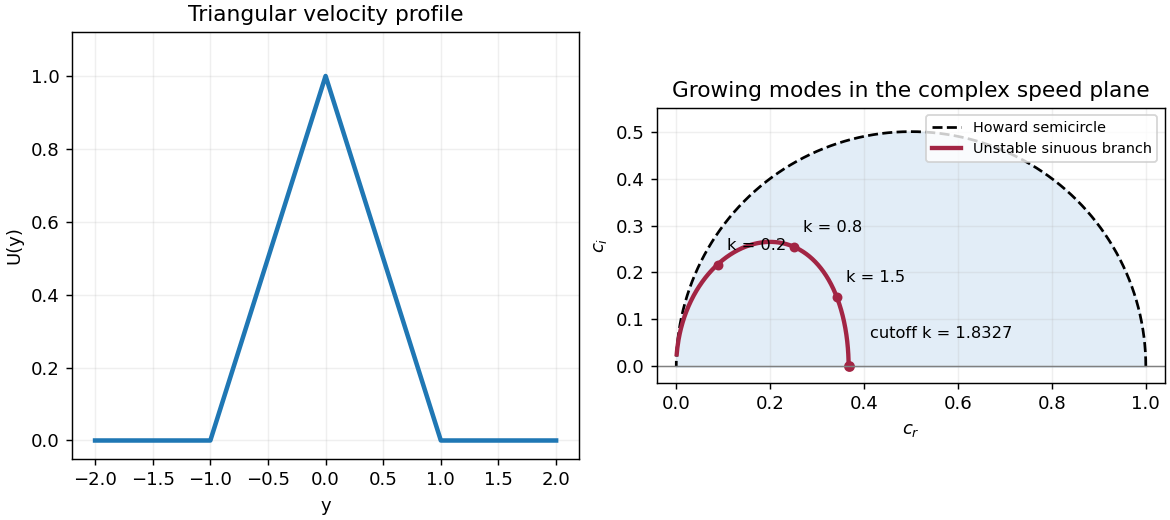
Triangular jet profile and unstable sinuous phase velocities inside the Howard semicircle
. Details. 
Articles by others on the same topic
There are currently no matching articles.