Use logarithms to base two, so all Von Neumann entropies and Shannon entropies are measured in bits. Write the nonzero eigenvalues of as . Orthogonality of the supports makes the mixture a block diagonal matrix, with eigenvalues . ThereforeEach has trace one. Terms with zero probability or zero eigenvalue vanish under the convention . This proves the entropy of an orthogonal quantum mixture.
For a bipartite density operator , the Subadditivity of Von Neumann entropy isHere and likewise for , using the partial trace. For a tripartite density operator, the Strong subadditivity of Von Neumann entropy isEquivalently, quantum conditional entropy cannot increase upon adding a conditioning system: .
Introduce an orthonormal classical label register and the classical-quantum stateThe blocks have orthogonal supports because their label vectors are orthogonal, regardless of whether the original have orthogonal supports. Part (a) gives . The marginals are and , so . Apply the Subadditivity of Von Neumann entropy and cancel :Thus . This is the Concavity of Von Neumann entropy.
The channel acts only on the input system ; the reference is untouched. WriteThe coherent information isThe reference marginal remains , whose nonzero eigenvalues agree with those of . Unlike a classical information quantity, coherent information can be negative.
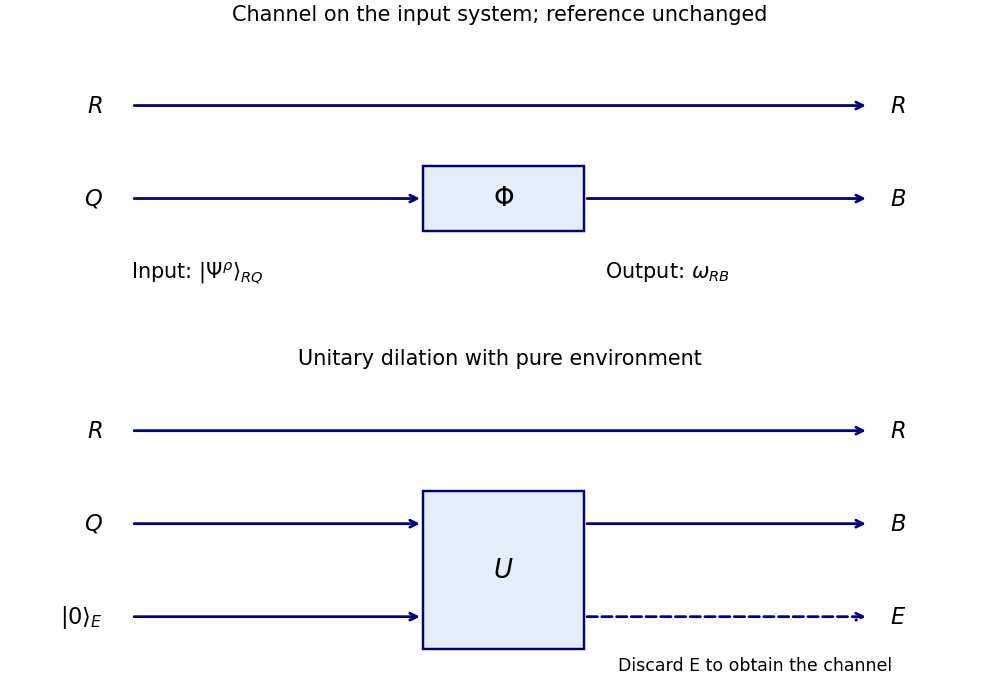
Quantum channel acting on one half of a purification, with untouched reference and discarded environment
. Details. 
The lower diagram uses a Stinespring dilation: append an environment in a fixed pure state, apply a joint unitary operator, and discard the environment by partial trace. Before discarding it, the global state is pure.
Implement the quantum channel by a unitary dilation with a pure initial environment. The final state on is pure. The Schmidt decomposition across either bipartition gives equal complementary Von Neumann entropies, so and . By the Subadditivity of Von Neumann entropy,The reference is untouched and purifies the input, hence . Therefore .
After the first quantum channel, denote the joint reference-output state by . Dilate the second CPTP map as an linear isometry , with the resulting state denoted . Linear isometries preserve nonzero eigenvalues, both globally and on the transformed output, givingTracing out implements the second channel, soThe Strong subadditivity of Von Neumann entropy for gives . Rearranging proves the data-processing inequality for coherent information:
Use the unsquared quantum fidelity convention in the question. For any matrix , its trace norm is : the two positive matrices have the same nonzero eigenvalues, namely the squared singular values. This follows directly from the singular value decomposition.
Set . Then and . Their positive square roots therefore have the same trace, provingThe argument also covers singular density operators, since zero singular values contribute zero.
For positive operators, the unique positive square root of an operator respects tensor products: . To verify this, diagonalize ; the product eigenvectors have eigenvalues , whose square roots are . Hence the operator inside the outer square root in the fidelity factors asTaking its positive square root and using gives .
We first establish the purification-overlap formula for quantum fidelity, rather than assume the desired monotonicity. Write a canonical purification of a density operator asTracing the second factor gives . The Schmidt decomposition shows that any other purification on a sufficiently large fixed ancillary space differs by a unitary on that space: its orthonormal ancillary vectors can be mapped to those of the canonical purification and the map extended to a unitary operator. Zero eigenvalues are handled by padding the ancillary basis.
The overlap of two canonical purifications, with a relative ancillary unitary , is , with zero padding when the ancillary dimension is larger. The unitary variational formula for the trace norm isIndeed if is a singular value decomposition, the trace is with unitary. Its modulus is at most because , and attains that bound. Thus the maximal absolute overlap of purifications equals ; this also proves the needed form of Uhlmann's theorem.
Choose purifications and attaining . Regard the very same vectors as purifications of with ancillary system . Their overlap is among those maximized in the marginal purification formula, soThis proves the monotonicity of quantum fidelity under partial trace.
Write a qubit density operator as , with Bloch vector . The depolarizing channel sends to . Its output eigenvalues are , so its Von Neumann entropy is minimized at . DefineThe minimum output entropy is , since binary entropy is symmetric under . The usual probabilistic-mixture convention has . The argument also holds throughout the physical qubit CPTP range , where this still lies in .
To handle multiple channel uses, let a classical message select a product input with probability . Memorylessness gives product outputs . Additivity of Von Neumann entropy on tensor products gives . The average output acts on qubits, so . Thus the Holevo quantity obeys the product-input block bound for a qubit depolarizing channelThe Holevo bound says the classical mutual information obtained by any measurement, including a joint measurement on all outputs, is at most .
For a reliable code with equiprobable messages and decoding error , Fano's inequality gives . Consequently . Letting the error tend to zero proves .
The bound is tight: equal use of and computational-basis output measurements produce a binary symmetric channel with crossover probability . Ordinary classical coding achieves bits per use.
They need a pre-shared entanglement resource that permits deterministic production of a Bell pair. In particular, one shared Bell pair and two classical bits suffice for exact quantum teleportation. This condition is stronger than merely having some entanglement.
Let Alice's input be , and let her system and Bob's system share . Use the Bell states and . Direct expansion givesAlice performs a projective measurement in this Bell basis and sends its two-bit outcome. Each outcome has probability . Bob applies respectively , recovering exactly, without either party knowing . Before he receives the outcome, his averaged state is , so the protocol does not communicate without the classical message. Alice's measurement consumes the input and the shared entanglement.
For necessity, exact transmission of every pure qubit means the induced quantum channel is the identity: pure-state projectors span the operator space, and a physical channel is linear. Alice can therefore prepare a Bell pair locally and transmit one half by the proposed protocol, leaving a Bell pair shared with Bob. The protocol would itself be a deterministic local operations and classical communication conversion of their resource into a Bell pair. This proves the exact teleportation resource criterion. With no shared entanglement, it is impossible: local operations and classical communication preserve separable quantum states, whereas the resulting Bell pair would be entangled.
For an ensemble , write its channel-output Holevo quantity asTake ensembles and independently, giving the product ensemble . Its average output factors:The Von Neumann entropy of a tensor product is the sum of its entropies. Applying this both to the average and to every labelled output givesChoose each ensemble within of its supremum. The supremum for the joint channel includes this product ensemble, so its value is at least . Let . The superadditivity of Holevo capacity follows:This argument does not restrict the joint supremum to product ensembles and does not require the individual suprema to be attained.
In the generalized measurement postulate, outcome is described by a Kraus operator , with . On a density operator its probability and conditional output, for nonzero probability, areFor a pure input the conditional vector is . The effects are positive and sum to the identity, defining a positive operator-valued measure.
More generally an outcome can have several Kraus operators . Then sum over in both the numerator and the probability, and require .
The usual projective measurement with the Lüders rule is recovered when the measurement operators are mutually orthogonal projections, , for , and . Projector-valued effects alone give projective outcome statistics; to obtain the Lüders state update as well, the instrument must implement , without an additional conditional state change.
The Schmidt decomposition of a normalized bipartite pure state isThe two sets of local vectors are orthonormal. The Schmidt coefficients are the nonnegative numbers , and the Schmidt number for this pure state, also called its Schmidt rank, is , the number of nonzero coefficients. It equals the rank of either reduced density operator and of the coefficient matrix in any product bases. The general mixed-state Schmidt number specializes to this same value on a pure state.
In the computational product bases, the coefficient matrix isIts determinant is , so it has rank two. Therefore the Schmidt number is . As a check, the reduced density operator has eigenvalues and , both positive.
The two displayed amplitudes have modulus . Absorb their phases into Bob's basis rather than use complex Schmidt coefficients. Take , , andBoth local bases are orthonormal. A Schmidt decomposition is thereforeThe two Schmidt coefficients are , the Schmidt number is two, and both reduced density operators are . Their equal eigenvalues make this decomposition nonunique.
Articles by others on the same topic
There are currently no matching articles.