Put , the filament bending modulus in the easier bending direction; is the relevant second moment of area. Take filament tension as positive in extension. A cut at height supports the weight of the material above it, so its axial force is compressive:The small transverse displacement induces a transverse tension force density , while bending produces . Their balance givesThe same result follows from elastic energy and gravitational energy. To quadratic order, local inextensibility shortens the height of the material point labelled by . Integrating its weight and interchanging the integrals gives the second-order potential energyTwo integration by parts steps in its first variation giveThe clamped boundary conditions fix displacement and slope at the base, and the unconstrained tip must have zero bending moment and transverse end force. Thus the complete four conditions areSince the filament tension vanishes at the tip, the last condition is . Integrate the ordinary differential equation once: is constant, and its tip value makes that constant zero. For the slope , it follows thatThe other tip condition already follows from this equation for a regular solution; it is not a third independent condition on the second-order slope problem. Finally reconstruct to impose the base position.
Set , , and . Then and , so becomesSubstituting givesThis is the Bessel differential equation of order , whose two independent Bessel functions of the first kind giveThe tip is . To decide which branch is admissible, retain both leading behaviours, not just the fact that stays finite:Since and , the first branch has zero tip derivative, while the second has a nonzero tip derivative. The moment-free condition therefore sets , and it does not require the tip slope itself to vanish. The base condition now requiresLet be the first positive zero. The Bessel threshold for self-buckling of a vertical rod isTo identify this as the first loss of stability, write the quadratic energy in terms of the slope as . On functions with , its critical coefficient is the minimum Rayleigh quotient ; variation supplies the moment-free condition at the tip and the same Sturm-Liouville problem. The first zero gives the lowest eigenvalue, so the straight state is stable below this load, neutral at it, and unstable above it, with the easier direction buckling first.
Introduce a constant filament bending modulus , which sets the mechanical force scale. The filament has intrinsic curvature of an elastic filament , and its actual signed curvature in a small-slope Monge representation is . To quadratic order one may identify material arc length with in , whileAt fixed positive extension force, the mechanical potential is bending energy minus . Replacing by leaves, up to a force-dependent constant,Its first variation isThe higher-order Euler-Lagrange equation is thereforeFor a Fourier transform relation, take a periodic bulk segment, or a long-filament bulk approximation with negligible endpoint contributions; these are necessary boundary conditions because the question specifies no filament end conditions. Using , every nonzero wavenumber obeysA zero displacement mode is an arbitrary translation. In a periodic representation a constant intrinsic-curvature mode contributes a constant bending cost but no bulk slope, so it does not contribute to the following deficit. The Parseval identity givesFor clarity about finite normalization, on a periodic interval of length define , . Then the equivalent exact quadratic-order formula isThis is force-extension of an intrinsically curved filament, determined by its particular fixed shape rather than by a thermal orientation entropy.
For an ensemble with quenched intrinsic curvature, first minimize each realization and then average the last expression, replacing by its ensemble mean. For stationary bulk disorder, let be the power spectrum, normalized so that its correlation is . The measurable mean deficit per unit projected length isIf the curvature is smooth enough that the second spectral moment is finite, one can take the large-force limit under this integral, obtaining the smooth-curvature high-force extension lawFor a stationary ensemble the integral is . Equivalently, the bulk slope is ; a plot of the mean deficit against measures the mean squared intrinsic-curvature gradient, if is known. The law is a smooth-curvature bulk result, not a universal law for every random filament. For example, ideal white intrinsic-curvature disorder with has an infinite second spectral moment; retaining the full integral instead gives in that ideal continuum model.
Endpoint conditions also matter. If each end is moment-free and has no transverse applied force, the natural conditions from the variation areat each end. These can produce a free-end curvature boundary layer of width . For a constant intrinsic filament curvature , integration of the higher-order Euler-Lagrange equation with zero transverse force gives and henceThe last formula follows by integrating , and tends to , despite the vanishing bulk curvature gradient. Thus a finite free-ended measurement must include or suppress endpoint bending before interpreting a bulk fit.
For the freely jointed chain, rigid links have independent orientations, so the restoring force is entropic. Let now denote absolute temperature, and with Boltzmann constant . In the usual three-dimensional chain, a segment at polar angle has force energy . Its angular canonical partition function and the full chain partition function areDifferentiating with respect to yields the exact mean projected displacementHere is the Langevin function; this is force-extension of a three-dimensional freely jointed chain, in the fixed-force canonical ensemble. At high extension, , soThus the smooth quenched-curvature bulk deficit falls as , whereas the three-dimensional freely jointed chain deficit falls as and depends explicitly on temperature. The distinction is mechanical straightening of a fixed intrinsic shape versus orientational entropy; thermal bending fluctuations of a stiff filament have not been included in the first calculation.
If the comparison chain is also restricted to two dimensions, it is a planar freely jointed chain rather than the three-dimensional model. In this case,The last identity follows directly by differentiating the integral defining ; and are Modified Bessel functions of the first kind. At large the angular weight is proportional to , giving . Consequently : the same inverse-force exponent, with half the three-dimensional coefficient. Both versions assume inextensible links and forces below the regime where the links themselves stretch.
First find the positive spatially homogeneous equilibrium. Setting the reactions to zero gives and , and hence the unique positive equilibrium isThe zero pair is not an admissible positive state and is singular in the term. For homogeneous deviations, the reaction Jacobian matrix at this equilibrium isThus , , and its eigenvalues areFor , both real parts are negative: a real pair has positive product and negative sum, while a complex pair has real part . The reaction equilibrium is therefore asymptotically stable, with no growing oscillatory mode. This does not exclude damped oscillations. Indeed, for the eigenvalues are complex; for example, gives , a stable focus with oscillatory transients. Thus a literal exclusion of every oscillatory solution is false; the intended exclusion of sustained or growing oscillations is the meaningful statement.
One can strengthen this to exclude nonlinear periodic oscillations in the positive quadrant without relying only on the local linear stability analysis. For the reactions , , use the Dulac function . ThenWere there a periodic orbit wholly in the positive quadrant, the flux of through it would vanish, since this vector is tangent to the orbit; Green's theorem would equate that flux to a strictly negative interior integral. This contradiction proves there is no sustained positive periodic oscillation when , the positive-quadrant Dulac multiplier for quadratic activation argument. It leaves the damped transients entirely consistent with the conclusion.
Now introduce a perturbation in the quadratic activator-inhibitor model. The Fourier mode of squared wavenumber evolves underIts matrix trace and determinant areA Turing instability must start with reaction stability, requiring . Then for every , so a mode is unstable exactly when : its two real eigenvalues have opposite signs. This also proves the diffusion-driven onset is stationary rather than oscillatory.
The upward-opening quadratic has its minimum at . To have a negative value at a physically allowed positive squared wavenumber, one needsWriting , the second inequality is , with roots . The first inequality discards the lower branch, givingThese are the Turing threshold of the quadratic activator-inhibitor model conditions. Equivalently, in the plane the instability region lies strictly above and strictly to the left of , with . The boundary diverges as and approaches as .
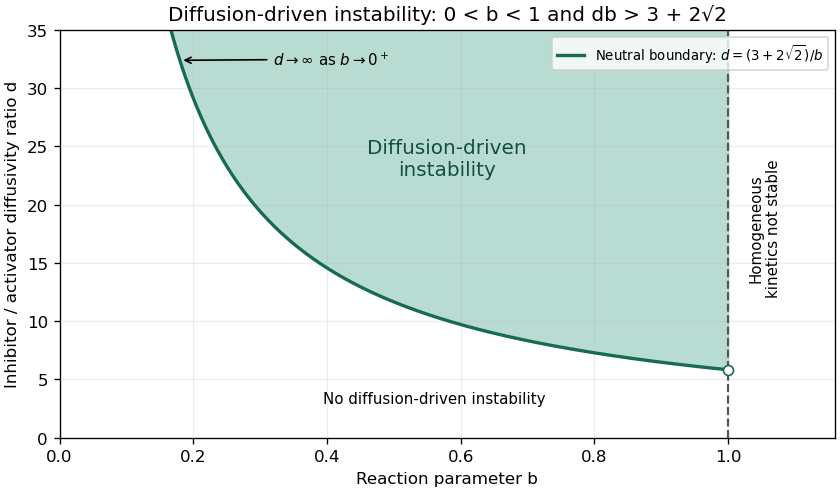
Diffusion-driven instability above the quadratic-model threshold in the reaction-stable parameter strip
. Details. 
At equality, the determinant has a double root and one growth rate is zero, while the other remains negative. Substituting into its minimum location givesBeyond onset, the unstable band isThe stated parameter region assumes continuously available wavenumbers, as on an infinite domain. With specified finite-domain boundary conditions, an allowed nonzero spatial eigenmode must additionally lie in this band; homogeneous stability alone does not ensure that a finite box admits the critical wavelength.
Articles by others on the same topic
There are currently no matching articles.