The endomorphisms of the finite-dimensional vector space over the complex numbers form the general linear Lie algebra with the usual addition and scalar multiplication and Lie bracket . This commutator is bilinear and antisymmetric, and expanding the six products verifies the Jacobi identity.
For a Lie subalgebra , being an abelian Lie algebra means . A nilpotent Lie algebra has , eventually zero; a solvable Lie algebra has , eventually zero. These are the lower central series of a Lie algebra and derived series of a Lie algebra, respectively. Nilpotence is a condition on the Lie bracket, and does not require every member to be a nilpotent endomorphism: a nonzero scalar multiple of the identity spans an abelian Lie algebra.
A flag of a vector space is an increasing chain of vector subspaces. The flag we construct is a complete flag, , where , and each is an invariant subspace for . We first prove the common-eigenvector assertion in the Lie theorem, by induction on ; the zero algebra is immediate. For nonzero solvable , its derived algebra is proper, so there is a codimension-one ideal of a Lie algebra containing . Write . By induction there are and a linear functional on such that for every .
Let be the cyclic subspace spanned by . The commutator derivation identity and show inductively thatThus and all its initial cyclic spans are -invariant. If , the first cyclic vectors form a basis, is also -invariant, and . For , the trace of a matrix commutator givesHence , since the field has characteristic zero. The nonzero common weight spaceis -invariant: . The restriction of to has an eigenvector, because is an algebraically closed field. This is a common eigenvector for . Its line is invariant, and repeating the argument on the quotient vector space gives the complete invariant flag. Equivalently, this proves simultaneous triangularization of a Lie algebra representation.
In a basis adapted to this complete flag, every member of is upper triangular, so every member of its derived algebra is strictly upper triangular. Products of strictly upper triangular matrices vanish, and each iterated Lie bracket of such matrices is a sum of these products. Consequently the derived algebra is a nilpotent Lie algebra. We may therefore take : it is an ideal, and the quotient Lie algebra is abelian. This also covers .
A linear map is a nilpotent endomorphism if for some positive integer , and a semisimple endomorphism if it is diagonalizable over . Decompose into its generalized eigenspaces , where . Define on to be , and set . Then is diagonalizable, is nilpotent, and both preserve these vector subspaces and commute. ThusFor uniqueness, suppose with semisimple, nilpotent and . Both commute with , so preserve each . On an eigenspace of of eigenvalue inside , the map is and has only the eigenvalue . Since the same subspace lies in , . Hence on , proving and . This is the additive Jordan–Chevalley decomposition.
We need a polynomial consequence of this decomposition. Hermite interpolation supplies a polynomial with , by prescribing for each eigenvalue. For any endomorphism , its semisimple part can likewise be expressed as a polynomial in with zero constant term: if zero is an eigenvalue, its interpolation condition already forces this; if not, add the independent condition .
On , the maps and commute. The first is diagonalizable, with eigenvalues on . The second is nilpotent, sincewhich vanishes for when . Uniqueness therefore proves adjoint compatibility of additive Jordan decomposition: .
Now assume . The condition implies that both and are invariant under , and every polynomial in with zero constant term maps into . Define to be multiplication by on . It commutes with . On , acts by . Polynomial interpolation on the finite set of differences gives with . The preceding paragraph then expresses as a polynomial in with zero constant term. Consequently , so .
The assumed trace orthogonality nilpotence lemma now follows directly. On , and , while the matrix trace of the nilpotent restriction of is zero. HenceEvery summand is nonnegative, so every eigenvalue of is zero. Its Jordan–Chevalley decomposition therefore has , and is nilpotent. Notice that neither nor was required to be a Lie subalgebra.
A finite-dimensional Lie algebra over the complex numbers is a semisimple Lie algebra when its solvable radical is zero, equivalently when it has no nonzero solvable ideals. Its Killing form isThe cyclic property of the trace makes this bilinear form symmetric and gives its invariance of a bilinear form on a Lie algebra:It follows that is an ideal of a Lie algebra. For , induces the zero map on . Therefore, for , the matrix trace splits over the invariant subspace and the quotient to give . In particular . The Cartan solvability criterion implies that is solvable. Since is semisimple, : the Killing form is nondegenerate.
For completeness, the trace step in the Cartan solvability criterion is precisely the mechanism of the previous solution. For a complex matrix Lie algebra with for , , set and . If and , then , since . Linearity and the trace orthogonality nilpotence lemma show that every member of is nilpotent. The Engel theorem makes nilpotent and hence solvable. Apply this to ; the kernel of this Adjoint representation of a Lie algebra is the abelian center of , so is solvable as claimed.
For an arbitrary complex Lie algebra, a Cartan subalgebra means a nilpotent Lie algebra that is self-normalizing: . This definition does not assume that is abelian. We prove that it is abelian when is semisimple.
Use the generalized-weight decomposition for a nilpotent Lie algebra for the action of on . Its zero generalized weight space isWe have , since is nilpotent. If , the Engel theorem gives a nonzero coset annihilated by every . Its representative satisfies , contradicting . Thus .
For a nonzero generalized weight , choose with . The operator is invertible on and nilpotent on . For , , write with large enough that . Invariance of the Killing form givesOn the other hand, is solvable, so the Lie theorem triangularizes its action on . For , the matrix is strictly upper triangular, while is upper triangular. Thus . Together with , this yields . Nondegeneracy gives .
Finally, if commutes with , it normalizes , hence lies in . Any abelian subalgebra containing consists of such elements. Thus is a maximal abelian subalgebra, indeed .
Here a reduced root system is crystallographic, as appropriate to a semisimple Lie algebra. It is a finite spanning set in a real inner product space of dimension , invariant under each Weyl reflectionwith for every pair of roots and . A base of a root system is a basis such that the coefficients of every root are integers that are either all nonnegative or all nonpositive. These define the positive system of a root system. We use the existing Cartan matrix conventionUsing the alternative denominator transposes all the matrices below.
The classification of rank-two root systems gives , , , and . In orthonormal coordinates we may choose the following simple roots and Cartan matrices:
- For , take , and . The positive roots are .
- For , take , and . The positive roots are .
- For , take the long root and short root , giving . The positive roots are . Interchanging the long and short convention gives type , which is the same rank-two classification up to the usual identification.
- For , take the short root and long root , giving . The positive roots are .
Each complete root system consists of these positive roots and their negatives. To see why the list is exhaustive, the off-diagonal Cartan matrix entries of two distinct simple roots are nonpositive integers, and their product is . Thus the product is or , corresponding to simple-root angles or . These determine the four systems and their length ratios.
The Weyl group of a rank-two root system is generated by the two simple Weyl reflections. Their product is a rotation of order , respectively, so the groups are the dihedral groups of order . The first is also the Klein four-group and the second the symmetric group . The root-orthogonal lines cut the plane into Weyl chambers, each of angle . A chosen fundamental chamber of a root system is , ; its walls are the two root-orthogonal lines. The Weyl group acts simply transitively on these open chambers.
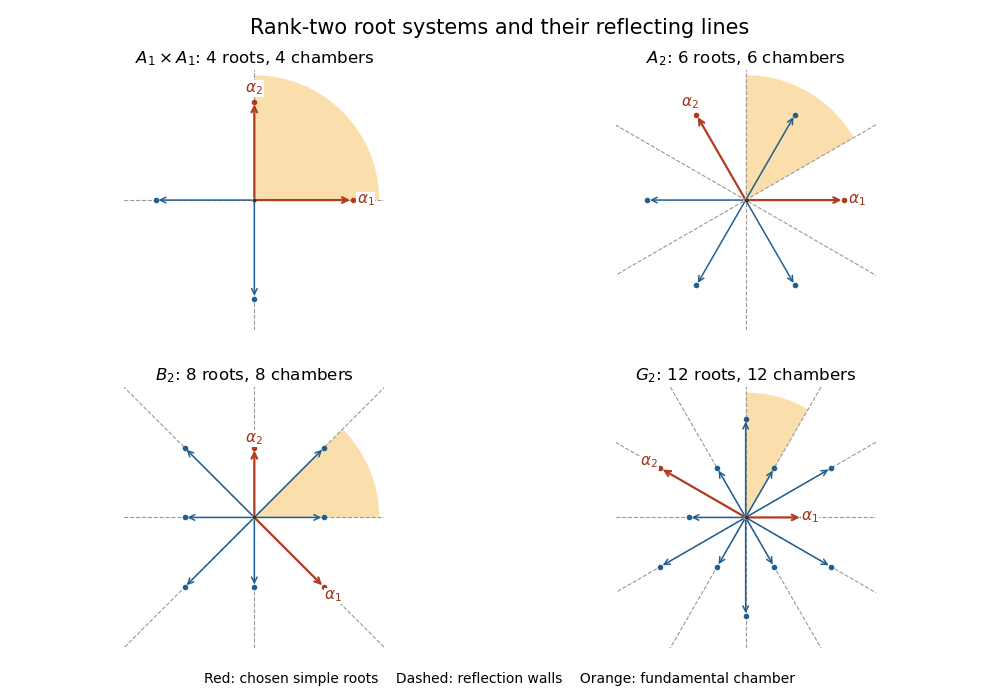
Roots, reflecting lines and a fundamental chamber for the four crystallographic rank-two root systems
. Details. 
The crystallographic hypothesis matters: if the integer-pairing condition is dropped, reduced noncrystallographic systems of type also occur. They are not additional Lie-algebra root systems.
Choose a positive system of a root system and the corresponding triangular decomposition of a Lie algebra . A primitive element of a Lie algebra representation of weight is a nonzero vector with for every and . Thus it is a highest-weight vector; the choice of positive roots is part of this definition. A highest-weight representation is generated by such a vector.
Let be the corresponding Borel subalgebra. Define its one-dimensional Lie algebra representation by the scalar on and zero on . This respects the Lie bracket, since . The induced Verma moduleis nonzero: the Poincaré-Birkhoff-Witt theorem identifies its underlying vector space with , and is a primitive element of weight . Its weight spaces are finite dimensional, its top weight space is the line , and all other weights are with and at least one positive coefficient.
A proper submodule cannot contain , because generates . More strongly it has no component of weight : any finite sum of distinct weight vectors can be projected onto its individual components by a polynomial in a generic element of . Therefore the sum of all proper submodules still misses the top weight line and is proper. It contains every proper submodule, so the irreducible quotient of a Verma moduleis irreducible and retains the nonzero primitive element . This constructs the requested representation for every . It is not asserted to be finite dimensional for arbitrary .
For the sl2 Lie algebra, use , and , with , , . The classification of finite-dimensional sl2 representations gives one irreducible for every integer . In a basis its action iswhere . These formulas satisfy the three Lie brackets. Any nonzero invariant subspace contains a weight vector by polynomial projection using ; repeated application of gives , and applications of then give the entire basis. Thus is irreducible.
Conversely, in any finite-dimensional irreducible module, start with an eigenvector of and apply until reaching a nonzero vector with . This process terminates because increases the eigenvalue by two and only finitely many eigenvalues occur. Write . The sl2 highest-weight lowering formula givesLet and , which again follows from the finite set of weights. Applying to the latter identity yields , so . The resulting distinct weight vectors span an invariant subspace, hence the entire irreducible module. Therefore and its primitive weight is , with ; its weights are .
The complexification of a Lie algebra is , with the Lie bracket extended complex-bilinearly. Equivalently write , whereComplex conjugation is an antilinear map and a Lie algebra automorphism whose fixed subalgebra is .
If the solvable radical of is nonzero, its complexification is a nonzero solvable ideal of . Conversely the solvable radical of is preserved by complex conjugation, because it is the unique largest solvable ideal. Consequentlyfor , both and belong to . If , is a solvable ideal of . This proves is semisimple if and only if is semisimple. Consistently, the complex Killing form is just the complex-bilinear extension of the real one; its determinant in a real basis is unchanged by extending scalars.
Take the sl2R Lie algebra and the special unitary Lie algebra . Both complexify to . This is immediate for the former; for the latter, the real basis consists of traceless matrices that are skew-Hermitian matrices and is also a complex basis of .
They are not isomorphic as real Lie algebras. Their Killing forms are , but on this is negative definite. On the basis has a diagonal Gram matrix with entries , so the signature of a quadratic form is . A Lie algebra isomorphism preserves the Killing form and therefore its signature.
A real split semisimple Lie algebra has a Cartan subalgebra whose Adjoint representation of a Lie algebra is simultaneously diagonalizable over , so its root-space decomposition is defined over . The example is split: the diagonal Cartan subalgebra has eigenvalues and real root spaces . The example is not split. Invariance makes every skew-adjoint for the positive definite inner product , so its eigenvalues are purely imaginary. If it were diagonalizable over , all these eigenvalues would be zero and . The center is zero, so only has this property; no nonzero split Cartan subalgebra exists. Thus is split and is not.
Articles by others on the same topic
There are currently no matching articles.