Over or , a Lie algebra is a vector space with a bilinear map which is alternating and obeys the Jacobi identity:Bilinearity and alternation imply .
For a Matrix Lie group, identify the tangent space with derivatives of smooth curves through . Product curves show that the sum of two such derivatives is again tangent, and reparametrization supplies scalar multiples. In particular this is a real vector space, even when the matrices have complex entries. For , choose a curve with . Conjugating a curve with derivative shows thatDifferentiate this curve in the finite-dimensional vector space . The result isThe matrix commutator is bilinear and alternating, and expanding the six terms proves its Jacobi identity. Thus this construction gives the Lie algebra of a matrix Lie group, with the appropriate bracket, using actual group curves rather than an assumed commutator closure.
For the unitary group, differentiating gives . Conversely, if , then is unitary and is a curve with derivative . ConsequentlyThis is the unitary Lie algebra. The diagonal entries are purely imaginary, contributing real parameters, and each upper off-diagonal entry contributes two real parameters. A matrix-unit basis of the unitary Lie algebra isThese anti-Hermitian matrix units and their combinations are linearly independent over and span every allowed entry.
The symplectic stabilizer is a subgroup: the identity preserves , and if and , thenMultiplying on the left by and on the right by gives . Products and inverses remain unitary. This is the compact symplectic group, often denoted or .
Differentiating the stabilizer equation gives . For , this saysTogether with , these are equivalentlyThese conditions are also sufficient: is unitary, andHence it stays in the subgroup. They characterize its compact symplectic Lie algebra without adding any trace condition. In fact the trace automatically vanishes. The free anti-Hermitian block has real parameters, and the complex symmetric matrix has real parameters. Thus
Here is a complete matrix-unit basis of the compact symplectic Lie algebra. The generators supplying areThe two families supplying the real and imaginary parts of are, for ,The denominator merely avoids double-counting diagonal entries. Each displayed generator obeys both defining tangent conditions. The generators form a real basis of the allowed blocks, and the generators form a real basis of the complex symmetric blocks. Thus they are independent and their total number is . They give all generators required by the real compact algebra, including the case .
A Lie algebra representation on a vector space is a linear map preserving the Lie bracket:The Adjoint representation acts on by . The Jacobi identity givesIf is nonabelian, some is nonzero, so this Adjoint representation is not the trivial Lie algebra representation. It is the required nontrivial representation of dimension . Nontriviality does not require its homomorphism to be injective.
For the finite-dimensional algebras here, with normalization one, the Killing form isIt is a symmetric bilinear form by cyclicity of the matrix trace. To prove its invariance, write , , . ThenThis also gives , the equivalent invariant bilinear form on a Lie algebra identity.
For the unheaded structural requests, a simple Lie algebra is nonabelian and has no ideals of a Lie algebra other than zero and itself. A semisimple Lie algebra has no nonzero solvable ideal of a Lie algebra; in finite dimension over or this is equivalently a direct sum of simple Lie algebras.
Suppose first that the Killing form is nondegenerate. If is an abelian ideal of a Lie algebra and , then maps into and vanishes on . Every preserves . Therefore has zero diagonal blocks relative to a basis adapted to , andNondegeneracy forces . If a nonzero solvable ideal of a Lie algebra existed, its last nonzero derived series of a Lie algebra term would be a nonzero abelian ideal of a Lie algebra, again impossible. Hence the solvable radical is zero, provingThis argument proves the needed implication rather than assuming the Cartan criterion for semisimplicity.
One can also see the direct-sum formulation explicitly through orthogonal ideal splitting for a nondegenerate Killing form. For an ideal of a Lie algebra , invariance makes an ideal of a Lie algebra. If , then for , , so . Thus is an abelian ideal of a Lie algebra, and must vanish. Consequently and the two summands commute. Select a minimal nonzero ideal; it is nonabelian, and any ideal inside it is an ideal of because the complementary summand commutes with it. It is therefore simple. The restricted form is the remaining summand’s own Killing form, because the two ideals commute. Repeating the splitting there terminates in a direct sum of simple ideals.
Conversely the radical of the Killing formis an ideal of a Lie algebra by the invariance just proved. For a simple Lie algebra it is either zero or the whole algebra. The permitted hypothesis that is not identically zero excludes the second alternative. ThusThe computations in the two following parts illustrate both a nondegenerate compact example and a degenerate algebra with an abelian ideal.
The Pauli matrix commutator identity givesfor the anti-Hermitian basis of the SU(2) Lie algebra. In the ordered basis the Adjoint representation matrices, with columns recording the images of basis elements, areTheir squared matrix traces are , and the mixed products have zero trace. Therefore the Killing form of the SU(2) Lie algebra isIt is negative definite and nondegenerate, so this real Lie algebra is semisimple. It is also simple: the displayed bracket is the three-dimensional cross product; if an ideal of a Lie algebra contains nonzero , the vectors span the plane perpendicular to , and together with span the whole algebra. This confirms that the simplicity implication applies with a nonzero Killing form.
For the Euclidean motion Lie algebra in two dimensions, use the ordered basis and keep the printed rotation signs. The Adjoint representation matrices areOnly the square of has a nonzero trace. Hence the Killing form of the planar Euclidean motion Lie algebra has matrixIts radical of the Killing form is , precisely the translation subspace. This is a nonzero abelian ideal of a Lie algebra, so the Lie algebra is neither simple nor semisimple. In fact its first derived series of a Lie algebra term is this translation ideal and its next is zero. Thus the degeneracy and the failure of semisimplicity agree with the structural proofs above; the adjoint action nevertheless remains nontrivial.
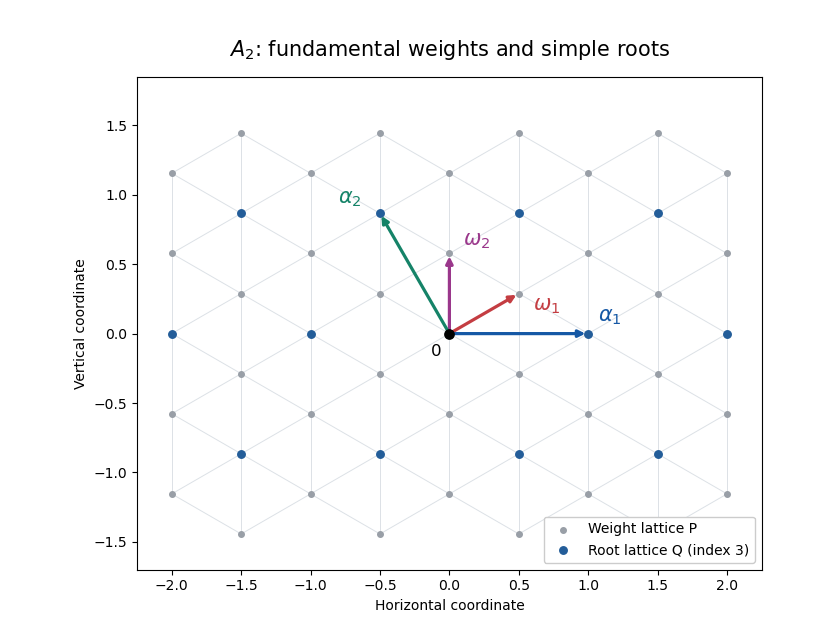
Let be the coroots. With a chosen set of simple roots, the root lattice and weight lattice areThe fundamental weights are defined by , and form an integral basis of . We use the Cartan matrix convention .
For the A2 root system, inversion of its Cartan matrix yields the A2 fundamental weights and weight lattice:Equivalently and . The root lattice has index three in the weight lattice, since the change-of-basis matrix has determinant three. For a planar realization takeThe weight lattice is triangular. In fundamental weight coordinates , a point is in the root lattice exactly when is divisible by three. The following sketch marks both bases and the sublattice:

The integers called Dynkin indices here are the Dynkin labels of the highest weight:For finite-dimensional Irreducible Lie algebra representations, they are nonnegative integers. All weight coordinates below are these Dynkin label coordinates, not simple-root coordinates.
A weight-string enumeration algorithm gives the set of weights without their weight multiplicities. Begin with and process known weights by increasing height below . For each simple root and known weight , find the largest with a weight; all such higher weights have already been processed. The weight string theorem says that the string has endpoints , , withand includes every intermediate step. Append and repeat until no new weights appear. This terminates in finite dimension and supplies all weights; every nonhighest weight can be reached by simple-root lowering. A string can contain contributions from several sl2 summands, so the resulting set does not by itself determine weight multiplicities.
For the explicit calculation we use the following general facts: finite-dimensional representations of a complex semisimple Lie algebra are completely reducible by the Weyl complete reducibility theorem; the symmetric powers of the defining sln representation are irreducible of highest weight ; and weights in a tensor product of Lie algebra representations add with multiplicities multiplied. We also use the highest-weight representation classification: each finite-dimensional irreducible has a unique dominant integral highest weight, and a nonzero vector killed by all simple-root raising operators supplies an irreducible summand with that highest weight in a completely reducible module. For , the Weyl dimension formula specializes toFor , the defining fundamental representation has weights . Thus the A2 representation of highest weight (2,0) is , with the six distinct weightsEach has multiplicity one: these are the weights of the six quadratic monomials.
For the tensor square of the A2 representation of highest weight (2,0), add every ordered pair of elements of . To list the complete answer compactly, define four disjoint weight sets:The tensor product has multiplicity one at each point of , two at each point of , three at each point of , and four at each point of . These fifteen distinct weights account for states.
We next identify the irreducible summands rather than just their dimensions. Split the tensor square of the six-dimensional space into its symmetric power and exterior power, of dimensions and . The square of a highest-weight vector in the symmetric part has highest weight , giving of dimension .
Let be vectors of weights and . In the exterior part has weight and is killed by both simple-root raising operators: raising along gives a multiple of , whose wedge with itself is zero, and the other raising actions vanish. Thus it is a highest-weight vector. The Weyl dimension formula gives , so the entire exterior part is this irreducible summand.
The remaining symmetric part has dimension six. To identify it, the fifteen weights of are exactlyeach once. Subtract them from the unordered-pair weights of . The residual weights are , each once, with highest weight . They are the negatives of , so this six-dimensional summand is . ConsequentlyThe corresponding dimensions are ; complete reducibility and the exhibited highest weights ensure that no summands are missing.
The full weight multiplicities in the A2 tensor square of highest weight (2,0) are summarized below. An entry is the multiplicity of each individual weight in that row's set:Thus has all fifteen weights once, has the six weights once, and has its nine boundary weights once and its three interior weights twice. Only the three interior weights of are degenerate among the irreducible components.
A Non-Abelian gauge theory promotes an internal group representation symmetry to a spacetime-dependent transformation and introduces a gauge field so that differentiation transforms covariantly. The symmetry is a gauge redundancy: physically meaningful quantities must be invariant under local changes of field representative. We work in four-dimensional Minkowski spacetime with signature , and use skew-Hermitian matrix generators throughout.
For the compact Simple Lie group , its real Lie algebra has a negative-definite Killing form. Hence is a positive invariant bilinear form on a Lie algebra. Choose a -orthonormal basis , , with . Invariance makes fully antisymmetric. This construction uses the Adjoint representation and works independently of any chosen scalar representation.
Let be a Lie-algebra-valued gauge potential, with the coupling absorbed into this connection. If is the given finite-dimensional irreducible representation of , its Lie algebra representation definesFor a finite local transformation , require and . Differentiating the first equation forces the gauge-field transformation lawThus the gauge potential transforms inhomogeneously; an ordinary derivative alone would leave an uncancelled derivative of .
The commutator of gauge covariant derivatives determines the gauge field strength:The Lie algebra representation preserves the bracket, so this formula holds for any , including a trivial scalar representation. The gauge field strength itself is defined in the gauge algebra. The transformation of the connection impliesIt is therefore covariant, rather than invariant as a Lie-algebra-valued quantity.
For infinitesimal , the same equations give the infinitesimal gauge transformation with an anti-Hermitian connection:Substitution into cancels the terms containing and gives , the gauge covariance of a scalar covariant derivative.
The Yang-Mills theory has Lagrangian densityThis is the Killing-form Yang-Mills Lagrangian. Its sign uses a positive internal form and the stated spacetime signature. In a -orthonormal basis it is . Gauge invariance follows because is invariant under the adjoint group action. Infinitesimally, the variation is proportional toAfter rescaling , the gauge coupling appears in and in the non-Abelian part of the canonically normalized field strength. Squaring that field strength gives cubic and quartic gauge-field self-interactions. An ordinary local quadratic mass term in the gauge potential is not invariant because its transformation contains .
For the scalar field kinetic term, compactness supplies a positive invariant Hermitian form on its representation space. One can obtain it by averaging any positive form with normalized Haar measure, the unitarization of a compact-group representation. Then is unitary for , and is anti-Hermitian. The Yang-Mills theory coupled to an arbitrary scalar representation hasHere is any real gauge-invariant scalar potential, so . For example,is available for every unitary representation, with giving a bounded quartic contribution. Other invariant interactions may exist for particular representations; the potential is not required to depend only on .
The scalar kinetic term is gauge-invariant because both covariant derivatives transform by the same unitary . Infinitesimally its variation vanishes byThe potential is invariant by its defining condition. For a real irreducible representation, use the averaged positive symmetric form instead and write the kinetic term as ; all transformation and invariance arguments remain valid. Expansion of the covariant kinetic term produces both the linear gauge-scalar interaction and the quadratic term needed by local gauge invariance.
The invariant inner products, gauge covariant derivatives and gauge field strength together construct the full theory for every compact Simple Lie group and every supplied finite-dimensional irreducible representation of the scalar fields. Both finite and infinitesimal transformation laws have been included, and every sign follows the same anti-Hermitian convention.
Articles by others on the same topic
There are currently no matching articles.