Work away from , where the inverse-square potential is singular. Variation of the phase-space action givesThe last equation is the constraint imposed by the Lagrange multiplier . The canonical momentum conjugate to is , not . Consequently the nonzero canonical Poisson brackets areIn particular,With the convention , the Noether charge generating is . Equivalently, the conserved physical energy is ; a convention that calls the energy the time-translation charge absorbs this minus sign into its parameter.
For the dilation charge,on the constraint surface. Its infinitesimal canonical transformations areFor constant , extending this by preserves the action: the kinetic terms are invariant and scales oppositely to . Thus the dilation acts on time and position with their nonrelativistic relative scaling. Its Poisson bracket with the energy is
Put . Direct variation of the Hamiltonian givessoThe supplied transformations are generated by the special conformal charge of inverse-square mechanicsChooseThen even for a time-dependent parameter. Expanding the kinetic-term variation, keeping the terms in , givesHenceFor a constant parameter only the boundary term remains, identifying as the Noether charge. Independently, the equations of motion giveUsing the same canonical Poisson bracket convention,Together, , and form the sl2R Lie algebra of conformal mechanics. These are time translation, dilation and special conformal transformation. A useful normalization check is the Casimir elementon the constraint surface.
Define the open-string endpoint momentum flux along the open string by . Variation of the Nambu-Goto phase-space action givesThe two last equations are the Virasoro constraints. Integration of the momentum equation givesThus the necessary and sufficient condition for total momentum conservation is equality of the two endpoint fluxes, component by component. Vanishing of both fluxes is a sufficient local boundary condition.
The spatial boundary term in the action variation is . For free ends the endpoint variations are arbitrary, soIn a gauge with and nonzero this reduces to the usual Neumann boundary condition . The conclusion is conservation of total momentum, not that total momentum must vanish. The PDF contains the derivative in this conclusion; the TeX transcription drops it.
For endpoints confined to , the Dirichlet boundary condition fixes . It therefore imposes no requirement that vanish. Preserving the fixed position requires at each endpoint, but that is a different condition. For example, in gauge the endpoint momentum is zero while can be nonzero. Consequently is generally not conserved: the normal endpoint forces transfer momentum to the hyperplane. A dynamical D-brane recoils and carries the missing momentum. If the hyperplane is idealized as fixed, its external support absorbs the momentum. The combined string-and-support system conserves momentum; freely varying directions tangent to the hyperplane retain their vanishing-flux condition.
Use the mostly-plus Minkowski metric, with the last spatial coordinate singled out:Then , as required. In these light-cone coordinates, , and .
Introduce the Kalb-Ramond field strengthThe field equation is . Under , every second-derivative contribution to cancels by commutation of derivatives. Thus and its equation are gauge-invariant. This is the differential-form identity for the two-form gauge field .
To impose light-cone gauge for a two-form, first choose andThis sets to zero. A residual transformation preserving the gauge obeys . With , this implies , including . Such a parameter changes by zero. Therefore no nontrivial gauge transformation of remains in the sector where is invertible. There is still a redundant description of the gauge parameter itself, ; the excluded zero modes would require separate treatment.
The field equations now say , hence . For this givesFor , follows automatically from antisymmetry of . Therefore the independent components and their equation areThe remaining equations follow from this wave equation and the reconstructed longitudinal components.
At the first massless level of the closed bosonic string, states carry a product of two transverse vector polarizations. Its symmetric traceless, antisymmetric and trace parts are respectively the graviton, the Kalb–Ramond field and the dilaton. The antisymmetric part has exactly the polarization count just found.
The gauge-invariant string coupling to a two-form uses the pullback of the background Kalb–Ramond field to the string worldsheet:Its variation is , by Stokes theorem. It vanishes on a closed worldsheet. For a cylindrical propagation surface it is only an initial/final boundary term, handled by fixed-boundary gauge parameters or the corresponding transformation of external states. Thus the closed string is naturally charged under a two-form gauge field.
For the Monge-gauge Hamiltonian of a three-dimensional string, in Monge gauge, and . The momentum constraint gives . The other Virasoro constraint then readsChoosing the positive-energy branch,Substituting into the phase-space action leaves , soFor an infinite string this is an energy-density expression; even the undeformed string has infinite total energy. One may regulate the length or subtract its constant reference energy when a finite total energy is needed. The positive branch is unambiguous at the density level.
The canonical Hamiltonian field equations areConsequently impliesThe second equation also becomes , consistent with differentiating the first. These are one-direction traveling profiles along the string.
For the linear profile, the spatial string is the straight line . It is tilted, and its coordinate intercept moves with speed . This is also a uniformly moving straight string: the physical transverse velocity of a tilted string is the velocity normal to the line. With unit tangent and coordinate velocity , the normal speed isThus does not imply superluminal physical motion. Fixed- labels have spacelike trajectories when , but labels on a string can slide tangentially and are not identifiable material particles. Choosing removes the tangential velocity and gives the subluminal velocity .
The induced worldsheet metric supplies a coordinate-invariant check:The string worldsheet remains Lorentzian for every finite , including and . Its constant energy density is . This linear profile is a tilted boosted straight string, rather than a localized finite-energy wave.
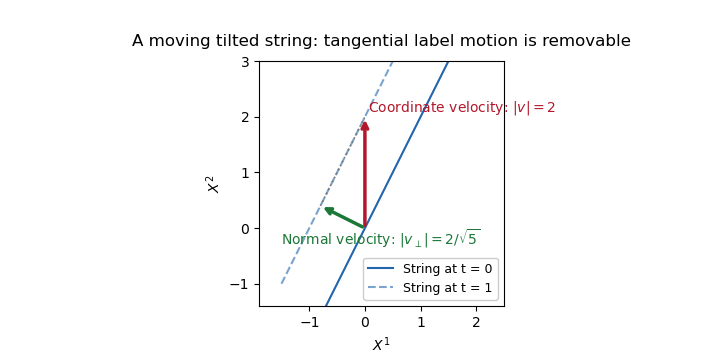
For slope k=2 the vertical coordinate velocity exceeds one, while its component normal to the tilted string has physical speed 2 divided by the square root of 5
. Details. 
Set and take the closed-string spatial coordinate periodic with period . One convenient Lorentzian convention for the conformal gauge action isThe two anticommuting bc ghost systems are the Faddeev-Popov ghosts of the worldsheet metric gauge fixing. Their fields have conformal weights and . Ghost normalizations can be rescaled without changing the algebra. After a Wick rotation the two terms become the familiar holomorphic and antiholomorphic and actions.
Let and include both matter and ghost contributions. With the conventional plane normalization of the zero mode, their Virasoro algebra isEach free coordinate boson contributes central charge , including the timelike coordinate after the usual analytic continuation. The weight- bc ghost system contributes in each chiral sector. Thus the total central charge is .
The Virasoro constraints originate in a gauge symmetry. A nonzero central term is a quantum obstruction to realizing that gauge symmetry without an anomaly; equivalently, the BRST charge fails to be nilpotent. Cancellation of the worldsheet Weyl anomaly therefore requiresThis is the critical dimension of the bosonic string. The accompanying physical-state normal-ordering condition gives the usual matter intercept in each sector. A shift of the zero-mode convention changes the linear term in the central polynomial, but cannot change the required cancellation of its cubic coefficient.
In a point-particle description of quantum gravity, interactions of a massless spin-two field occur at localized vertices of Feynman diagrams. The gravitational coupling has negative mass dimension for spacetime dimension greater than two, so short-distance loop integrations generate higher-derivative counterterms that cannot all be absorbed into the Einstein action. A string worldsheet instead joins incoming and outgoing strings by a smooth surface. In particular, a closed string splits or joins through a smooth pair-of-pants surface. There is no invariantly distinguished point at which every part of an extended string interacts. The choice of a time slicing can draw a joining point, but it is not a physical pointlike vertex. This removes the point-interaction geometry responsible for arbitrarily localized interactions and introduces the string length .
This geometric explanation is supported by the organization of the Polyakov path integral. Introducing a worldsheet metric makes the Nambu–Goto action amenable to gauge fixing. In the Euclidean integral, metrics on a fixed oriented surface are divided by worldsheet diffeomorphisms and Weyl transformations. What remains is a Riemann surface with a conformal structure, together with finitely many worldsheet moduli and the positions of external string vertex operators. The determinants from fixing the metric are represented by Faddeev-Popov ghosts. Schematically, for closed-string external states,Here is the moduli space of genus- punctured surfaces. The dilaton weights a surface by its Euler characteristic , giving before the normalization of external states. Every additional handle multiplies the contribution by . The string genus expansion therefore plays the role of the ordinary loop expansion, with the sphere giving tree level and the torus giving one loop. The critical dimension cancels the worldsheet Weyl anomaly, making this reduction to conformal geometry consistent.
The massless symmetric traceless closed-string state is a graviton, and its long-wavelength interactions reproduce gravity. At distances comparable with , however, an infinite tower of excited states contributes. This is more than a single particle form factor: the same amplitude contains graviton exchange, massive higher-spin exchange and string-scale softness.
The dimensionless variables in the given Virasoro–Shapiro amplitude correspond to , , , where capital letters denote the usual dimensionful Mandelstam invariants. Its constraint identifies the external particles as the closed bosonic tachyons, not four gravitons. Nevertheless its intermediate massless pole directly exhibits graviton exchange. The overall normalization will be suppressed below; no additional copy of the amplitude formula is needed.
First, the amplitude is symmetric under permutations of , expressing crossing symmetry. The poles in any channel areFor generic , the residue can be calculated with the Gamma function pole at and its recurrence:The product is when . Indeed, the pole factor contributes , while the two remaining Gamma ratios contribute . A residue polynomial of degree shows exchange of spins up to , with leading Regge trajectory . At , the massless residue is , containing the spin-two exchange. By crossing, the massless -channel pole isfor generic . Thus at large the pole behaves as , the characteristic energy dependence of graviton exchange. Its massless propagator produces the long-range gravitational interaction. At low energies the massive poles can instead be expanded into local higher-derivative corrections to the effective gravitational action.
At the string scale one must retain the whole tower. The Gamma reflection formula rewrites the amplitude exactly asAt large and fixed , away from the resonance poles or with a specified complex continuation, the Gamma ratio scales as . Hence the Regge limit scales as , up to the signature factor and the displayed -dependent coefficient. In particular, a fixed nonzero momentum transfer changes the point-graviton power law by a factor : the graviton belongs to an entire trajectory rather than remaining an isolated spin-two exchange at arbitrarily high energy.
There is stronger suppression when the scattering angle is fixed. Put , with . Applying Stirling formula to the Gamma functions, after the same treatment of real-axis poles, gives the leading smooth envelopeThe leading terms cancel and the remaining entropy-like combination is negative. In physical units the exponent is . This fixed-angle softness of the closed-string amplitude is absent for an elementary pointlike gravitational vertex. Equivalently, short-distance gravitational scattering probes additional string degrees of freedom. In a four-dimensional long-distance effective setting, a massive exchanged mode contributes a Yukawa-type correction proportional to , with couplings and tensor factors depending on the external states. Such terms are suppressed for and become relevant for . The amplitude establishes the spectrum and short-distance change; it does not by itself give a universal static potential for arbitrary sources. Its bosonic tachyon also signals an unstable vacuum, so it must not be treated as a complete stable model of a gravitational force.
Finally, the modular group prevents overcounting equivalent surfaces and reorganizes the loop ultraviolet region. A torus is with . A change of lattice basis identifiesThus the one-loop integral uses a fundamental domain for , for exampleThe measure is invariant, and the physical integrand, including matter, ghosts and external insertions, must respect torus modular invariance. In this domain . The region of arbitrarily small proper time that causes ultraviolet divergences in a particle loop is therefore not an independent part of the string integral; a modular transformation relates it to another description already represented in the domain.
This does not remove every possible divergence. The cusp is a long tube, and factorization through it can produce infrared divergences, massless tadpoles or the bosonic tachyon divergence. At higher genus, degenerating cycles similarly factorize into propagating intermediate string states. The essential improvement is the relation between worldsheet geometry, the full spectrum and the quotient by large diffeomorphisms; infrared and unstable-background problems remain separate questions. A short-distance expansion that keeps only the graviton discards precisely this structure.
The first-order fermionic kinetic term produces second-class momentum constraints. After eliminating them, the canonical graded Dirac brackets arewith other mixed brackets zero. The bracket of two odd variables is symmetric, consistently with the graded Poisson bracket. The constraint algebra isIt is the worldline supersymmetry algebra: the square of the fermionic constraint generates the Hamiltonian constraint.
With , quantization converts these toRepresent the fermions by Gamma matrices, , where , and . The wavefunction is a Dirac spinor. Its physical-state constraint iswhich is exactly the massless Dirac equation. Moreover , so this equation implies the remaining mass-shell constraint. Conversely, a solution of the massless Dirac equation satisfies both constraints. The Klein-Gordon constraint alone would not impose the spinorial first-order equation.
The PDF's displayed zero-mode term has no derivative. Read literally, vanishes for classical Grassmann variables and supplies no zero-mode symplectic structure. The subsequent canonical-algebra requests therefore require the standard kinetic term . We use that intended correction explicitly; the rest of the displayed action fixes the nonzero-mode normalization.
The Ramond level operator, with vacuum-annihilating normal ordering, isThe canonical oscillator relations, for transverse indices , areThe hermiticity convention is and . The commuting bosonic zero mode is supplied by the center-of-mass momentum. For , define and . Their bosonic occupation numbers are and their fermionic occupation numbers are . Therefore, on the Fock space generated from an oscillator vacuum,Equivalently, creation operators raise the level by , since and . The zero modes commute with and do not change the level. The multiplier imposesso the states are massless. In the Ramond sector the bosonic and fermionic oscillator zero-point contributions cancel, consistently with the stated zero intercept. The massless ground states are spacetime spinors, as the Ramond zero-mode Clifford algebra now shows.
Normalize . ThenLet . Each positive-frequency bosonic annihilator commutes with , while each fermionic annihilator anticommutes with it. Applying either annihilator to therefore gives zero. Thus all eight are oscillator vacua. For real , the hermitian operator satisfies , soThis proves the real independence of Clifford-generated vectors, and hence their linear independence over .
The same argument applies to the nonzero vacuum , because . It gives eight real-linearly independent oscillator vacua . They include itself, at . Products of two zero modes preserve vacuum annihilation just as products of one do.
For the chirality matrix , reversing eight anticommuting factors introduces . HenceMoving any through the other seven factors also gives . If , thenThe first collection has negative chirality; the second has positive chirality. If and have these respective chiralities, hermiticity gives , so they are orthogonal. Combining the two real-independent collections therefore gives at least sixteen real-linearly independent oscillator vacua, eight in each chirality.
The real qualification in the question matters: the particular eight vectors generated from an arbitrary complex need not be independent over . Nevertheless the dimension bound from paired Clifford involutions also follows from the full Clifford algebra. Define four commuting hermitian involutions , . Their joint spectral projections preserve the vacuum space, so it contains a nonzero common eigenvector . Multiplication by flips the eigenvalue of and leaves the other three eigenvalues unchanged. The sixteen products obtained by independently choosing whether to apply these four odd-indexed Gamma matrices to consequently have distinct joint eigenvalue quadruples. They are nonzero, mutually orthogonal oscillator vacua. Thus the unprojected vacuum space also has complex dimension at least sixteen, with eight states of each chirality in the minimal representation. A further chiral projection is an additional physical restriction, not part of the oscillator-vacuum conditions here.
Articles by others on the same topic
There are currently no matching articles.