For one target galaxy, an encounter with relative speed sweeps a cylinder of volume in time . Multiplication by the number density gives the encounter rate . Thus the geometric galaxy-encounter rate givesThis is the expected number of mergers in the geometric model. For independent encounters, the Poisson process probability of at least one is , so the displayed linear probability is valid for rare encounters, . There is no factor of one-half for a single target; that factor would enter a count of distinct pairs across the whole population.
For an illustrative group environment, take , , and a Hubble time of order years, or . The path length is about , using the stated distance conversion. HenceThe estimate scales linearly with environment density and quadratically with the adopted merger radius. It is an order-of-magnitude model estimate, not a universal observed merger fraction; reducing the illustrative density by a factor of one hundred reduces the estimate by the same factor.
For the tidal calculation, use the relative potential convention in which acceleration is . Expand the point-mass potential about the target centre:The constant does not exert a force. The linear term accelerates the target centre and is subtracted in its freely falling frame. The remaining leading quadrupolar point-mass tidal potential isThe condition permits the convergent expansion; using only this term is the leading tidal approximation, accurate when the target radius is small compared with the closest separation.
The given impact and velocity directions imply . This trajectory is in the plane, correcting the incompatible printed plane. In the impulse approximation, hold the stellar position fixed while integrating the tidal tensor:For , the needed integrals arewith the mixed integral zero by oddness. Thus the integrated tidal tensor of a straight-line flyby is andThere is stretching along the impact direction, compression in the other transverse direction and no net kick along the path.
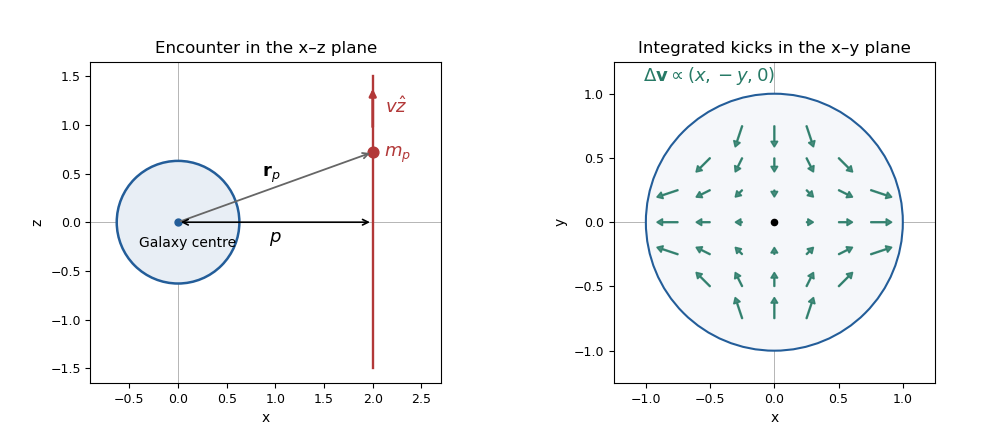

Write for the star's initial velocity, distinguishing it from the perturber speed . Its specific energy change is . The no-correlation assumption removes the first term on averaging; it is not an identity for every individual star. The mean specific heating at a given position is thereforeFor a spherical target, the mass-weighted averages satisfy . The tidal impulse heating of a spherical galaxy is consequentlyHere is assumed finite. Notice the change from specific energy to total energy after multiplying by .
For two equal targets, each gains the same internal energy, so . Their relative-motion reduced mass is . If denotes their relative speed at infinity, their initial orbital energy is . Internal tidal heating comes from this orbital energy. In the tidal capture of galaxies model, capture occurs if , which gives the equal-mass tidal-capture thresholdCapture allows further passages and eventual merger in this simplified picture.
The encounter lasts roughly . The impulse approximation needs , so that a star barely moves during the tide. When , stellar orbits respond during the perturbation and the kicks can cancel. Adiabatic invariance of an orbital action produces adiabatic shielding of tidal encounters, rather than the impulsive heating used above. The capture inequality cannot be extrapolated into that slow-encounter regime.
A spherically symmetric stellar model has no preferred direction in the tangent plane at a fixed radius. Rotations about the radial axis exchange its two transverse velocity directions, so . This uses spherical symmetry of the velocity distribution, not just a spherical mass density.
The augmented density treats radius and relative potential as independent variables, agreeing with the physical density only along . For any regular bound spherical galactic distribution function , write and . At fixed , and . Integration by parts therefore givesFor , the velocity measure is , and . Integrating the transverse derivative gives , while integrating the radial derivative in gives . Consequentlywhere is fixed. These identities show that the augmented representation holds for any such spherical distribution, not only a monomial ansatz. With radial pressure vanishing at the zero-binding boundary, set Along the physical curve, the chain rule gives . The Spherical Jeans equation then requiresThus the Jeans moments from an augmented density areThe partial derivative holds fixed. Substitution cancels the integral of and leaves precisely in the Spherical Jeans equation. This is a representation by a chosen augmented density, not a unique solution determined by the one-variable density: different extensions off the physical curve encode different anisotropies, and not every formal extension necessarily gives a nonnegative galactic distribution function.
For the hypervirial density-potential family, differentiate the potential and use the spherical shell theorem:Differentiating and dividing by givesThe enclosed mass tends to at infinity and to zero at the centre for every . The same result follows from , with the stated sign convention.
From now on set . The separable augmented density is . Integrating it givesand henceWith these are the requested radial expressions. The velocity-anisotropy parameter is , and the total mean square speed is .
The local kinetic-energy density is . With the potential zero at infinity, the gravitational energy density is , where . ThereforeThis is the local virial relation of the hypervirial model, a special property stronger than the global virial theorem. To compute the global energies as well, set . The substitution yields the global binding integral of the hypervirial modelThe beta function integral converges for all . ThusRestoring dimensions multiplies by .
To derive the hypervirial distribution function, let be the positive relative energy and the magnitude of the specific angular momentum. Seek for and zero otherwise. Its density isThe angular integral is . Substitution makes the radial integralMatching the augmented-density power gives . Matching its coefficient gives the normalization of the hypervirial distribution functionAll integrals are finite in velocity for , and . Because and are orbital integrals, this is a steady solution by the Jeans theorem. As checks, gives for the Hernquist model, and gives for the isotropic Plummer model.
The density and potential do not uniquely fix the stellar distribution. The preceding coefficient is fixed within the chosen separable power-law model, but nonuniqueness of spherical galactic distribution functions remains without that extra restriction. An explicit positive counterexample uses the same density. Define the Osipkov-Merritt distribution function variable and takeRescale the transverse velocity by . Then and the velocity Jacobian contributes . Direct integration givesexactly the same Plummer model density. This anisotropic Plummer distribution with unit anisotropy radius has , so it is distinct from the isotropic distribution while remaining positive and spherical. Its second moments differ, so it does not share the extra augmented-density and local-virial restrictions of the chosen hypervirial model.
A small-angle gravitational encounter between a test star and a field star of mass gives a transverse kick , where is the impact parameter and the relative speed. For number density , encounters in occur at rate . Independent kicks add in mean square, giving the random-walk derivation of stellar relaxationThe Coulomb logarithm in stellar dynamics has of order system size , and of order the strong-deflection scale . For a virialized -star system, , so is of order . The stellar relaxation time is the time for accumulated velocity variance to become comparable with :Using gives . With a diameter-crossing convention , this is , conventionally rounded toThe coefficient is approximate: spatial profile, velocity averages and crossing-time convention change it by factors of order unity. The robust result is crossing times.
For and years, the estimate is about years, enormously longer than a Hubble time. Most galaxies therefore behave as collisionless stellar systems. Dense nuclei and star clusters can relax more rapidly. Negligible stellar encounters do not mean negligible collective gravitational instabilities.
Define the mass-weighted galactic distribution function by , so . Hamiltonian gravitational motion preserves phase space volume by the Liouville theorem in Hamiltonian mechanics. In the collisionless regime no encounter term redistributes stars between neighbouring phase space trajectories, so . With acceleration , the Collisionless Boltzmann equation is
For a steadily rotating galactic bar, write the inertial polar angle as . The inertial radial and angular equations are and . Substitution gives the equations of motion in a rotating frame:Here the velocities are measured in the bar frame. Set , and define the positive-force rotating-frame relative effective potentialThe centrifugal sign is positive in this relative-potential convention. The characteristics areConsequently the rotating-frame collisionless Boltzmann equation isFor these planar equations, integrate over and interpret as the planar or vertically integrated mass density. Define . Boundary terms in velocity vanish for a sufficiently decaying distribution.
Let the velocity accelerations above be . Their velocity divergence is . Thus integration by parts in the zeroth moment contributes , producing the cylindrical continuity equation for a rotating stellar systemThis is conservation of mass: change of density balances flux through the radial and azimuthal sides of a small cylindrical element. The factor is geometric; the physical phase space measure is .
For the radial first moment, multiply the rotating-frame collisionless Boltzmann equation by . Its velocity integrations are and . Hence the radial cylindrical Jeans equations in a rotating frame areFor the azimuthal first moment, the velocity integral vanishes, while . This givesThe Jeans equations are local momentum-balance equations. The second moments include streaming momentum flux and random-velocity stress, while gravity, centrifugal acceleration and Coriolis acceleration supply the frame-dependent forces. They do not by themselves close the full distribution: a stress prescription or a galactic distribution function is also needed.
False. Stellar evaporation removes stars above the escape energy after two-body relaxation has redistributed their energies. The remaining self-gravitating cluster need not become less dense; losing mass is not the same as holding its radius fixed.
For a slowly evolving isolated cluster, apply the virial theorem at each approximate equilibrium: . Stars evaporating with nearly zero energy at infinity remove little total energy, so the bound cluster has nearly constant negative . With gravitational radius defined by ,For homologous structure, its characteristic mean density therefore scales asIt increases as mass is lost. Escaping stars carrying positive energy make the bound energy more negative and strengthen the contraction tendency. This is virial contraction under stellar evaporation, related to the negative heat capacity of bound gravitational systems. A tidally limited globular cluster has additional radius constraints, so this scaling is not universal, but the claimed inevitable density decrease is false even in the simplest isolated evaporation model.
False as a claimed change between isolated steady endpoints. Conservation of energy by itself would allow a more negative and a larger , but both endpoints must also obey the virial theorem. For a finite isolated equilibrium with no surface term,If total is conserved between the two equilibria, the fixed-energy virial constraint between steady states givesThis includes both ordered rotation and random stellar motion. A galactic bar or other instability can redistribute angular momentum and concentrate a central component, but compensating expansion or rearrangement elsewhere must preserve the global energy constraint. Central concentration alone does not prove that the whole system has a more negative .
A remnant could have different energies if stars escape, or if an external component exchanges energy with it; then the conserved total energy would include that other component. Those cases do not justify treating the bound disc simultaneously as a closed fixed-energy system and as a new equilibrium with increased .
False. The singular isothermal sphere is infinite in extent and mass. The isolated finite-system virial theorem cannot be applied to its global divergent energies without boundary terms.
A direct Spherical Jeans equation counterexample is enough. For isotropic velocities with constant one-dimensional dispersion , its density slope givesThus and the circular and isotropic speed comparison in a singular isothermal sphere isThis is realized by a positive isotropic distribution , which gives a Maxwell-Boltzmann distribution of velocities and . Circular orbits have instead and , so their total mean square speed is . The isotropic model contains eccentric orbits except for a measure-zero subset.
The boundary virial term of a singular isothermal sphere explains the different energy budgets of a finite spherical region. At radius , its radial-pressure surface term is . It is nonzero in the isotropic model and zero in the circular-orbit model. Equality of the density therefore does not enforce equality of the velocity energy through an incorrectly omitted surface term.
False. Adiabatic invariance of an orbital action preserves actions under sufficiently slow regular evolution, not the ratios of their frequencies. With action-angle variables, can change even when does not. A closed bound orbit requires commensurate radial and angular frequencies; rational commensurability is not an adiabatic invariant.
For an explicit counterexample, slowly change the physical potential from Kepler form towith a small, slowly varying positive . The radial epicyclic frequency and circular angular frequency at a nearly circular orbit areInitially their ratio is one. For generic nonzero , is irrational, producing the Kepler-harmonic epicyclic precession. An initially slightly eccentric ellipse with nonzero radial action therefore becomes a precessing nonclosed orbit, while its radial action remains approximately fixed and its angular momentum remains exactly fixed by spherical symmetry.
Adiabatic actions do not preserve orbital closure. Exceptional circular or resonantly commensurate final orbits do not rescue a claim about every initially closed orbit.
False. The enclosed-mass formula is a consequence of the spherical shell theorem. In a spherical galaxy, exterior shells exert no radial force and interior mass acts as though concentrated at the centre, giving .
A razor-thin axisymmetric disc instead hasBoth interior and exterior annuli contribute to that derivative. Its geometry is not determined by .
A concrete counterexample compares a central point mass plus an exterior spherical shell with the same point mass plus a thin circular ring of mass and radius . Their enclosed-mass profiles are identical: inside , and outside. The interior gravitational force of an exterior thin ring follows by expanding its angularly averaged relative potential:For , the ring's acceleration is outward, , whereas the spherical shell's acceleration is zero. With large enough to retain circular orbits, the disc-side speed isA narrow smooth annulus gives the same distinction. This proves that enclosed mass does not determine a disc rotation curve, even when the mass profiles of the spherical and disc models agree.
Articles by others on the same topic
There are currently no matching articles.