Neon has and sodium has , while is unchanged. The conversion is therefore beta-minus decay,A neutron is converted to a proton by the weak charged current. If an excited daughter is populated, subsequent gamma decay produces the observed photons without changing either or . The initial weak transition and the later electromagnetic nuclear de-excitation are distinct stages. A direct transition to the daughter ground state produces no nuclear de-excitation gamma ray.
The supplied schematic has four daughter energy levels, including the ground state, and all six downward pair transitions. Thus the observed gamma ray energies must be the six positive pairwise differences ofThe largest difference fixes . Since are themselves transitions to the ground state, each must occur among the measured energies. Testing those pairs gives exactly two level schemes:They are reflections of one another about half the total span: replacing every level by preserves the set of differences. The assignment of every observed line is
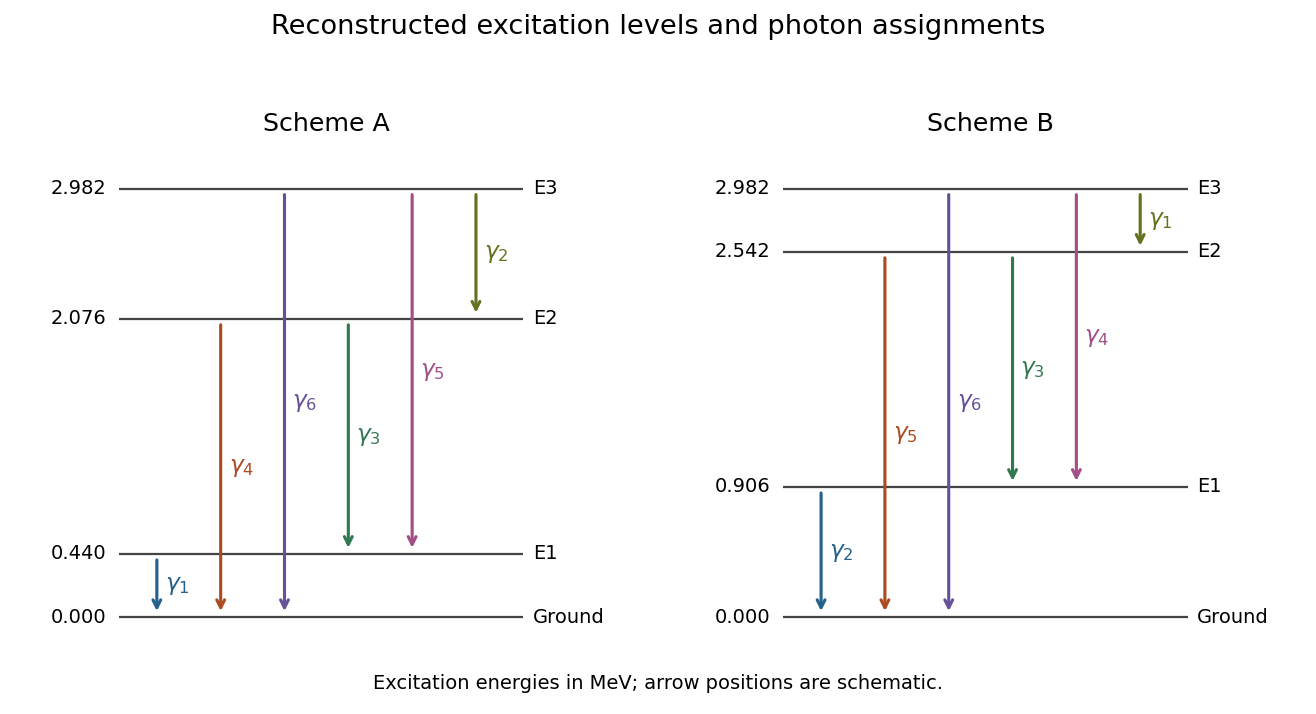
These original diagrams plot the inferred excitation energies to scale. They do not reproduce the source schematic. The reconstruction treats the supplied three-decimal gamma ray energies as the transition gaps, neglecting their much smaller nuclear recoil corrections.
For every daughter energy level, the total number leaving it must equal direct beta feeding plus cascades entering it. Direct feeding cannot be negative. This nuclear level population balance gives a decisive test without assuming any electromagnetic transition-strength model.
In scheme B, the first excited level is populated by and , with counts . Its only downward transition is , whose count is . Its direct beta feeding would therefore have to bewhich is impossible.
For scheme A the corresponding direct feeding values, in the same arbitrary count normalization, areAll are non-negative. Thus scheme A is the compatible scheme. Under the stipulated complete decay sample and the six-transition model, scheme B is ruled out by population conservation, rather than merely being less probable. This inference assumes that the reported emitted-photon counts account for de-excitation: substantial unreported internal conversion or other decay paths would require additional terms.
The four direct beta decay branching fractions exhaust the parent decays in the model, soHere the question's are dimensionless branching fractions, despite the conventional use of for a dimensionful decay width. Its “zeroth excited state” means the daughter ground state. Cascades through an excited level do not count as an additional direct beta branch to it.
Let be the common normalization converting the quoted to photon numbers per parent decay. Apply nuclear level population balance to scheme A, starting with the top level:For example, the transition contributes to the population of level 2; it must be subtracted from the total leaving level 2 to obtain its direct beta feeding. Similarly, a photon in the strong line need not imply a direct beta transition to level 1.
The three equations giveAdding them cancels the internal cascade counts:This also has a simple physical meaning: each decay that initially feeds an excited daughter eventually contributes exactly one of the three transitions into the ground state. The number of all emitted photons is not the correct normalization, because a single cascade can emit several.
Consequently the required formulae are
Using the observed counts,ThusTogether with the direct ground state branch, these sum to unity. No measurement uncertainties were supplied for these ratios, so the extra digits only document the arithmetic.
A ground-state baryon contains three quarks in a spatially symmetric wavefunction, giving positive parity. Each quark is a spin one-half fermion, so the complete wavefunction must be antisymmetric under interchange of its complete quark labels. A physical baryon is a colour singlet, with the antisymmetric colour factorConsequently the combined spin-and-flavour factor must be symmetric. The product notation in the question organizes the degrees of freedom; it need not mean that spin and flavour are separately unentangled. In particular the octet requires a correlated sum of products.
For the three light flavours, the flavour symmetry decomposition isThe subscripts describe permutation symmetry, with denoting mixed symmetry. The addition of angular momentum of three spin one-half particles givesThe symmetric spin quartet has total ; the two spin doublets have .
For , the spin factor is symmetric, so the flavour factor must also be symmetric: this gives the spin- baryon decuplet. Its flavour content is four states, three states, two states, and one state.
For , the mixed-symmetry spin functions combine with the mixed-symmetry flavour functions to make one fully symmetric spin-flavour factor for each octet weight: this gives the spin- baryon octet, containing two nucleons, three Sigma baryons, one Lambda baryon, and two Xi baryons. The two mixed-symmetry octets in the raw flavour product are not two distinct ground-state octets; their permutation partners are correlated with the spin factors. An antisymmetric flavour singlet would require a fully antisymmetric spin factor to make a symmetric product, but three spin states drawn from a two-dimensional single-quark spin space have no such factor.
Equivalently, the symmetric three-particle representation of spin-flavour symmetry has dimension and decomposes under flavour and spin intoThese are approximate multiplets: the larger strange quark mass breaks exact flavour symmetry and splits their energies.
The baryon hyperfine mass formula is a phenomenological constituent-quark model. The three constituent quark masses include effects of strong-interaction dressing and an approximate spin-independent confinement energy; they are not the small running quark masses in a short-distance Quantum chromodynamics calculation.
The residual correction has the form of a colour-magnetic spin-spin interaction. A nonrelativistic reduction of one-gluon exchange produces a contact contribution proportional toAfter taking its expectation in the common spatial wavefunction and the colour singlet, the colour factor, coupling, and contact density are absorbed into . Summing the three quark pairs gives the supplied formula. Positive raises aligned-spin configurations relative to lower-spin configurations. In natural units, the spin angular momentum operators are dimensionless, so has units of energy cubed, as in the given .
Label the identical strange quarks as 1 and 2 and the up quark as 3. In the ground spatial state, the pair has symmetric space and flavour factors but an antisymmetric colour factor. The Pauli exclusion principle therefore requires a symmetric spin factor: the pair has .
The angular momentum identitygivesNext couple to , where . For total ,For the spin- Xi baryon, this is . By symmetry the two pair correlations are each . Inserting the pair correlations into the baryon hyperfine mass formula givesFor the spin- state, the same coupling gives . Each pair correlation is therefore , as expected for a fully symmetric spin state. HenceThe predicted splitting is a useful independent check:
Use GeV consistently with the supplied :The spin-independent sum is . The spin-spin interaction corrections areThusThe displayed decimal places document the calculation, rather than asserting that this simple constituent-quark model has sub-MeV predictive precision.
The predicted-minus-measured differences areRelative to the measured masses, these are and . The predicted spin-spin interaction splitting is , compared with the measured , a discrepancy of about in the splitting.
This is an effective constituent-quark model, with a common spatial contact factor and a nonrelativistic spin-dependent interaction applied to light quarks. Relativistic motion, different spatial wavefunctions, and omitted strong-interaction corrections prevent an expectation of accuracy at the experimental -- scale. Agreement at the level of several percent in absolute baryon masses would already be useful for such a simple formula; the sub-percent absolute-mass agreement here is better than that rough expectation.
No theoretical uncertainty or fitting prescription is supplied, so there is no unique numerical “expected error” or justified statistical significance to attach to the deviations. Small relative errors in the large spin-independent mass sum also need not imply equally small relative errors in the much smaller spin-spin interaction splitting.
The charged pion has spin zero. In its rest frame, the outgoing muon or Positron and the neutrino travel in opposite directions. With a nearly massless left-helicity neutrino, total angular momentum zero requires the positive charged antilepton to have negative helicity. The weak charged current instead creates a massless positive antilepton with positive helicity. A nonzero charged-lepton mass supplies the required opposite-helicity component.
Thus the decay amplitude is proportional to : this is helicity suppression. Explicitly, contracting the pion's axial-current matrix element, proportional to its four-momentum , with the leptonic current and applying the Dirac equation leaves a factor . The leptonic pseudoscalar decay width is, in the convention,The phase space advantage of the lighter Positron cannot offset its much stronger helicity suppression. The common factors cancel in the pion electron-to-muon decay ratio:This tree-level estimate explains why the muonic branch dominates by roughly four orders of magnitude. The paper's table gives an electronic branching fraction ; electromagnetic corrections change the simple ratio by a few percent without changing the mechanism.
The original table gives the dimensionless branching fractionsThus the four-lepton channel is about times as frequent, despite its smaller available phase space.
The dominant neutral-pion interaction is with two photons. In double Dalitz decay, both are virtual and convert to separate Electron-Positron pairs:This requires two electromagnetic conversions but does not force the whole final state into a helicity-suppressed two-fermion configuration. The two virtual photons and four final leptons allow the necessary angular momentum correlations.
For the two-lepton mode, a single virtual photon cannot mediate a pion into : the electromagnetic vector current has the wrong quantum numbers. The leading electromagnetic mechanism involves two virtual photons attached to the same lepton line, with a loop integration. The resulting pseudoscalar two-lepton amplitude vanishes as , so its decay width has an additional helicity suppression factor proportional to .
Both channels involve extra electromagnetic couplings relative to . The crucial distinction is the extra leptonic loop and helicity suppression of the two-lepton channel; counting final particles or couplings alone misses it. The pion-two-photon interaction itself already contains strong-interaction structure, so “extra loop” here compares the diagrams after representing that common interaction by an effective vertex.
Both formal processes use one weak charged current transition, with a virtual W boson producing the lepton pair. Two representative lowest-order quark-line diagrams are shown below. They use the component of ; attachment to the antiquark line in the component gives the other contribution to the same hadronic current.
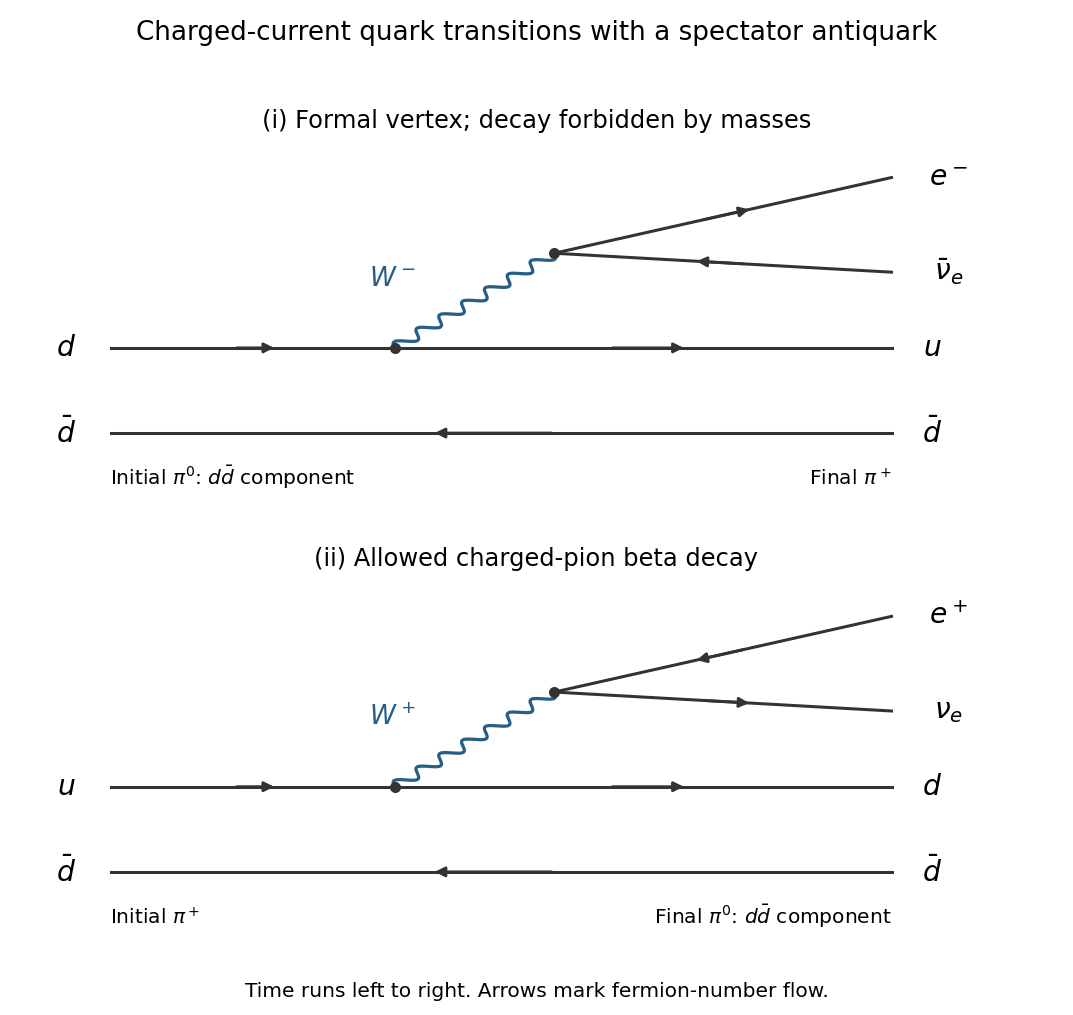


In the first diagram, and , with a spectator quark. In the second, and , again with a spectator . The diagram for the first process describes the coupling but cannot make an energetically forbidden on-shell decay occur.
From the original tables,Therefore the first process has Q valueand is forbidden for an isolated pion. The second hasThe table therefore lists only the second, pion beta decay, withIts tiny branching fraction combines a weak interaction with an exceptionally small available energy. An allowed semileptonic transition has a decay width scaling approximately as , where , with electron-threshold and recoil corrections. The fifth power makes the few-MeV gap especially restrictive. Unlike direct , this semileptonic channel is not forced to have an amplitude proportional to ; its primary extra suppression is the small phase space. Its approximately Cabibbo-favoured current does not supply a further large flavour suppression. The observed branching fraction corresponds to a partial decay rate of about , competing with the much faster dominant muonic decay.
For (i), CP symmetry relates the negative- and positive-pion radiative channels to excellent accuracy. The original positive-pion table therefore predictsThe comparison requires the same photon-energy and event-selection definition. The table attaches an unexplained footnote to this radiative channel; it does not specify those cuts in the supplied excerpt. An arbitrarily soft photon is not a separately infrared-finite exclusive observable, so the numerical value must retain the table's definition.
Part (ii) contains an apparent notation error in the original PDF as well as the TeX: it prints , rather than . Taken literally, the charged leptons carry net electron-family lepton number , and the printed adds another . The initial pion has zero lepton number. This is a channel, not the charge conjugate of the listed positive-pion decay. In the ordinary lepton-number-conserving Standard Model approximation,Allowing lepton-number-violating masses for Majorana neutrinos would require additional physical assumptions and does not justify assigning the tabulated number to that channel.
For the likely intended charge-conjugate process, the prediction is insteadThis distinction follows from a lepton-number test of a decay channel; replacing the printed neutrino by an antineutrino must be stated explicitly.
The table gives the Xi baryon mean lifetime . At , an initially resting particle has survival probabilityThus the most probable contents are one undecayed . The initial momentum is unspecified. For a moving parent, time dilation replaces the denominator by , making the survival probability at least as large. The times below are characteristic proper mean lifetimes; laboratory times depend on the particle velocities.
The principal first step isIt typically occurs on the scale. The neutral pion almost immediately converts to two photons, with and . The Lambda baryon has and two dominant routes.
In the charged-pion route,The muon lifetime is a standard additional input, not present in the supplied five table pages.[ref]
Review of Particle Physics by Particle Data Group (2022). Muon listing, mean-life entry: approximately 2.197 microseconds
The successive contents are approximately , then , then . After a few muon lifetimes the dominant stable endpoint isThe leading-path probability including the tabulated two-photon pion branch isHere the last factor is the tabulated dominant muonic charged-pion fraction; rare radiative corrections are being neglected in describing a fixed photon count. Before selecting pion decay channels, the probability of reaching the history is .In the neutral-pion route,This produces by roughly the nanosecond scale. It is a long-lived intermediate state, not the final endpoint: the free neutron has in the original table and eventually undergoes beta-minus decay,Thus after several thousand seconds the dominant stable endpoint isBefore selecting the two decays, the history has probability . The familiar rough description is therefore a charged-pion route and a neutron route; including the specified leading pion branches gives approximately and for the two displayed endpoints. The remainder includes Dalitz decays and other rare channels, not a failure of probability conservation.
These are particle decay cascades, treating the separated final proton, Electron, photons and neutrinos as stable asymptotic particles and neglecting subsequent collisions and rare extra radiation. An infinitely large box prevents escaping particles from being removed from the inventory. Neutrino labels specify their production flavours. Each lifetime describes a stochastic waiting time, so there is no finite sharp instant at which every unstable particle has certainly decayed.
Articles by others on the same topic
There are currently no matching articles.