[ref]
https://www.whatdotheyknow.com/request/natural_science_tripos_physics_e_2/response/2340776/attach/2/FOI%202023%20399%20Zahid%20materials.pdf?cookie_passthrough=1. Original public PDF, physical pages 482–485; dated 27 April 2012
The metric source is a gravitational frequency shift. photons following null geodesics through a time-dependent spatial metric change momentum relative to the background comoving frame. The directional projection of that metric change gives the factor. It is not a collision term or continuing photon scattering after recombination. The normalization and sign belong to the specified definition of and ; a distribution perturbation should not silently be identified with temperature without fixing that normalization.
Define , where dots here mean conformal-time derivatives. In an Einstein-de Sitter background,A power law therefore satisfies , or . Thuswith the required growing mode . This is a solution in the perturbation convention used in the question, rather than a statement that every gauge-invariant gravitational potential grows as .
Use an integrating factor for the photon equation:For the growing mode . For the polynomial-source photon transport solution, a particular solution is : direct substitution gives . The initial-value solution is consequentlyThis also follows by integrating the source twice by parts. The apparent inverse powers of cancel in the complete long-wavelength limit; the integral form remains regular. At , the source vanishes and the complete expression reduces to .
Physically, the exponential transports the recombination pattern along photon trajectories; its direction-dependent phase projects a Fourier perturbation onto different angular multipoles. The extra terms are the accumulated gravitational contribution, here expressible as endpoint terms because the source has this special time dependence. For endpoint monopole and dipole in photon transport, at the observer the last two terms are respectively a directional dipole and an angular monopole for each mode; they do not supply a new sky pattern at multipoles . The propagating recombination combination contains the intrinsic perturbation and gravitational/velocity endpoint contributions. Individual terms depend on the perturbation gauge; observable temperature anisotropy requires the consistent emitter and observer contributions.
In pure matter domination the gauge-invariant scalar potentials are constant for a growing linear mode: the matter contrast grows as while the potential scales as its contrast divided by . Thus growth of this is compatible with no late Integrated Sachs-Wolfe effect in Einstein-de Sitter. When dark energy suppresses matter growth, the potentials generally evolve; photons gain and lose unequal energies entering and leaving a potential well. In a convention where are the dimensionless Newtonian-gauge potentials, the integrated temperature source is along the light path.
Large-angle cosmic microwave background data can constrain that late contribution, but low-multipole power alone has large cosmic variance and depends on the primordial radiation spectrum, geometry and foreground treatment. Cross-correlating the temperature map with low-redshift galaxies or other matter tracers isolates a late-time connection; decaying wells typically correlate overdensities with hotter cosmic microwave background directions. Boughn and Crittenden compared WMAP temperature data with the HEAO1 hard X-ray background and examined possible foreground origins of the correlation. This tests potential evolution under a cosmological model, not dark energy independently of all gravity and curvature assumptions.[ref]
Gravitational evidence requires much more nonbaryonic matter than can be supplied by ordinary luminous material or by the baryon abundance permitted by nucleosynthesis. A stable, electrically neutral massive particle is a plausible cold component. Thermal production followed by cosmological particle freeze-out gives an additional motivation: an annihilation rate near a weak-interaction scale can leave an appreciable relic abundance. This is a mechanism and search hypothesis, not proof that the dark matter must be a WIMP or have any particular elastic-scattering cross section.
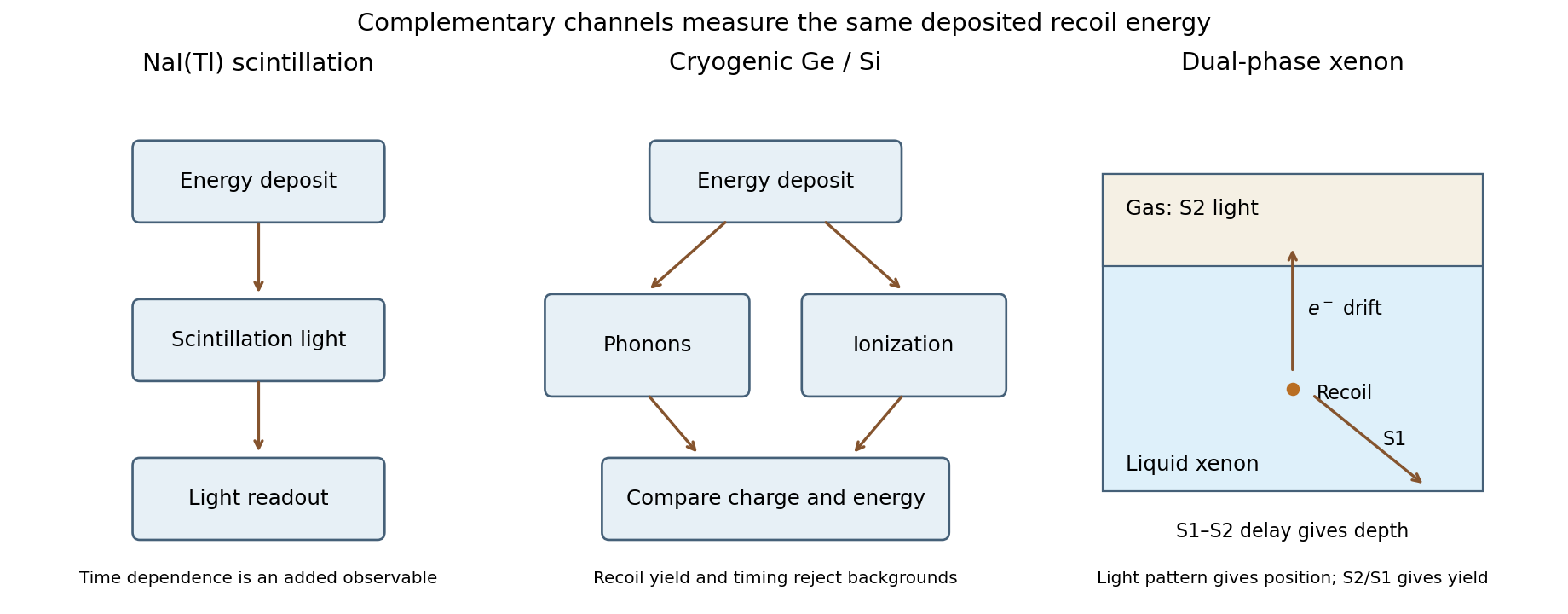
The plotted regions are conditional WIMP interpretations of different measurements. The experiments use different targets and distinguish signal from background differently:
- DAMA experiment uses NaI(Tl) particle scintillation and seeks an annual variation of low-energy single-hit counts as the Earth's velocity through the halo changes. Multiple-hit events and other energy ranges provide controls, but particle scintillation alone does not identify every event as an electron or nuclear recoil. Converting the modulation into mass and cross section requires a halo model and nuclear-recoil quenching factor assumptions.[ref]New results from DAMA/LIBRA by R. Bernabei and others. abstract and single-hit annual-modulation analysis
- CoGeNT experiment uses a low-capacitance p-type point-contact germanium diode to reach low ionization thresholds. Low-energy event radiation spectrum and a possible annual modulation can suggest light dark matter, but surface charge collection, internal x-ray lines and threshold efficiency must be distinguished from bulk recoil events. Its 2011 modulation paper described a modulated component of unknown origin rather than an unambiguous particle identification.[ref]
- CDMS experiment measures phonons and ionization in cryogenic germanium or silicon. The smaller ionization yield of nuclear recoils and phonon timing help reject electron and surface events. The lowered-threshold germanium analysis improves low-mass sensitivity, at the cost of more difficult background discrimination near threshold; this explains why distinct 2010 and 2011 curves appear.[ref]Results from a Low-Energy Analysis of the CDMS II Germanium Data by CDMS Collaboration. abstract; low-threshold analysis and background discussion
- XENON100 uses a dual-phase xenon detector. A recoil produces prompt liquid particle scintillation, S1, and ionization electrons. A drift field transports the charge to the surface; extracted electrons produce gas electroluminescence, S2. Drift delay and the S2 light pattern reconstruct position, while S2/S1 statistically separates electron and nuclear recoils. An inner fiducial volume suppresses external radiation. Neutron and gamma calibrations establish recoil response and leakage, and low-light-yield calibration is particularly important for light WIMPS. Neutrons can themselves mimic nuclear recoils.[ref]The XENON100 Dark Matter Experiment by the XENON100 Collaboration. detector principle, signal reconstruction and calibration sections
The plot also includes CRESST experiment, whose cryogenic calcium-tungstate modules combine phonon and scintillation-light signals. Different nuclei contribute to its recoil interpretation. Its excess region is another conditional candidate region, not an extra confirmed detection.[ref]
Around ten GeV, the shaded regions favour cross sections roughly –, while the XENON100 solid curve and the improved low-mass CDMS curve cut into or exclude much of those regions under the common elastic, spin-independent WIMP-nucleus scattering interpretation expressed per nucleon. There is tension within that shared model; the plot does not show mutually confirmed discoveries. electron backgrounds, threshold response, nuclear-recoil quenching factors, channeling assumptions and the halo velocity distribution can shift interpretations. Changing the interaction model can also alter target comparisons, but cannot establish a WIMP by assertion. The 100-live-day XENON100 result itself reported candidates compatible with estimated background.[ref]
Dark Matter Results from 100 Live Days of XENON100 Data by XENON100 Collaboration. abstract; background-compatible candidates and elastic spin-independent limit
For a rough dimensional event estimate, givesIf a collider production cross section had this value, that small yield, before acceptance and backgrounds, would not support a likely discovery. The plotted nuclear-scattering cross section is not the LHC production cross section, however. Converting between them needs a mediator, couplings, parton distributions and production kinematics; a light stable WIMP would normally be inferred from missing transverse momentum with a visible recoil object, not a visible WIMP track. The mass makes pair production kinematically accessible, but the plot and integrated collider luminosity alone do not decide discovery probability.
For the relic estimate, define and . The sharp-freeze-out relic dilution model givesAssume stable particles, no subsequent annihilation, and . Conserved comoving particle number then givesThe present rest-energy density and its critical fraction areThus the supplied toy model yields a cosmologically substantial density, of the right broad scale to motivate a dark-matter candidate. It is not an independent precision prediction: is imposed and the abundance depends exponentially on it. If entropy degrees of freedom change, entropy conservation instead gives an extra factor in when using the photon temperature. The species content needed to evaluate that correction is not supplied. A realistic calculation also follows residual annihilations with the abundance Boltzmann equation rather than stopping exactly at equilibrium freeze-out.
Complementary nuclear-recoil signals
. Details. 
annihilation can produce gamma rays, charged antiparticles and neutrinos, directly or through decay and hadronization of the primary products. For self-conjugate dark matter of mass , the annihilation rate per unit volume is . For a photon yield , the optically thin flux from a chosen solid angle isUse consistent mass-energy units. The factor assumes identical self-conjugate particles; distinct particle-antiparticle populations require their separate number densities. A gamma-ray continuum with an endpoint near the particle mass is generic for many channels, whereas a narrow line from or would be especially distinctive but often loop suppressed. dwarf spheroidal galaxies offer high dark-matter content with limited conventional emission; the Galactic centre has a potentially larger signal and much more complicated foregrounds.
Charged Positrons and antiprotons are redistributed by magnetic fields and lose energy, so their radiation spectrum depend on propagation and cannot usually point directly to the source. annihilation electrons can also produce synchrotron and inverse-Compton radiation. dark matter captured in the Sun could produce escaping high-energy neutrinos, with the signal depending on capture, annihilation equilibrium and particle interactions. Early annihilation energy injection can alter recombination and cosmic microwave background anisotropies.
A persuasive interpretation joins particle-like spectral structure with a consistent density-dependent morphology and other channels. Pulsars, cosmic-ray interactions and unresolved sources can imitate continuum excesses. Density-profile uncertainties, substructure and velocity-dependent annihilation modify the predicted signal; a lack of a detectable line does not exclude all annihilating dark matter.
A cosmological constant has fixed density and equation of state . A separately conserved dynamical component obeysIf departs from , its history changes the Hubble parameter, luminosity distances and angular-diameter distances. Type Ia supernovae probe a relative distance-redshift relation, baryon acoustic oscillations provide standard-ruler distances and expansion information, and the cosmic microwave background fixes early-time scales and geometric combinations. Combining these breaks some degeneracies with matter density, curvature and calibration. Distance observables integrate the expansion history, so they smooth rapid variations in and cannot determine an arbitrary function exactly.
Structure-growth measurements add a dynamical test. Galaxy clustering, redshift-space distortions and weak gravitational lensing constrain the growth of matter perturbations and metric potentials. The late Integrated Sachs-Wolfe effect probes potential evolution through CMB-matter correlations. A scalar-field dark-energy model can have perturbations and an effective sound speed different from other models with a similar background expansion. Comparisons of geometry and growth can therefore distinguish some models and test gravity assumptions.
A statistically significant, robust departure from or from constant dark-energy density would disfavor a pure cosmological constant within the stated framework. Consistency with over a finite redshift range does not prove exact constancy: a slowly rolling field can mimic it. Supernova calibration/evolution, galaxy bias, photometric redshift errors, intrinsic galaxy alignments and foregrounds must be controlled; modified gravity can also change growth. Parameterizations such as are useful finite-dimensional tests rather than a complete classification of all dark-energy histories.
The baryon excess requires a mechanism that produces different net baryon numbers from an initially symmetric ensemble. In the usual local, CPT-invariant framework, the Sakharov conditions are baryon-number violation, C and CP violation, and departure from thermal equilibrium. Baryon conservation would preserve zero net baryon number; exact conjugation symmetries equate the conjugate production processes; equilibrium inverse reactions and detailed balance erase a would-be asymmetry. These necessary conditions do not determine its magnitude.[ref]
Violation of CP invariance, C asymmetry, and baryon asymmetry of the universe by Andrei Sakharov. 1967 original statement of the conditions
For example, let equal numbers of a heavy particle and its antiparticle decay into channels with baryon numbers . Their mean net yield per pair isIt can be nonzero even though CPT requires equal total widths: the branching fractions differ among channels carrying different baryon numbers. A nonzero decay-rate asymmetry requires interference with both a CP-odd weak phase and an absorptive phase. If the expansion rate overtakes the inverse-reaction rate, decays can occur out of equilibrium; later baryon-violating washout must then be weak enough for the asymmetry to survive.
In electroweak baryogenesis, CP-asymmetric transport near a first-order phase-transition boundary can bias baryon-violating sphaleron transitions. CP violation alone is insufficient: the transition and washout dynamics also matter. In leptogenesis, out-of-equilibrium decays of heavy Majorana neutrinos can generate lepton asymmetry, part of which sphalerons convert into baryon asymmetry while conserving . The CKM phase demonstrates CP violation in the Standard Model but does not by itself supply a successful cosmological mechanism. The key quantity is a surviving net charge yield, not merely the existence of a CP-violating reaction.
A Majorana neutrino is its own antiparticle, with a mass term that can violate lepton number by two units. It is not thereby a state of both readily observable helicities with equal weak rates: charged-current vertices still select chirality. In light-neutrino exchange, the needed helicity connection between two beta vertices supplies a neutrino-mass factor.
Ordinary two-neutrino double beta decay is and conserves lepton number. It can occur when the direct single-beta route is energetically forbidden or highly suppressed but the double change is allowed. neutrinoless double beta decay, , violates lepton number by two. For the conventional light-Majorana exchange in neutrinoless double beta decay mechanism,Here is the lepton mixing matrix, the phase-space factor in this convention and a nuclear matrix element. Complex phases can cancel contributions to the effective Majorana mass; oscillation mass differences alone do not fix it. Other lepton-number-violating mechanisms can also cause the process, so a rate is not a model-independent measurement of .
The experimental signature is a peak in the summed electron energy at the nuclear Q-value, apart from small recoil and energy losses. Two-neutrino decay instead gives a continuous sum-energy radiation spectrum because neutrinos carry away variable energy. Isotope enrichment, large exposure, good energy resolution and radiopure shielding improve sensitivity; gamma backgrounds, radon, surface events and the two-neutrino tail require calibration and sideband controls. Coincidence or track information can test whether the topology is compatible with two electrons. A later concrete example is GERDA's 2013 germanium-76 source-detector search, which used pulse-shape discrimination and background controls rather than identifying any isolated energy deposit as a decay.[ref]
Results on neutrinoless double beta decay of 76Ge from GERDA Phase I by the GERDA Collaboration. experimental method and pulse-shape/background analysis; published after this exam
Observation would establish lepton-number violation and support a Majorana mass component; a null search constrains mechanisms and does not prove neutrinos are Dirac particles.
Articles by others on the same topic
There are currently no matching articles.