For this calculation define the net wavevector gained by the neutron as , the opposite of a common sample-transfer convention. Since ,The perpendicular neutron recoil and phonon absorption condition therefore requires . In the supplied periodic dispersion, interpret its as this transfer in the extended-zone representation of a phonon dispersion. Put and . Nonzero intersections obeyThere is no root in : there and . On the ratio increases strictly from to infinity, so exactly one root occurs. Nor can there be a higher root: gives , with strict inequality at the possible boundary. For , use ; throughout this short interval, since its minimum there is . Thus the only nonzero magnitude satisfiesSolving the exact dispersion, which is permitted instead of the linear approximation, givesA straight chord between the zone edge and the next zone centre gives . Its intersection solves , yielding and as a less accurate estimate.
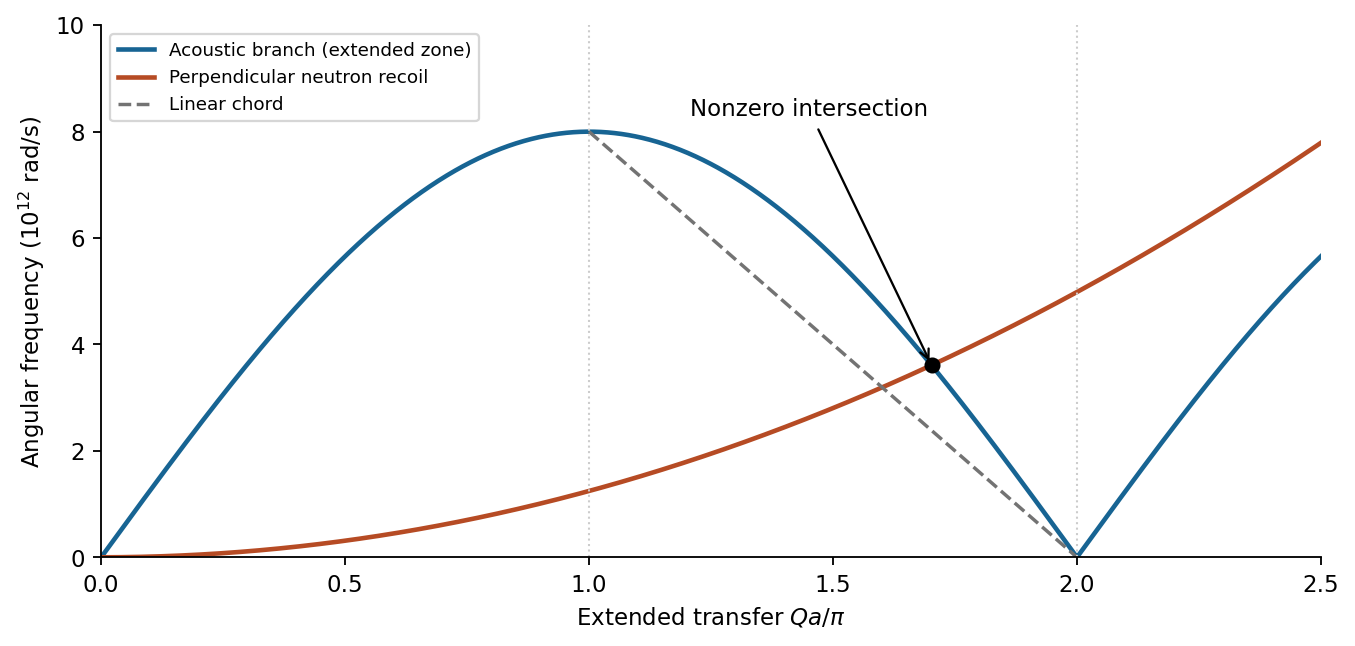

The reduced-zone phonon wavevector is along the chosen positive transfer direction. The difference is a reciprocal-lattice vector, not an additional independent phonon outside the first zone. At low temperature the absorption probability contains the Bose-Einstein distribution factor , which tends to zero. Here , so this absorption channel is strongly suppressed well below that scale. elastic scattering and kinematically allowed spontaneous phonon creation need not disappear.
For elastic scattering, and , where is a reciprocal lattice vector. In the ideal static crystal, coherent scattering obeys this lattice selection rule; the crystal as a whole can take the mechanical recoil with negligible energy. crystal momentum is defined modulo , not as unconstrained free-particle momentum.
For annihilation of a phonon ,For phonon creation,The signs follow whether the neutron gains or loses the phonon's energy and crystal momentum. These are one-phonon coherent inelastic neutron scattering conditions, with accounting for lattice periodicity.
For the electronic and lattice heat-capacity crossover in a monovalent metal, to obtain a numerical estimate from alone, assume monovalent potassium is a three-dimensional free electron gas with a parabolic band. Including both spins, the molar density of states is . Using the supplied approximate coefficient , rather than silently replacing it by , givesEquating it to the stated low-temperature Debye heat capacity yields the nonzero crossoverWe used and . This is self-consistently far below and the Fermi temperature. Using the exact Sommerfeld coefficient instead gives ; that is a change of approximation, not a discrepancy in the algebra. Without a band/DOS assumption, the supplied Fermi energy does not by itself determine .
For independent conduction-electron states labelled by band, wavevector and spin, combine those labels into . ThenHere counts the same spin and band states as the sum, and is fixed by the number constraint . The energy zero is a fixed band reference. Use the total DOS for total internal energy or the molar DOS for molar internal energy; these conventions must not be mixed.
In the harmonic approximation, sum over wavevector and phonon branch :The occupation factor is the Bose-Einstein distribution with zero phonon chemical potential; is the zero-point energy. A temperature-independent zero-point term does not contribute to the heat capacity in this fixed-frequency approximation.
Only states within an energy shell of width roughly around appreciably change occupation at low temperature. There are roughly such states and each excitation costs energy of order . Thus , giving . This is the thermal-shell estimate of electronic heat capacity; filled states far below are blocked by the Pauli exclusion principle. A smooth DOS and fixed particle number give the more precise Sommerfeld result to leading order.
For three-dimensional acoustic modes, and the mode count in a spherical shell is proportional to , giving phonon DOS proportional to . Thermally occupied modes have of order , so . Differentiation gives . At , all harmonic modes are classically populated; each has mean energy by equipartition. Thus the molar heat capacity tends to , the Dulong-Petit law. Anharmonic expansion and electronic contributions are not included in that lattice limit.
Articles by others on the same topic
There are currently no matching articles.