For a photon, . Using Planck constant , speed of light and givesThe Rayleigh criterion for a circular aperture of diameter is , set by the first zero of its Airy disk. Thus the ideal diffraction-limited resolution isThe conversion to transverse separation uses the small-angle approximation. An order-of-magnitude estimate instead gives and ; the distinction is the chosen resolution criterion. These are aperture limits, before instrumental aberrations and detector sampling.
Both the incoming and outgoing spherical wavefronts contribute to the path excess. At aperture radius , with axial distances before and after the aperture,The outer edge of the th Fresnel half-period zone has . HenceTherefore the outer radius is . The paraxial approximation is excellent because . Treating the illumination as a plane wave would incorrectly omit the source-side path curvature.
At normal incidence between lossless media with real positive acoustic impedances , continuity of pressure and normal particle velocity gives the pressure transmission amplitude . Since the mean acoustic intensity is , the fraction of incident energy transmitted isThis is acoustic reflection and transmission at an interface. With the supplied acoustic impedances,A thin water-based gel layer excludes air gaps and approximately matches the body's acoustic impedance. About of incident energy would otherwise reflect at the air-body interface. The coupling is also needed on the return journey, so it strongly improves the detectable echo. These figures concern interface transmission, before absorption within tissue; the gel is approximated by the stated water value.
Take nearest-neighbour separation , a common spring constant , and one scalar displacement per atom. For a monatomic chain, the harmonic approximation near a potential minimum, Newton's second law and a normal mode giveThe monatomic-chain dispersion relation has one acoustic phonon branch, with near the origin. The first Brillouin zone ends at , where and the group velocity vanishes.
For alternating masses , choose a two-atom cell of length . The coupled normal modes give the diatomic-chain dispersion relation with equal springs,The first Brillouin zone now ends at . The minus branch is the acoustic phonon branch; its two atoms move together at long wavelength. The plus branch is the optical phonon branch; at the atoms move oppositely with a stationary centre of mass and . For the edge frequencies are and , with a gap between them.
If , the two branches reduce to and , touching at . This is zone folding in an equal-mass diatomic chain: identical sites actually have a primitive unit cell of length . A doubled cell folds the monatomic branch but opens no gap. Equal masses alone do not specify all possible spring models; the sketches assume equal nearest-neighbour spring constants.
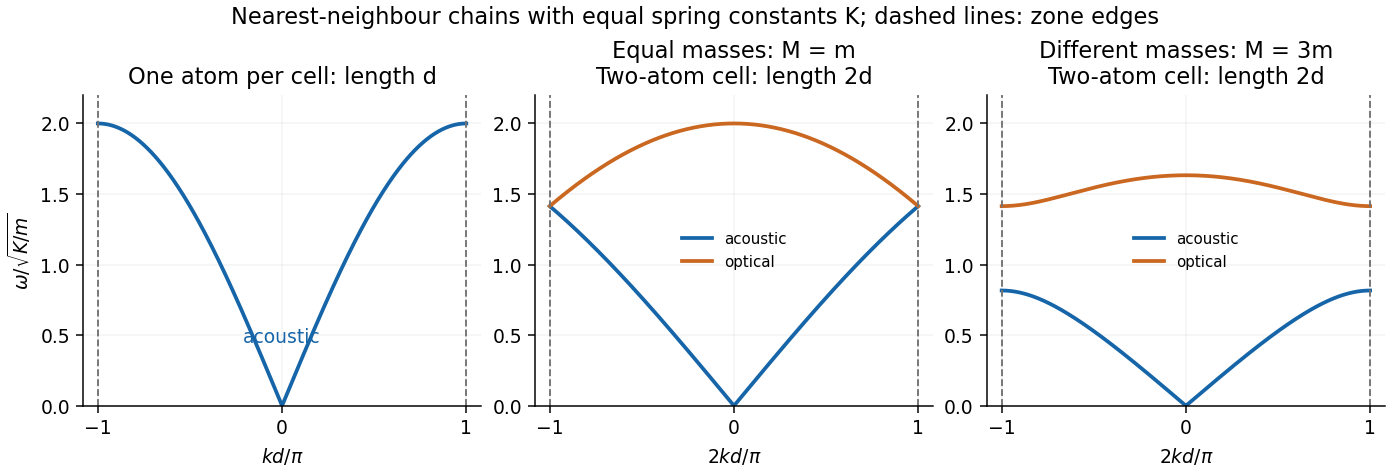
Monatomic and two-atom-chain dispersion relations, with explicitly chosen cell lengths and zone edges
. Details. 
Under the one-carrier Drude model, the magnitude of the Hall coefficient gives an effective carrier densityConvert the material mass density to and its molar mass to . The atomic number density isHere is the Avogadro constant. The positive Hall coefficient gives a hole-like response in a one-carrier interpretation. The Hall carrier count versus valence distinction matters: beryllium has two valence electrons, but the result is neither two free Electrons nor a literal fractional atom donating charge. Its energy bands and Fermi surface invalidate the simple isotropic one-carrier inference. Electron-like and hole-like contributions with different charge carrier mobilities can yield this sign and effective count.
Articles by others on the same topic
There are currently no matching articles.