Build a narrow-band wave packet from plane waves with wavenumbers close to :The Taylor expansion of the dispersion relation is , where . Put to obtainThe carrier's wave phase travels at the phase velocity , while the envelope has constant shape at constant . Its group velocity is thereforeThe approximation neglects higher derivatives of the dispersion relation. Those derivatives cause the wave packet to spread or distort over sufficiently long propagation times; the result describes the local envelope speed of a sufficiently narrow band.
Assume a massless junction and common tension . The characteristic impedance of a stretched string is , where is its linear mass density. The displacement reflection coefficient is , so the reflected fraction of power isSet . The positive solutions are , which are reciprocals. Thus the string density ratio for prescribed reflected power isThe impedance ratio is about , rather than the required density ratio. Reversing which string is on the incident side changes the reflected displacement sign but not the reflected power fraction.
A Michelson interferometer splits a collimated beam at a partially reflecting beam splitter. Two mutually perpendicular arms reflect from mirrors and recombine at the same beam splitter; the superposed returning beams produce interference fringes at the detector. Translate one mirror along its arm while holding the other fixed.
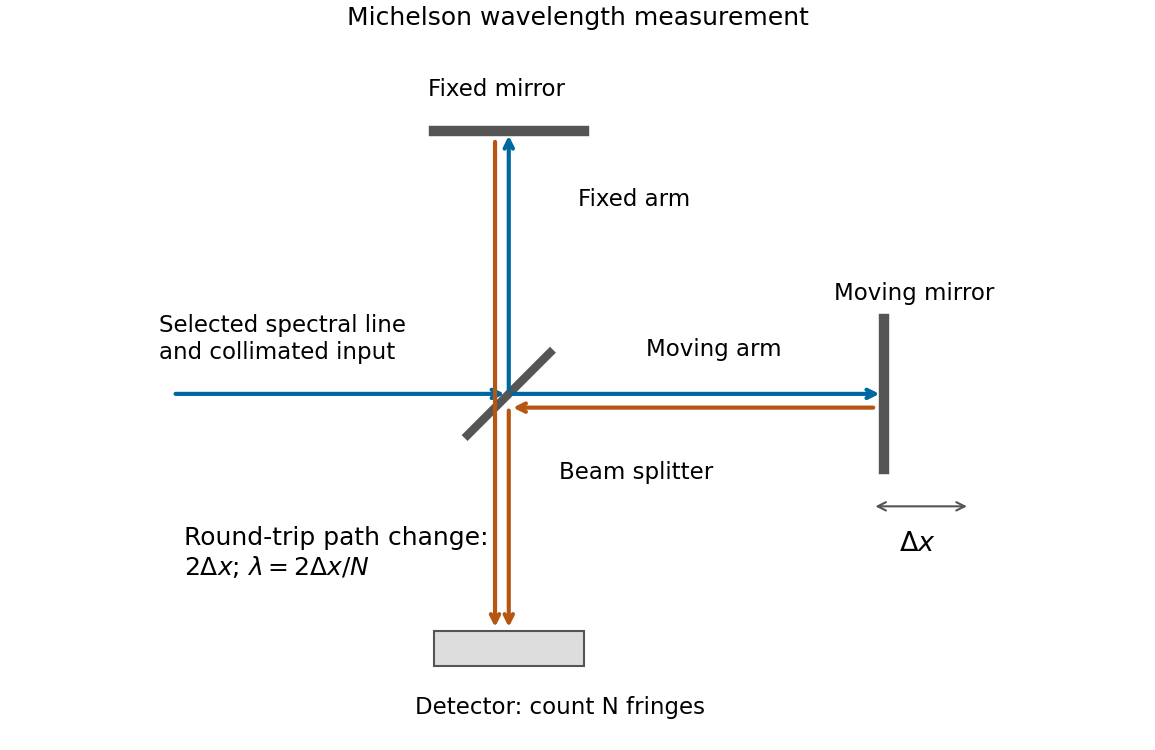

If that mirror moves a measured distance , the round-trip optical path difference changes by in air, approximated as vacuum. Every change of one wavelength moves one complete bright-dark-bright fringe cycle past a fixed detector point. Count such cycles to obtainUse a spectral line selected with a suitable optical filter, and count many interference fringes to reduce the fractional uncertainty of the distance and count. Keep the two arms within the source's optical coherence length and maintain overlap and alignment. If the vacuum wavelength is required for an arm filled with air of known refractive index , the corrected relation is at stable .
Take an abrupt equilibrium p-n junction with the p side at and the n side at . In the quasi-neutral bulk, electron holes are the majority carriers on the p side and Electrons are the majority carriers on the n side. With ionized dopant densities and nondegenerate statistics,where is the intrinsic carrier concentration. The semiconductor mass-action law applies at equilibrium. Both mobile populations are small in the depletion region compared with the dopant densities.
The charge and carrier density of an abrupt p-n junction must distinguish mobile populations from net charge. Diffusion leaves negatively charged ionized acceptor impurities on the p side and positively charged ionized donor impurities on the n side. Under the depletion approximation,The neutral bulks have large carrier densities but nearly zero net charge density. The electric field points from the positive donor region toward the negative acceptor region, balancing diffusion at equilibrium.
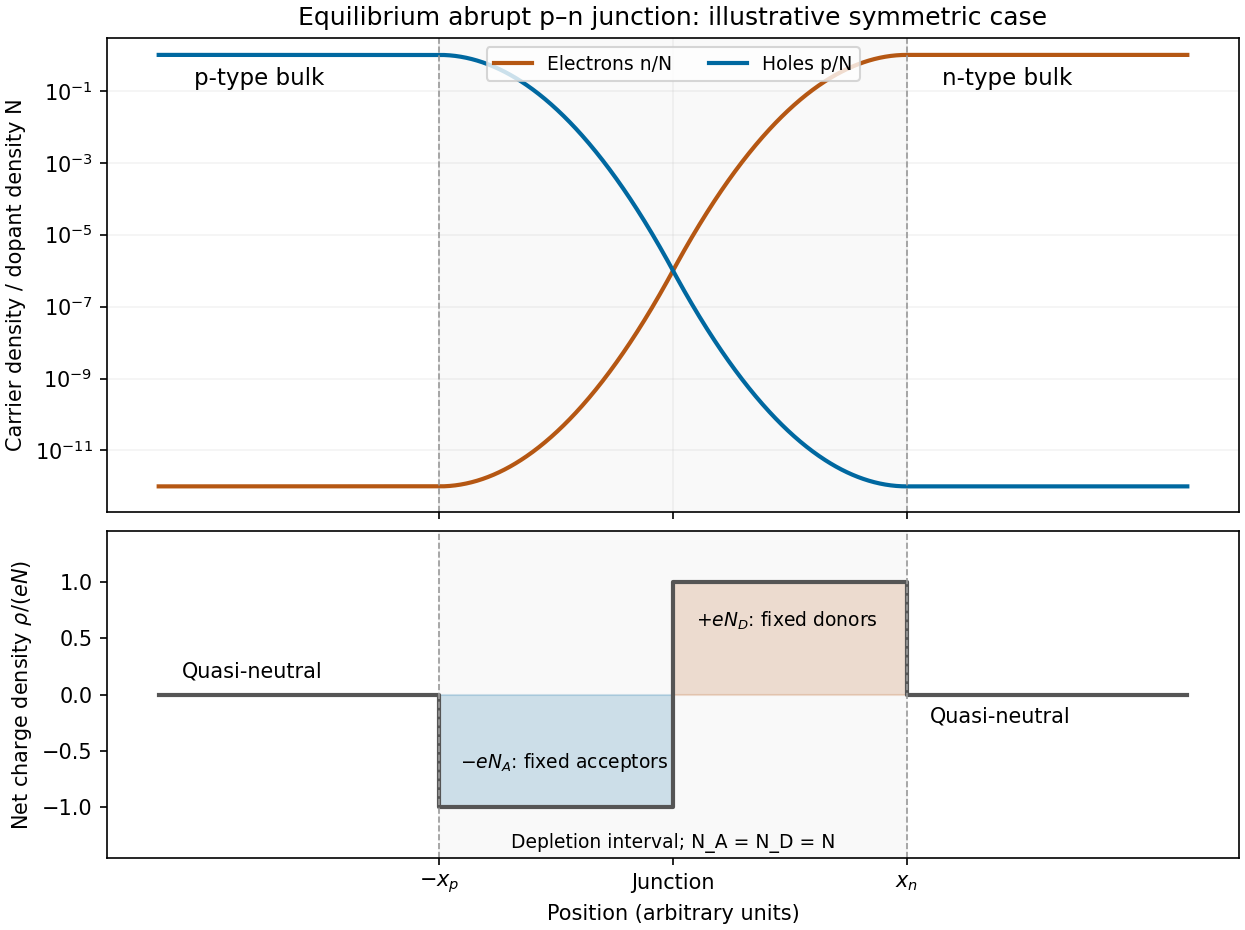
Illustrative equilibrium carrier densities and depletion-approximation net charge for a symmetric abrupt p-n junction
. Details. 
The figure uses equal dopant densities only to show a simple symmetric sketch. Generally the more lightly doped side has the wider depleted interval. The carrier profiles are smooth, whereas the step-shaped net charge density is the ideal depletion approximation.
Treat sodium as monovalent, with one mobile Electron per atom. Its mass density is , and its molar mass is . Using the Avogadro constant,The electron mobility relates the magnitude of drift velocity to electric field. The Drude model then givesUsing ,The inferred time is the momentum relaxation time. Identifying it with the mean time between collisions is the intended simple isotropic Drude model assumption; small-angle scattering need not relax directed momentum in a single event.
Articles by others on the same topic
There are currently no matching articles.