A Bravais lattice is the set of positions generated by integer combinations of independent primitive translation vectors, . Every lattice point has the same translational environment. A crystal may additionally have a basis of several atoms attached to each lattice point; those atoms are not automatically separate points of its Bravais lattice.
A unit cell is a region whose translated copies fill the crystal without gaps or overlaps. It can be chosen for convenient symmetry, and a conventional cell may contain several lattice points. A primitive unit cell is a smallest such repeating cell, containing exactly one lattice point when boundary sharing is counted. Its shape is not unique, but its volume is fixed for a given lattice. For a monatomic Bravais crystal, each primitive cell contains one atom.
Interpret the sphere as an atom of iron, and assume neighbouring atoms touch without overlap. Its radius is , and its mass is , using atomic mass unit .
In the face-centered cubic lattice, atoms touch along a face diagonal: , so . Four atoms occupy a conventional cube. The hard-sphere atomic volume in cubic lattices therefore givesIn the body-centered cubic lattice, atoms touch along the body diagonal: , so . There are two atoms per conventional cube, givingThese are primitive unit cell volumes, not the volumes of the conventional cubes or of the atomic spheres. The denser FCC contact packing gives the higher mass density in this fixed-radius model. Actual hot phases have temperature-dependent dimensions and bonding, so these numbers should not be treated as exact experimental phase densities.
The reciprocal lattice is the set of wavevectors satisfying for every direct Bravais lattice translation . Equivalently, is an integer multiple of . It describes the spatial periodicities that can produce coherent Bragg scattering.
For direct primitive vectors and oriented cell volume , the primitive reciprocal vectors areThey obey , and every reciprocal vector is an integer combination of them. Their units are inverse length. The reciprocal primitive cell volume is , so expanding a direct lattice contracts its reciprocal scale.
The direct body-centered cubic lattice has a face-centred cubic reciprocal lattice, whereas the direct face-centered cubic lattice has a body-centred cubic reciprocal lattice. Thus the reciprocal lattice change in a structural phase transition reverses the two cubic types: the reciprocal lattice changes from FCC to BCC when the real material changes from BCC to FCC. If the direct conventional side is , the reciprocal conventional side is in either case, with the appropriate phase-specific .
Within one phase, ordinary thermal expansion increases direct spacings and decreases reciprocal spacings. At the structural phase transition, reciprocal points acquire the new symmetry and allowed positions. A first-order transformation may show both phases simultaneously and may create differently oriented domains; it need not continuously preserve one perfect reciprocal array throughout.
Using the fixed-radius estimates from part (b), , so the reciprocal primitive cell volume would increase by about . That comparison belongs to the ideal contact model. The question supplies neither the actual thermal expansion nor a crystallographic orientation relationship, so it does not determine a unique trajectory of individual reciprocal points during the transition.
Use temperature-dependent X-ray diffraction, with the crystal in a controlled heating stage and a detector measuring diffracted directions. A reflection occurs when the scattering wavevector matches a reciprocal lattice vector, or equivalently when Bragg's law is satisfied. Record peak positions and intensities while heating to infer changes in lattice spacings and structure.
A monatomic conventional BCC cell has nonzero crystal basis structure factor only when is even. For FCC the indices must be all even or all odd. The change in reflection selection and peak positions therefore distinguishes the phases. For instance, BCC starts with a family whereas FCC starts with , when indexed in their own conventional cells.
The transformation can create multiple orientation variants, grains, strain and phase coexistence. A reciprocal point that formerly satisfied the diffraction geometry may disappear or move off a fixed detector; a loss of one spot alone does not identify the new phase. Thermal expansion shifts peaks, thermal motion weakens coherent intensities, and hot iron may oxidize without a protective atmosphere.
After transformation, scan crystal angle and scattering angle or use an area detector to locate the new reflections. If single-crystal order has been lost, powder X-ray diffraction or a sufficiently broad orientation survey collects rings or many grain reflections instead of relying on the original alignment. Index several new peaks using the FCC selection rule and fit their common lattice parameter; this probes the new structure even when the original crystal orientation is no longer usable.
The quantum free electron model treats conduction Electrons as independent particles moving in an approximately constant potential, with parabolic dispersion relation . Fermi-Dirac statistics successfully explains important features such as a Fermi energy and a small electronic heat capacity, but a constant potential gives no band gaps and cannot by itself explain why different band fillings produce metals, semiconductors and band insulators. It also misses lattice-dependent effective masses, detailed directional responses and the topology of real Fermi surfaces. Scattering and finite electrical resistivity require additional physics.
The nearly-free electron model introduces a weak periodic lattice potential. Bloch's theorem replaces individual free plane waves by Bloch states, and Fourier components of the potential mix plane waves whose wavevectors differ by a reciprocal lattice vector. Near degeneracy at a Brillouin zone boundary, this coupling opens a band gap; for a two-wave crossing its size is . Away from the crossing, energies remain close to free-particle values. Band curvature produces band effective masses, and band filling determines whether the Fermi energy lies inside an allowed band or a gap.
The improvement is the inclusion of lattice periodicity, rather than a switch from classical to quantum statistics: the quantum free electron model already uses Fermi-Dirac statistics. The strong delta barriers in the later numerical example are treated exactly by the Kronig-Penney model, rather than by assuming that their strength is perturbatively small.
A Bloch state on the loop has , with . Its circumference is , so . Single-valuedness after one complete circuit requires the periodic boundary conditionThereforeThe allowed Bloch wavevectors are spaced by . Values of differing by label the same crystal momentum modulo a reciprocal lattice vector, so there are inequivalent choices in one Brillouin zone. In this notation is the Bloch wavenumber, not a dimensionless phase; is dimensionless. Spin gives additional states but does not alter this condition.
Between delta barriers, and the Schrödinger equation gives , with for positive energy. Write the state and derivative as a two-component vector . Free propagation across one interval of length isThe wavefunction is continuous at a delta barrier, while its derivative jumps by , with . Thus the barrier matrix isBloch's theorem requires . Both and have determinant one, so the two eigenvalues of are and . Taking its trace givesTherefore the Floquet discriminant of the delta-comb Kronig-Penney model yieldsThis trace argument is the one-cell transfer method for the Kronig-Penney model. The loop imposes the additional discrete values of derived in part (b). Real requires the right-hand side to lie in , giving allowed energy bands; values outside this range are band gaps. The strength has units of energy times length, because a Dirac delta distribution has units of inverse length.
With length measured in units of , plot the real functionOnly the portions with can equal , so the strip between the horizontal lines and identifies allowed energy bands. The band edges of a repulsive delta-comb potential have the following approximate first intervals:Each interval corresponds to energy ; the intervening intervals are forbidden. The exact upper endpoints follow from . The lower endpoints solve inside . The divergence suggested by at the origin is removable, and , so there is no zero-energy state in the repulsive model.
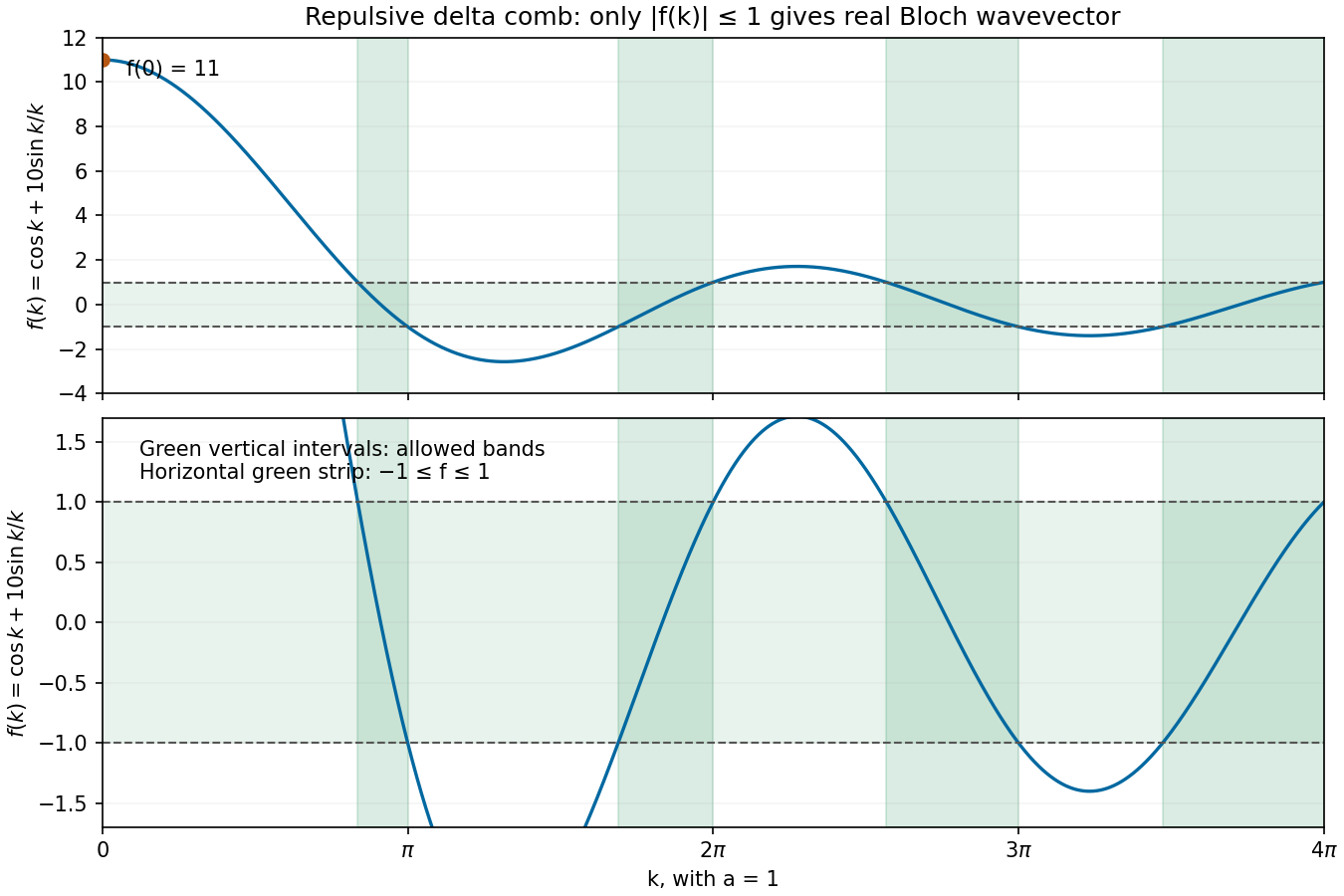
Calculated delta-comb discriminant for barrier strength 10, with allowed bands marked by the strip between minus one and plus one
. Details. 
The periodic barriers produce separated energy bands and band gaps, unlike the continuous free-particle spectrum. A finite -atom loop has discrete states within these bands. Whether the material conducts still depends on band filling: one Electron per primitive cell half-fills a spin-degenerate band, while two Electrons per cell can fill the first band and place the Fermi energy in a gap. Band gaps alone do not establish that every filling is insulating. At high , the perturbing term becomes relatively small and the spectrum approaches free-electron behaviour in relative terms.
Articles by others on the same topic
There are currently no matching articles.