An equation of state relates equilibrium state variables such as pressure, volume, temperature and material amount. At fixed composition, it reduces the number of independent thermodynamic variables. It does not by itself specify all caloric properties: information such as heat capacity or internal energy is also needed.
At a liquid-gas first-order transition, an equilibrium isotherm can contain a constant-pressure interval in which changing total volume changes the phase fractions. A metastable single-phase extrapolation can instead show a region with ; that region has negative isothermal compressibility and is mechanically unstable. Thermodynamic phase coexistence requires equal temperature, pressure and chemical potential, and a consistent free-energy description replaces the unstable region by coexistence. For an appropriate analytic fluid equation of state, a liquid-gas critical point occurs where .
These tests diagnose the phase behaviour represented by that equation of state. They do not guarantee detection of every possible transition involving an additional order parameter which the mechanical equation omits.
For the given one-mole model,At fixed positive temperature its isotherm is an ideal-gas hyperbola shifted right by : pressure diverges as and tends to zero as . Higher temperatures give higher pressure at any fixed allowed volume.
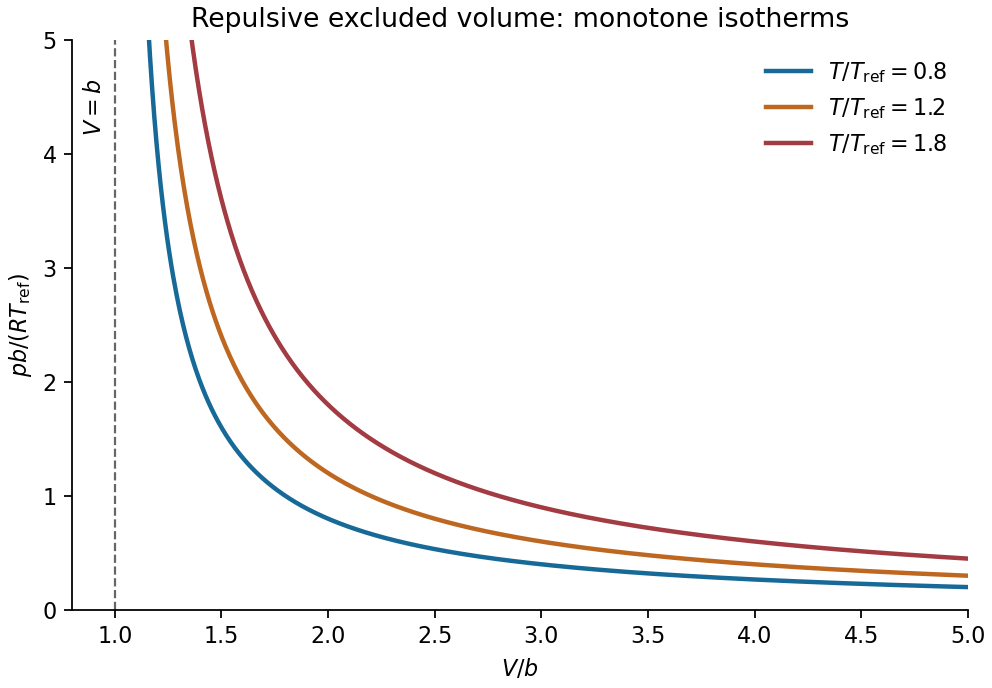

For positive , the volume is the effective volume available to molecular motion. Thus describes excluded-volume repulsion or an effective incompressible molecular core. It is a molar volume in this one-mole equation, not necessarily the literal sum of molecular geometric volume. Setting recovers the ideal gas law. No attractive-energy term is included.
Start with the fundamental relation at fixed material amount, , and expand entropy in independent variables :The last equality uses the supplied Maxwell relation. ConsequentlyFor the excluded-volume ideal gas, , so the bracket vanishes:Once depends only on temperature, cannot depend on volume either. Its stipulated temperature independence therefore makes it a constant, giving with arbitrary energy reference . Excluded volume changes the pressure without adding the volume-dependent attractive internal energy that a more general interacting-gas model might have.
Use the enthalpy . The equation of state gives , soAt fixed pressure, is constant. ThereforeSince and are constants, this ratio is independent of both temperature and pressure. Although the gas is not mechanically ideal when , its constant-pressure/constant-volume heat-capacity difference remains in this model.
For a reversible adiabatic change, , equivalently . Substitute :Integration, with fixed positive reference values , givesSince and ,The relation applies to the quasistatic reversible adiabat. Adiabatic heat isolation alone does not enforce it for an irreversible process which generates entropy. The shifted volume , rather than itself, is the appropriate coordinate in this model.
At every , ,There is no constant-pressure coexistence interval, unstable loop or finite-temperature critical inflection. The isothermal compressibility is positive:Thus this equation of state predicts no liquid-gas phase transition in its physical domain. Its divergence at the excluded-volume boundary is a repulsive constraint, not a liquid-gas coexistence mechanism. This conclusion concerns the stated model and cannot rule out an ordering transition requiring additional physics or an additional thermodynamic variable. Extrapolation to absolute zero is also outside the classical gas model's reliable regime.
Articles by others on the same topic
There are currently no matching articles.