For steady currents in vacuum, Ampère's law is . A rectangular loop with one long side inside an ideal long solenoid and the other outside gives , because the exterior field is negligible and the perpendicular sides contribute zero. Thus , approximately uniform away from the ends.
Write the electron electric charge as , with . The Lorentz force is ; it does no work. For perpendicular motion, givesHere is the positive angular speed; the rotation sense is determined by the negative electron electric charge.
The parallel velocity is unaffected, while the perpendicular component rotates. Hence the path is a helix with and . For on-axis entry into a solenoidal tube, the transverse circle passes through that axis: its guiding centre is displaced by , and its maximum distance from the tube axis is , not .
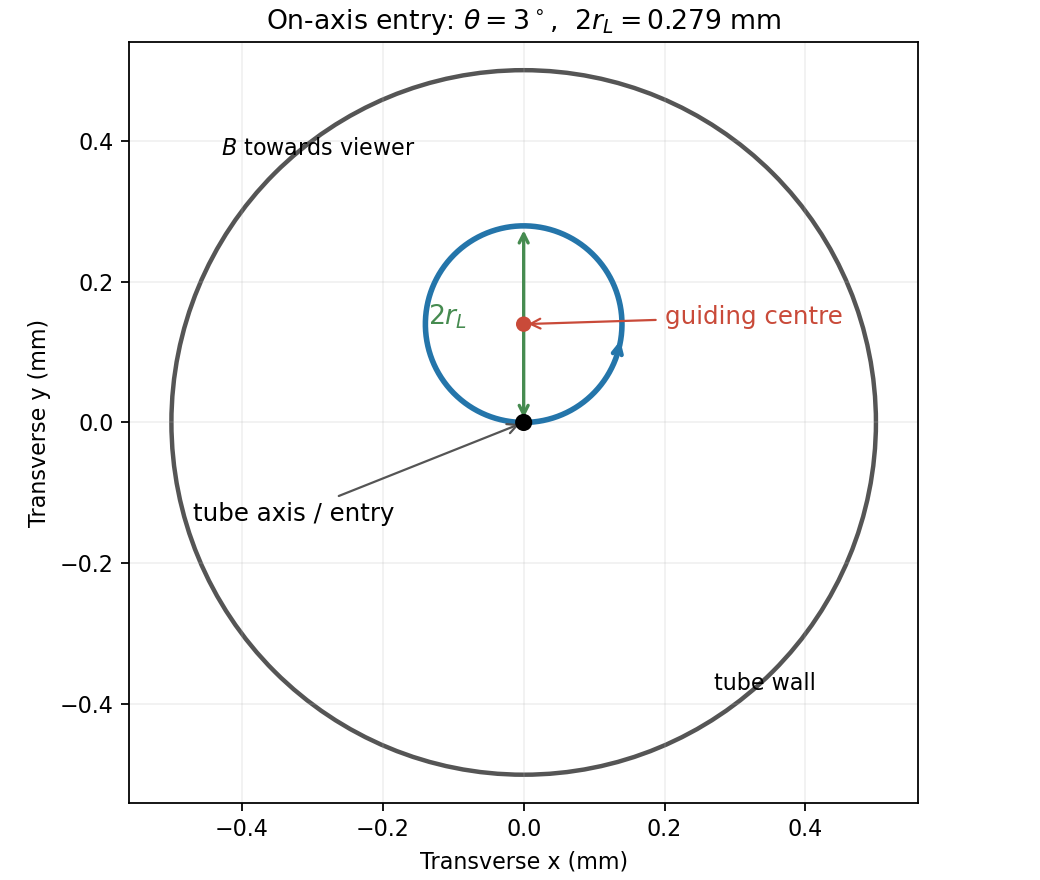
End-on electron orbit: the circle passes through the tube axis and reaches twice its Larmor radius from it
. Details. 
Using the nonrelativistic approximation appropriate to ,The cyclotron period is , so the flight lasts revolutions. The electron therefore crosses the axis again four times before leaving. At , . Wall clearance requires , givingThe transit is longer than a full orbit, so the maximum transverse excursion really is sampled before exit.
For the solenoidal time-of-flight energy window, the prescribed time fixes , while . ThereforeThese are total kinetic energies. The upper value is the ideal grazing limit; if touching the wall counts as rejection, it is a supremum approached from below.
An electric dipole consists of opposite charges separated by a small displacement, with electric dipole moment directed from negative to positive. At distances large compared with its size,The net charge term vanishes; the field decays faster than a monopole field. In an imposed slowly varying electric field,for a permanent fixed dipole. A uniform field produces a torque but no net force. For a linear induced dipole , the interaction energy is instead , because building the dipole also costs energy.
A small planar current loop has magnetic dipole moment , with the normal fixed by the right-hand rule. Outside the source,Magnetic field lines form closed loops; a current-loop dipole does not require magnetic monopoles. Dipole moments describe the leading directional field of a neutral localized source, and their torques explain alignment in external fields.
For two isolated point masses, introduce total mass , reduced mass and relative separation . The relative acceleration is . Conserved specific angular momentum fixes a plane and a constant areal velocity . The specific orbital energy isFor , the trajectory is a conic:Negative energy gives an ellipse, including the circular limit ; zero energy gives a parabola; positive energy gives a hyperbola. Bound ellipses obey andThus Kepler's laws of planetary motion follow from angular momentum conservation and the inverse-square force. For a circular orbit of radius , , while escape from that radius requires . Energy determines whether the orbit is bound; angular momentum also determines its shape. These ideal results neglect extended-body perturbations, drag and relativistic corrections.
In electrostatic equilibrium a conductor has throughout its bulk and constant electric potential on each connected component. Otherwise free charge would continue moving. Gauss's law then excludes bulk excess charge; it resides on surfaces. Just outside a conductor the tangential field vanishes and the normal jump isfor a vacuum interface with outward normal . Surface charge rearranges in an external field to enforce these boundary conditions. Greater curvature often concentrates charge, but the actual distribution is a global boundary-value problem.
An empty closed cavity inside a conductor has constant potential and zero field, even in an external electrostatic field. If a charge is placed in the cavity, a Gaussian surface in the metal shows that the cavity wall carries total induced charge ; its detailed distribution depends on geometry. An initially neutral isolated conductor then has on its exterior surface. A grounded conductor can exchange charge with Earth, so this isolation condition no longer applies.
A useful example is a charge at height above an infinite grounded plane. In the physical half-space, the method of images replaces the induced charges by an image at height , giving the attractive force . The image is a mathematical construction, not an actual charge behind the conductor. Equipotential surfaces and charge conservation determine conductor fields together.
In vacuum, Maxwell's equations in SI units areThe displacement current term makes the last equation consistent with the charge continuity equation. In a source-free region, take the curl of Faraday's law and use . This givesA plane electromagnetic wave therefore propagates at . The divergence equations make both fields transverse; the curl equations giveThe electric fields and magnetic fields are in phase and perpendicular to one another and to the propagation direction. Their energy densities are equal:For electric-field peak amplitude , the time-averaged intensity is . Mutually coupled changing electric fields and magnetic fields transport energy through vacuum, even where no charges or conduction currents are present.
Articles by others on the same topic
There are currently no matching articles.