In the centre-of-momentum frame the two equal masses have opposite velocities. Conservation of kinetic energy in an elastic collision fixes their common speed, so scattering changes their directions only. For incoming laboratory velocities and , the frame velocity is and the incoming relative velocities are . If the outgoing relative velocities are , then and the laboratory velocities are . Their dot product is zero: nonzero outgoing laboratory velocities are perpendicular.
For this smooth equal-disc oblique collision, let point from A to B at contact. The impulse acts only along ; the tangential velocity of A is unchanged. With , equal masses exchange their normal velocity components:ThereforeNo rotation about a disc centre is generated by these central impulses. At exactly head-on impact A stops, so its outgoing direction is undefined; the angle formula then denotes a limiting direction.
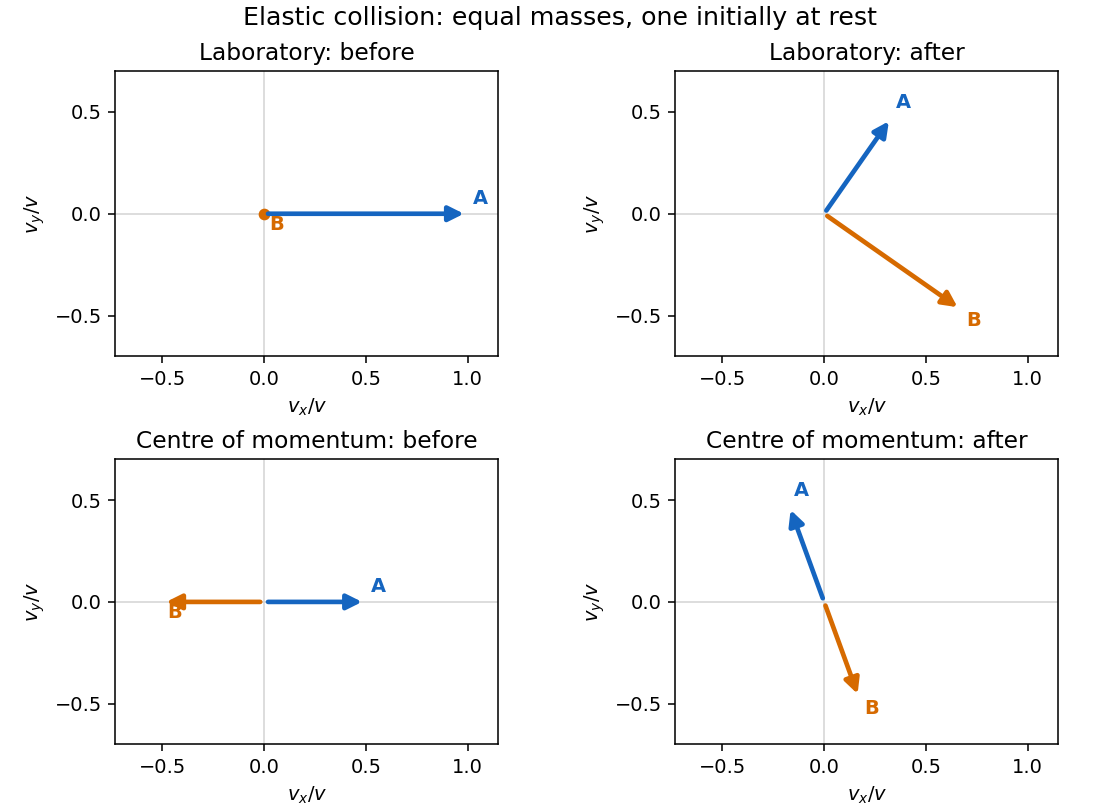
Original velocity-vector construction for an equal-mass elastic collision, before and after impact in the laboratory and centre-of-momentum frames
. Details. 
For this adhesive collision of two equal discs, use the parallel axis theorem about the midpoint of the touching centres:Its magnitude is . Linear and angular momentum conservation giveThe rotation has the sign of , clockwise for the printed geometry. The energy loss is . After impact the midpoint translates uniformly and the rigid pair rotates uniformly about it: there are no external horizontal forces or axial torques.
Rough unglued edges can transmit a tangential impulse and generate angular momentum about the individual disc centres. The centre-of-mass velocity and total angular momentum still have the values above, but individual translational speeds, angular velocities and energy loss require a friction/contact law and normal restitution. Roughness alone does not imply permanent sticking or the adhesive result.
Take inertial axes parallel, with frame moving at relative to and origins coincident at zero time. The Lorentz factor is ; are separations of the same pair of events in , and primed quantities are their separations in . The transverse coordinates are unchanged. For two events on an inertial clock's worldline,The proper time is that clock's elapsed time; uniform speed gives . Coordinate intervals between spatially separated events must instead be Lorentz-transformed with their spatial separation included.
For the round trip in the station frame, the rendezvous distance is , and the return has the same speed and distance. Thus . Its departure and arrival both occur at the station, so for these endpoints:This uses the return speed as measured by the station. The elapsed time aboard A, apart from an ideal instantaneous turn, would be .
For the crash, A's station-frame velocity components are , while B's are . Here and . Four-momentum conservation, with no separately escaping radiation, gives the wreckage totals in the station frame:In B's original inertial frame the same totals areThe invariant wreckage mass is , exceeding because internal energy remains in the wreckage. Its momentum cannot be specified without naming a frame; both natural frames have been given.
Put the station at and take B's initial position to be . Interception after time requires A to cover displacement at speed :The required launch components are and .
Between launch and interception, . The time-coordinate Lorentz transformation therefore givesThis is an elapsed coordinate time in B's inertial frame, not the travel time on A's clock. The latter would be .
For a fixed rotation axis with constant moment of inertia, the axial torque obeys , with . For a point mass at radius , the tangential equation is ; multiplying by gives , as required. Radial forces have zero moment about the axis.
Take increasing in the direction of the clapper's initial fall and let the contact force oppose that tangential motion. Initial equilibrium of the clapper givesWhile contact persists the bell and clapper rotate together. Their respective offsets from the upward vertical are and . Summing external gravitational moments eliminates their internal contact force:The clapper alone satisfies . Hence for ,A nonadhesive contact cannot exert tension. The first zero of this expression on the released trajectory is the loss-of-contact angle. Write . ThenThe second-quadrant root is reached from ; selecting the principal negative arctangent would choose the wrong branch. Indeed the exact contact force before taking is , so its zero is unchanged.
Articles by others on the same topic
There are currently no matching articles.