For a bulk liquid and vapor at common fixed temperature and pressure, transfer molecules from vapor to liquid while holding their sum fixed. The Gibbs free energy change is . Thermodynamic equilibrium with both phases present requires stationarity under either sign of transfer, hence . This is the bulk coexistence condition; an interface's curvature adds a surface-energy cost.
In the capillarity approximation, take an incompressible drop with constant liquid number density , bulk chemical potential at the specified reservoir conditions, and size-independent surface tension . The liquid bulk is extensive, so its Gibbs thermodynamic free energy is . Creating interface area reversibly at fixed temperature adds . Equivalently, along growth at fixed bulk parameters the stated differential integrates as , with the no-drop reference set to zero. For a sphere,This approximation uses bulk properties for the interior and neglects the molecular interface thickness, curvature dependence of surface tension and higher compressibility corrections. It does not apply quantitatively to drops only a few molecules across.
The vapor contains molecules. Treat its chemical potential as approximately unchanged by forming the drop, as for a large surrounding reservoir or negligible vapor depletion. ThenThe radius is limited by the available molecules in a finite sample; the constant-reservoir expression is a local nucleation model, not a description of arbitrarily complete vapor depletion. The excess over the vapor reference has derivativeIf , it increases for every , leaving only the stable boundary minimum . If , is a metastable local minimum and the additional stationary radius isAt that radius , so it is an unstable maximum. The classical nucleation theory barrier is .
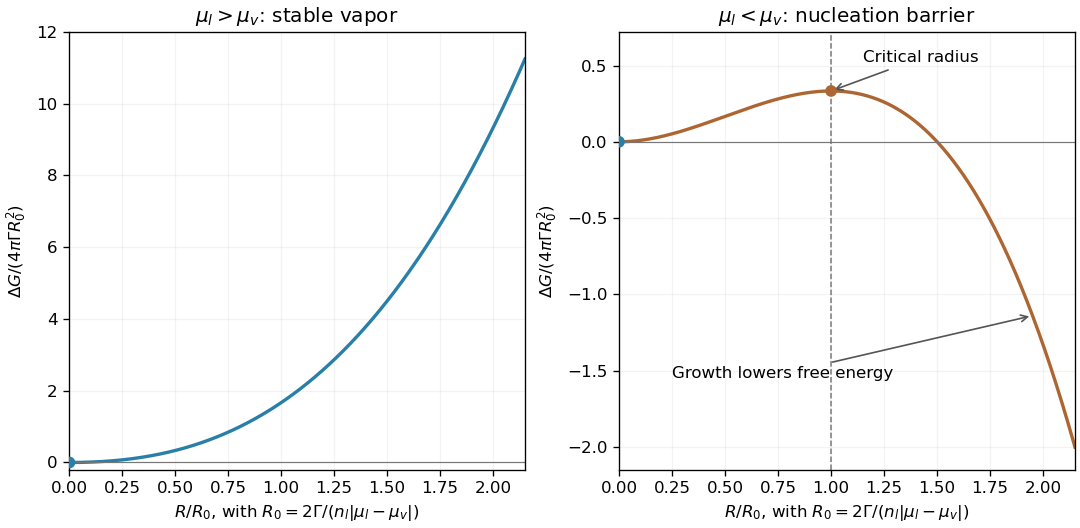

A fluctuation below tends to shrink because reducing its surface cost lowers thermodynamic free energy. A supercritical drop tends to grow, because its bulk free-energy gain outweighs the added surface cost. Growth continues while material supply and supersaturation allow it, eventually changing the vapor state or leading to macroscopic liquid. Curved-interface pressure and chemical thermodynamic equilibrium can also be described through the Young–Laplace equation and the Kelvin equation.
Put , with . For a single quantum state of energy , dilute Maxwell–Boltzmann statistics gives . For bosons this is the leading expansion of ; the occupation must be small for that expansion. Thus the grand potential isWith the ground-state energy set to zero, a dilute classical gas requires , giving negative . This sign is relative to the chosen energy zero. For an ideal Bose gas, approaches the ground energy from below at condensation, so it approaches zero with this convention.
The printed degeneracy formula requires , rather than strictly positive integers. With zero-point energy omitted these are the appropriate oscillator quantum numbers. The stars and bars count of three nonnegative integers summing to givesThere is one ground state at . If the integers were strictly positive, the count would instead be for , inconsistent with both the printed formula and its energy reference.
For large , . Consecutive energy shells are separated by , giving the continuum density of statesUse this when , and integrate the single-state grand potential over energy:because the integral is . Particle number follows by differentiating at fixed temperature and trap frequency:These are the high-temperature expressions for the classical grand potential in a harmonic trap.
Extrapolating to gives the requested transition scaleIt is an order-one estimate because Maxwell-Boltzmann occupations cease to be accurate near condensation. The Bose-Einstein distribution gives the more precise ideal-trap result , and hence , about times the estimate. Excess particles populate the ground state after the excited-state capacity saturates: Bose condensation in a three-dimensional harmonic trap.
The observation of Bose-Einstein condensation in rubidium in 1995 implemented laser precooling followed by radio-frequency evaporation from a magnetic trap. Imaging the released cloud revealed a narrow anisotropic component within a broader thermal population. This provides an experimental connection to the population-counting argument; the measured expansion also reflects interactions and imaging resolution, not just the ideal-trap density of states.[ref]
Observation of Bose-Einstein Condensation in a Dilute Atomic Vapor by M. H. Anderson and others. 1995, pp. 198–201, Figs. 1–4
For an isotropic free-electron gas at zero temperature, the Fermi wavevector is the radius of the occupied region in wavevector space. Its energy is . The first Brillouin zone is the Wigner-Seitz cell of the reciprocal lattice; it contains one distinct crystal momentum per primitive cell and per band, with spin counted separately.
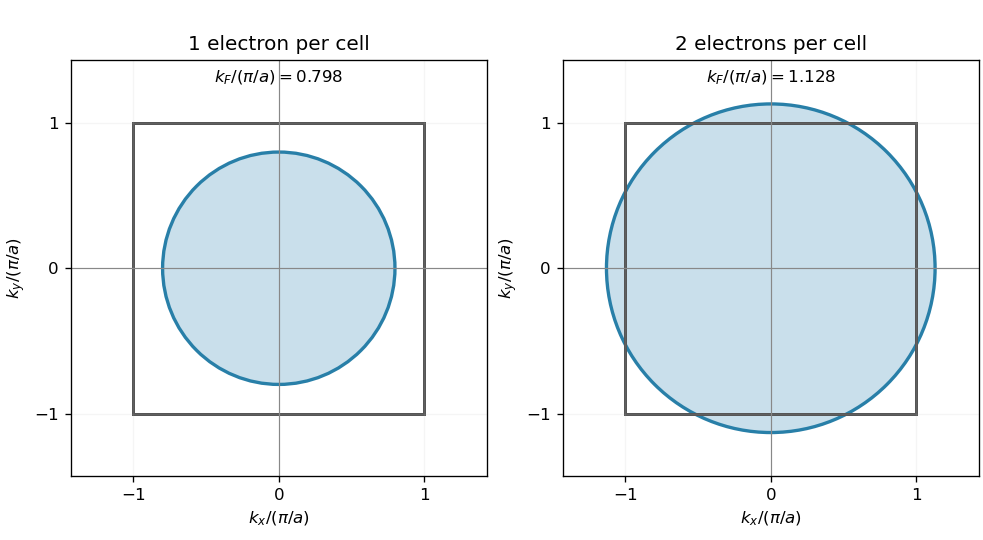
For a two-dimensional sample of area , allowed wavevectors have density . Including two spin states, filling a circle gives . Dividing by area therefore yieldsThe square lattice has one atom per area , so for valence the free-electron density is . Its Brillouin zone has . ThusThe monovalent Fermi circle lies inside the square. The divalent circle crosses the faces but misses the corners; its area equals the zone's area. These are the free-electron contours before distortion by the periodic potential.

At a Bragg plane, the periodic potential mixes degenerate plane waves differing by a reciprocal lattice vector. The two standing-wave combinations have different charge densities relative to the ions and split in energy, opening the gap. In a two-wave approximation, the boundary energies are , with .
The boundary wavevector magnitude is along and along . The free-electron boundary energies are thereforeWithin the stated direction-independent gap picture, the upper band's lowest face-edge energy is approximately , while the lower band's corner-edge energy is approximately . There is consequently a small overlap, about , rather than a global insulating gap. The divalent Fermi level lies in that overlap, producing occupied upper-band states and unfilled lower-band states.
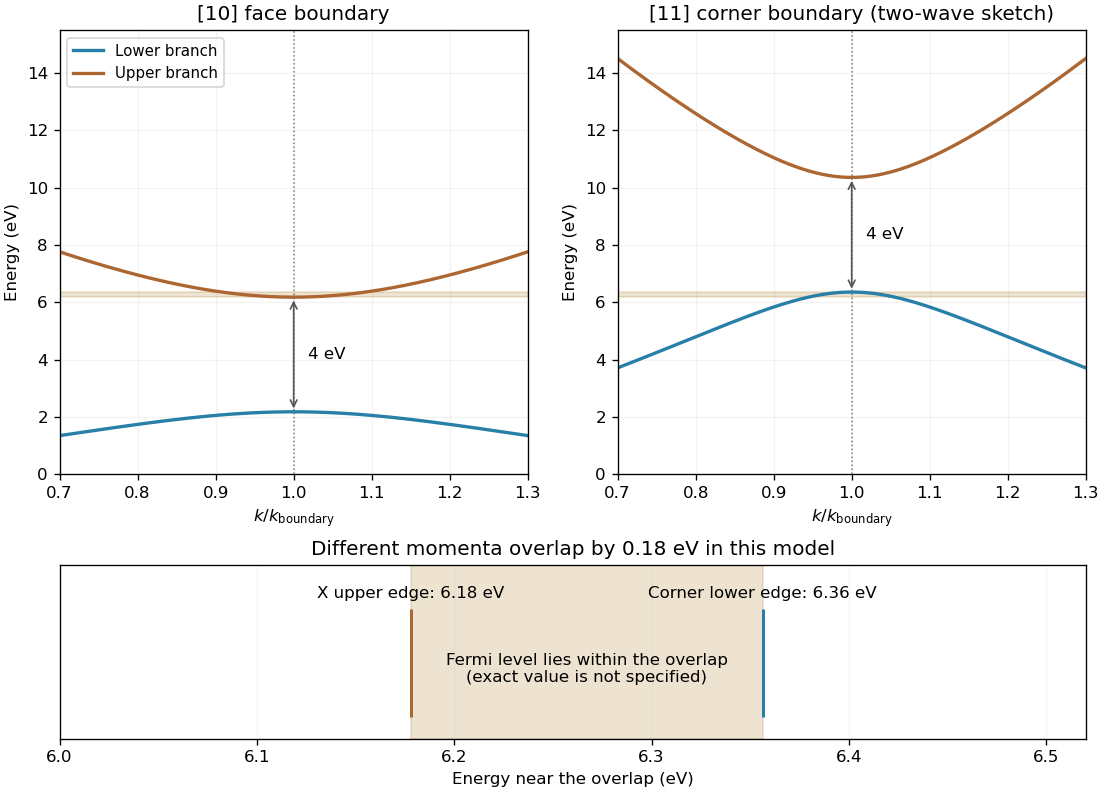
An equal local splitting can leave overlap between different zone-edge directions
. Original schematic two-wave dispersions near the and boundaries. The shaded Fermi-level range marks the overlap implied by the question's direction-independent gap approximation; no precise Fermi energy is inferred. These separate directional sketches do not specify a complete two-dimensional periodic potential. Details.
Thus the intended isotropic-gap approximation predicts a metal, with small electron and hole pockets. Positive direct gaps can coexist with band overlap. A fully specified square-lattice potential would require simultaneous treatment of the corner degeneracies; a numerical boundary splitting alone does not uniquely determine an arbitrary two-dimensional band structure. The conclusion here uses the given simplified gap picture, rather than electron count alone.
Semiconductor doping introduces electrically active impurities. In gallium arsenide, silicon has one more valence electron than gallium but one fewer than arsenic. Silicon on a gallium site can therefore supply a shallow donor electron, while silicon on an arsenic site can accept an electron and leave a mobile hole. It is an amphoteric dopant, so its net effect depends on site occupation and growth conditions.[ref]
Thermal equilibrium concentrations of the amphoteric dopant Si and the associated carrier concentrations in GaAs by Chang-Ho Chen and others. 1999 abstract: neutral and ionized donors on Ga sites and acceptors on As sites
For isotropic parabolic bands, shift the energy origin in the given free-electron density of states to the appropriate band edge and use its effective mass:and, for valence electron states,The stated normalization includes the two spin states and assumes one effective valley. In a nondegenerate semiconductor, the conduction occupation is approximately and the probability of a valence hole is approximately . Substituting in the first integral, and the corresponding hole energy in the second, giveswhere the effective density of states values are and . The factor comes from the supplied Gaussian-weighted integral. Multiplying cancels the shared thermodynamic equilibrium chemical potential and proves the semiconductor mass-action law:For the given sample and . With complete donor ionization and occupied acceptors, charge neutrality gives . At the given masses and gap giveSolving the compensated semiconductor equations, or using , yieldsThe very small minority density is consistent with the wide gap and the strongly n-type balance. Also and , checking the nondegenerate approximation. The acceptor levels are occupied in this n-type regime; complete acceptor ionization in the compensation equation is appropriate to the model.
At low temperature dopant freeze-out reduces the conduction-electron population; a quantitative curve would require dopant binding energies and occupation factors. Once donors are ionized while intrinsic excitation is negligible, gives an extrinsic plateau. At higher temperature intrinsic pairs eventually dominate, so if the gap and masses are treated as constant. Real gap and mass changes modify that last expression.
Articles by others on the same topic
There are currently no matching articles.